
Qalandiya –the Red Crescent worker experiences racism
Once again, a closure honoring a Jewish holiday that is no holiday for non-Jews.
Once again, people are kept from crossing over to where they heed to be.
Once again, soldiers, security guards and policemen hold guns and make what they think is the order to setting sovereignty in its place.
Once again, the offices that are meant to provide services for a minimally operative life are closed, shut, non-operative.

On the Palestinian side of the checkpoint, pre-Ramadan atmosphere reigns.
“The economic situation is bad, very bad”, says a fruit vendor. Others have spread their goods on the concrete blocks along the road leading from Ramallah. And Anan (in the photo) whose home is far away, in Bani Naim, Hebron District, and he and his uncles are migrant workers inside Palestine, tries to make a few shekels around the Qalandiya checkpoint for the livelihood of the family at home, by selling lanterns meant to light up the dark Ramadan nights.
Talking with an acquaintance of the Jerusalem Red Crescent, I learned how deep Israeli racist illness reigns. The man who makes sure to repeat again and again that his role is to help every human, and never asks whether the person facing him is a Jew or an Arab, that’s how he was brought up and that’s what he does – spoke with me sincerely, saying that although he arrives at the scene in an ambulance and although he wears the garb of a medical team member, he falls victim to Israeli racism time and again.
This happens when he rushes an ill patient or some bleeding wounded person to one of the Jerusalem hospitals, that unlike the entrance gates opening for Magen David (Jewish) ambulances as they approach, when he arrives with his Red Crescent ambulance, they stop and inspect it and delay it even when he says that his patient riding the ambulance is in critical condition, that it is a matter of life or death and that every second of delay might cost the person his life. He emphasizes: “I’m an Israeli, not a stranger”, and the answer he receives is, “Such are our instructions. Your papers!”
Once, as he was trying to stop the unceasing hemorrhage of a road accident victim while the ambulance drove, the security guard at the hospital gate demanded to see the entire body of the victim, “for perhaps he came to commit a terrorist attack”. “Look”, said the paramedic, “I have his blood all over me, my shoes are red from his blood, my clothes are soaked with it, he cannot speak, he must get to the Intensive Care Unit as fast as possible, he might die any second now.” “I have my orders. You shut up” – thus the security guard at the gate. I shut up.
Another time, he continued, while he was on his way to the Erez crossing to pick up a patient from Gaza and bring him to a hospital in East Jerusalem, he witnessed a road accident. The victim was a soldier riding a motorcycle that turned over. My acquaintance stopped, hurried to the soldier, treated him and saved his life. “It’s my profession, my commitment”. But then the police arrived, and a Magen David ambulance, and they both treated him roughly and chased him away.
“I don’t expect them to thank me, but why offend me? Am I not a human being?” he said.
Qalandiya Checkpoint / Atarot Pass (Jerusalem)
See all reports for this place-
Click here to watch a video from Qalandiya checkpoint up to mid 2019 Three kilometers south of Ramallah, in the heart of Palestinian population. Integrates into "Jerusalem Envelope" as part of Wall that separates between northern suburbs that were annexed to Jerusalem in 1967: Kafr Aqab, Semiramis and Qalandiya, and the villages of Ar-Ram and Bir Nabala, also north of Jerusalem, and the city itself. Some residents of Kafr Aqab, Semiramis and Qalandiya have Jerusalem ID cards. A terminal operated by Israel Police has functioned since early 2006. As of August 2006, northbound pedestrians are not checked. Southbound Palestinians must carry Jerusalem IDs; holders of Palestinian Authority IDs cannot pass without special permits. Vehicular traffic from Ramallah to other West Bank areas runs to the north of Qalandiya. In February 2019, the new facility of the checkpoint was inaugurated aiming to make it like a "border crossing". The bars and barbed wire fences were replaced with walls of perforated metal panels. The check is now performed at multiple stations for face recognition and the transfer of an e-card. The rate of passage has improved and its density has generally decreased, but lack of manpower and malfunctions cause periods of stress. The development and paving of the roads has not yet been completed, the traffic of cars and pedestrians is dangerous, and t the entire vicinity of the checkpoint is filthy. In 2020 a huge pedestrian bridge was built over the vehicle crossing with severe mobility restrictions (steep stairs, long and winding route). The pedestrian access from public transport to the checkpoint from the north (Ramallah direction) is unclear, and there have been cases of people, especially people with disabilities, who accidentally reached the vehicle crossing and were shot by the soldiers at the checkpoint. In the summer of 2021, work began on a new, sunken entrance road from Qalandiya that will lead directly to Road 443 towards Jerusalem and Tel Aviv. At the same time, the runways of the old Atarot airport were demolished and infrastructure was prepared for a large bus terminal. (updated October 2021)
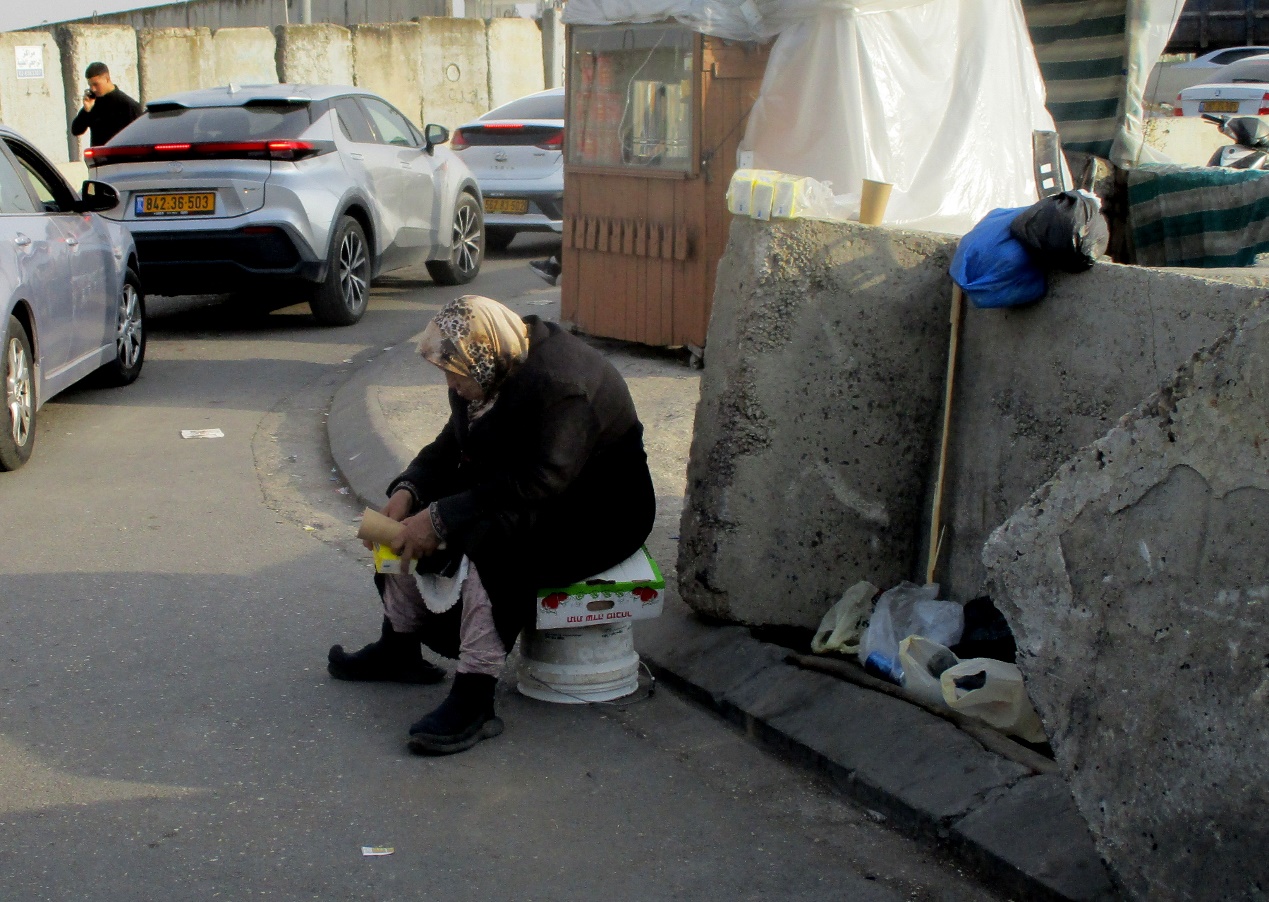 Tamar FleishmanOct-11-2026Qalandiya. Female Beggar
-
