
Qalandiya: "The worst part is that there’s no hope left. You can't live without hope"
In the morning, the Israeli army invaded Kafr Aqab and annihilated/neutralized/killed/murdered/executed a person.
Each of you is invited to choose the wording that suits her views.
In the Israeli media there is no hint of the fact that a person existed and is now no more. Only among Palestinians is the fact that another shaheed has been added to the list – only in their mouths is this fact uppermost.
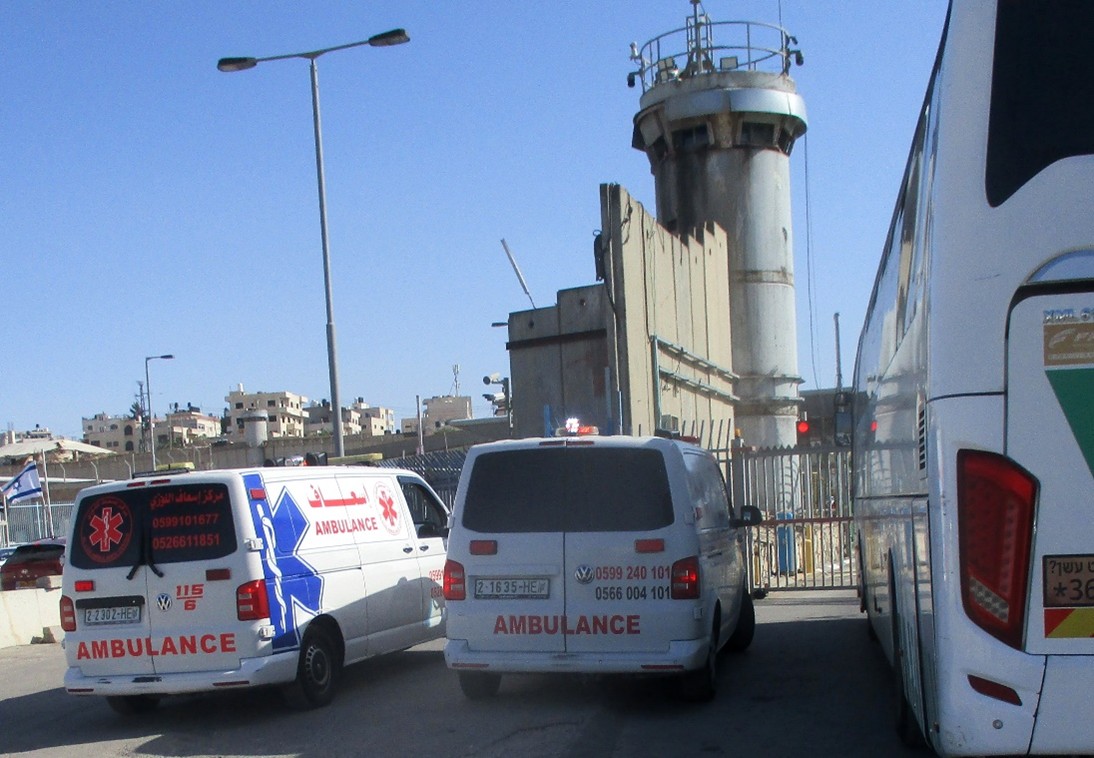
“Since then, they are nervous and stressed”, people explained soldiers’ and security guards’ conduct at the checkpoint.
They, soldiers and security guards, have been taking out their rage and frustration mainly on the weakest. Ambulances waited longer than usual at the entrances to the checkpoint until permitted to cross and connect to the ambulance that would take the patients and bring them to the hospitals designated for them. Saving human lives is not top priority in the soldiers’ and security guards’ minds. What is most important is over meticulousness in carrying out procedures set somewhere else by the ruling echelons.
An ambulance was parked in the designated place for carrying out the shameful procedure called back-to-back. I have been waiting here for 40 minutes, said the Red Crescent worker. The man was waiting for the ambulance that was supposed to bring a patient from Ramallah to the East Jerusalem hospital Muqassad. I waited with him. A conversation ensued. The man asked where I lived in Jerusalem. I answered – not in Jerusalem, in Nes Ziona. Hearing this, the man’s face fell, and after some silence, he said: “There, in Nes Ziona, are the lands of my family”. From here on, I was made aware of a family story motivated by the Nakba:
In 1948 the man’s family was expelled beyond the Green Line. Reality forced them to leave all their land and property behind. When they were expelled, they built their home in Sheikh Jarrah. That’s where my conversant was born. A few years ago, they were beaten by destiny once again. The Israeli authorities demolished their home and they were expelled. Again. Now they live in Kafr Aqab.
Our talk developed and dealt with the dire circumstances of the West Bank. “He will never stop this war”, said the man, and summed it up as follows: “The worst thing about it is that there is no hope left. One cannot live without hope”.
As waiting was longer than usual, an instruction came from the Red Crescent headquarters to desist. Why? No coordination. What about the patient waiting in Ramallah? All the patients waiting wherever they do? Answers are reserved for weapons and the men handing out the orders.
The ambulance turned around I left in great sadness.
This is no private case. It has a name, a face, a voice, and reflects the faces and voices of millions whose hope has been robbed.
It was nice, albeit moving, to meet a young man who welcomed me warmly: “I have known you for twenty years…” said the young man who, then as now, finds his livelihood in vending.
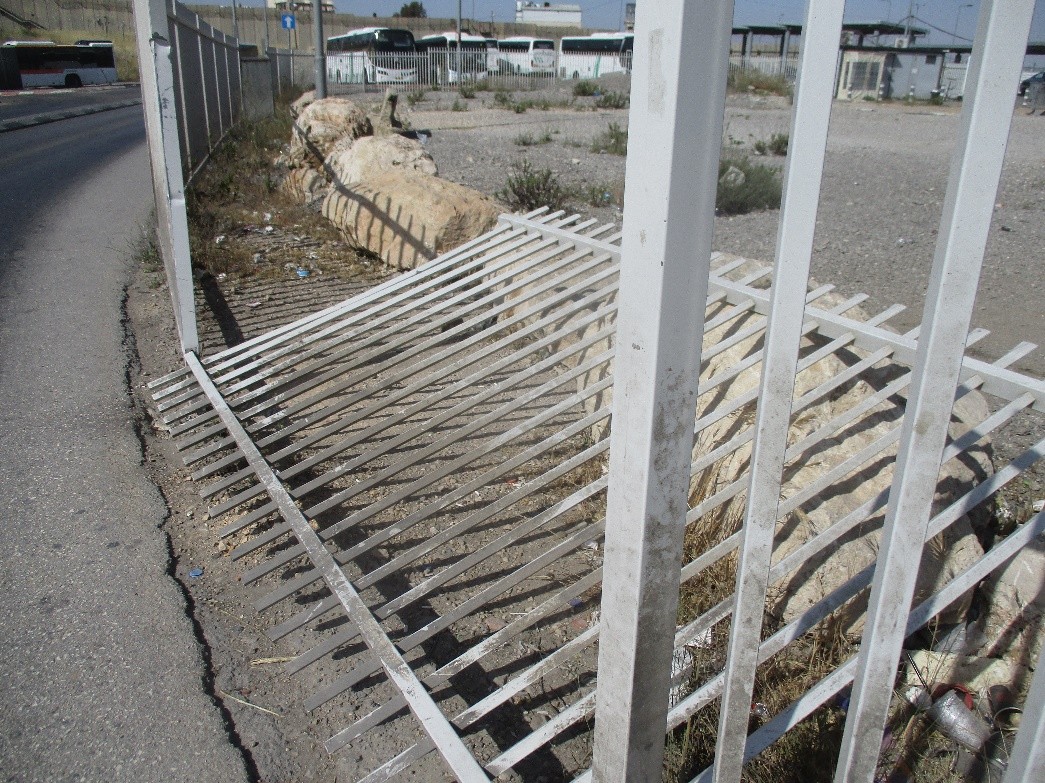
Anonymous hands have opened the fence around the powerful bridge, and we who have to cross in an out of Palestine through the checkpoint, jumped over and beside the stones, entered the compound dry and saved ourselves a long walk.
On the way back, Ofer prison still sports the sign “The Lion’s Roar” and I cannot help thinking that it’s not only time to take down this moldy motto, but to replace it with one saying “Netanyahu’s Catastrophe”.
Location Description
Qalandiya Checkpoint / Atarot Pass (Jerusalem)
See all reports for this place-
Click here to watch a video from Qalandiya checkpoint up to mid 2019 Three kilometers south of Ramallah, in the heart of Palestinian population. Integrates into "Jerusalem Envelope" as part of Wall that separates between northern suburbs that were annexed to Jerusalem in 1967: Kafr Aqab, Semiramis and Qalandiya, and the villages of Ar-Ram and Bir Nabala, also north of Jerusalem, and the city itself. Some residents of Kafr Aqab, Semiramis and Qalandiya have Jerusalem ID cards. A terminal operated by Israel Police has functioned since early 2006. As of August 2006, northbound pedestrians are not checked. Southbound Palestinians must carry Jerusalem IDs; holders of Palestinian Authority IDs cannot pass without special permits. Vehicular traffic from Ramallah to other West Bank areas runs to the north of Qalandiya. In February 2019, the new facility of the checkpoint was inaugurated aiming to make it like a "border crossing". The bars and barbed wire fences were replaced with walls of perforated metal panels. The check is now performed at multiple stations for face recognition and the transfer of an e-card. The rate of passage has improved and its density has generally decreased, but lack of manpower and malfunctions cause periods of stress. The development and paving of the roads has not yet been completed, the traffic of cars and pedestrians is dangerous, and t the entire vicinity of the checkpoint is filthy. In 2020 a huge pedestrian bridge was built over the vehicle crossing with severe mobility restrictions (steep stairs, long and winding route). The pedestrian access from public transport to the checkpoint from the north (Ramallah direction) is unclear, and there have been cases of people, especially people with disabilities, who accidentally reached the vehicle crossing and were shot by the soldiers at the checkpoint. In the summer of 2021, work began on a new, sunken entrance road from Qalandiya that will lead directly to Road 443 towards Jerusalem and Tel Aviv. At the same time, the runways of the old Atarot airport were demolished and infrastructure was prepared for a large bus terminal. (updated October 2021)
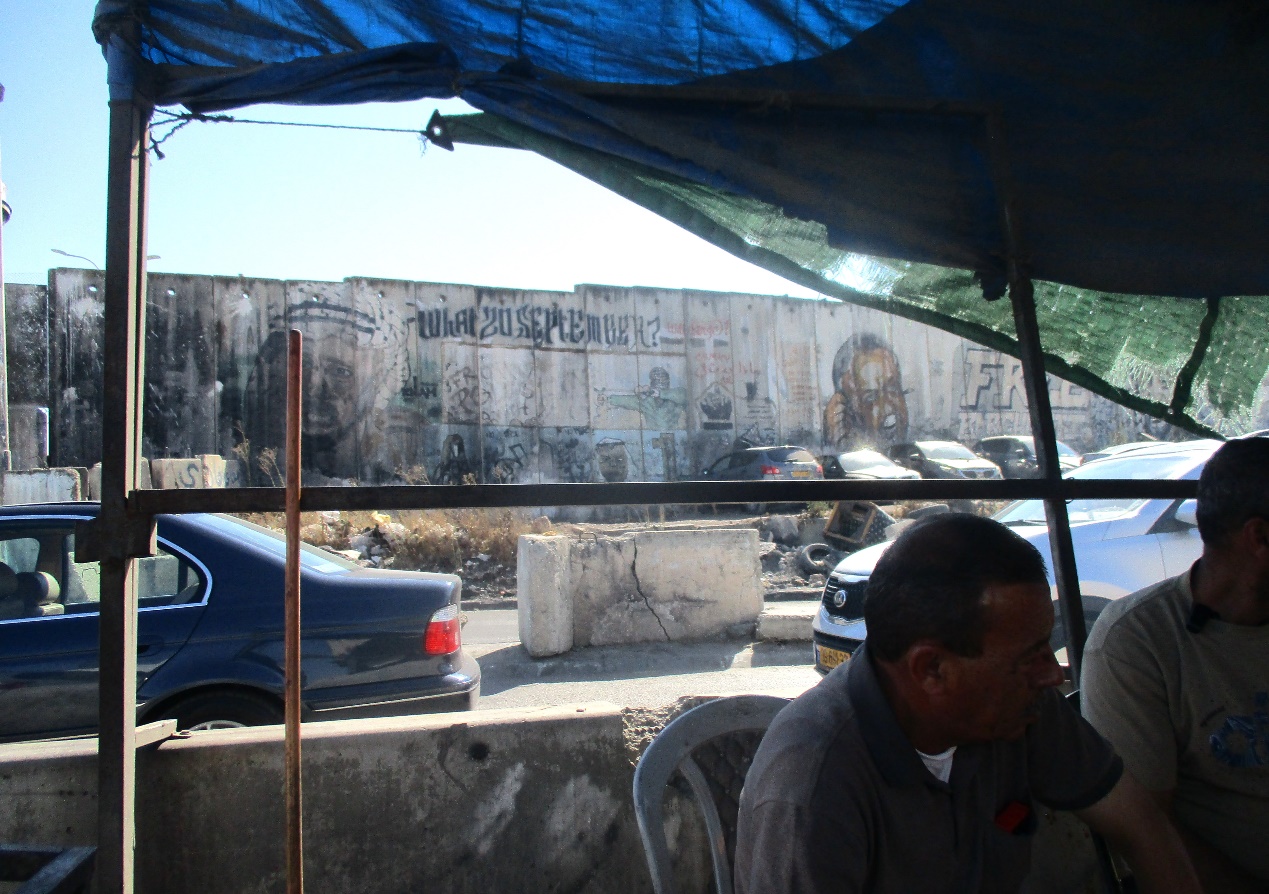 Tamar FleishmanJul-21-2026Qalandiya. Conversation in the shadow of the wall
-
