
Qalandiya, Thu 22.1.09, Morning
We parked on the Israeli side of the checkpoint. On our way in a woman stopped us to tell us how difficult the passage was as people were being allowed through only one at a time and therefore it was taking over two hours to go through. We were to discover the truth of this report when we got to the other side.
The shed was absolutely crowded with three dense, long lines waiting to get through the three carousels. An 'ecumenical' was keeping count as the carousels opened, from which we learned that about 120 people passed in an hour. Each time a carousel opened there was, of course, a jostling to get through. What became clear was that the real bottleneck took place at the checkpoints themselves where crowds gathered and the carousel openings were regulated to allow for this. The humanitarian gate opened every half hour (after a lot of beckoning and begging on our part to allow people with hospital appointments) when, of course, as many people as possible squeezed through in the limited time allowed. As these people use the same checkpoints as the men at the carousels, each time a group went through the humanitarian gate these men cry in protest. We could not manage to make contact with an officer in charge. The police and soldiers in their hut diligently refrained from making eye contact with us, on the whole. When we did manage to ask why progress was so slow, one policeman just said 'there are problems.'
At 9 a.m. we decided to leave together with others through the humanitarian gate. We were then held for 30 minutes in the 'enclosure' before being allowed to proceed to the checkpoint. Here we really experienced hell! To the loudspeakered calls of the woman soldier 'wahad, wahad!' and 'ir'ga', crowds were pressing at the turnstile which frequently jammed because of the pressure. Each time the turnstile had to reverse a bit so that it would contain only one person – as the soldier insisted – people who were close to entering once again got pushed back into the throng and other, stronger, folk would get closer. Once through the turnstile one had to put one's packages on a plastic tray before putting them through the inspection machine. People who didn't do so then had to retrieve their parcels and pass them through a second time in the tray. Remember that all this was done one person at a time.
We finally made it through the checkpoint at 10.30 – That means that it takes one and a half hours after going through the gate! And this does not take into account the waiting time before the original carousel and that this was a late hour- usually very quiet because all the workers have passed through.
We were not able to ascertain if this was a 'once only' procedure and, if so, who was responsible, or – even worse – if this is a new policy. But it requires urgent attention.
Qalandiya Checkpoint / Atarot Pass (Jerusalem)
See all reports for this place-
Click here to watch a video from Qalandiya checkpoint up to mid 2019 Three kilometers south of Ramallah, in the heart of Palestinian population. Integrates into "Jerusalem Envelope" as part of Wall that separates between northern suburbs that were annexed to Jerusalem in 1967: Kafr Aqab, Semiramis and Qalandiya, and the villages of Ar-Ram and Bir Nabala, also north of Jerusalem, and the city itself. Some residents of Kafr Aqab, Semiramis and Qalandiya have Jerusalem ID cards. A terminal operated by Israel Police has functioned since early 2006. As of August 2006, northbound pedestrians are not checked. Southbound Palestinians must carry Jerusalem IDs; holders of Palestinian Authority IDs cannot pass without special permits. Vehicular traffic from Ramallah to other West Bank areas runs to the north of Qalandiya. In February 2019, the new facility of the checkpoint was inaugurated aiming to make it like a "border crossing". The bars and barbed wire fences were replaced with walls of perforated metal panels. The check is now performed at multiple stations for face recognition and the transfer of an e-card. The rate of passage has improved and its density has generally decreased, but lack of manpower and malfunctions cause periods of stress. The development and paving of the roads has not yet been completed, the traffic of cars and pedestrians is dangerous, and t the entire vicinity of the checkpoint is filthy. In 2020 a huge pedestrian bridge was built over the vehicle crossing with severe mobility restrictions (steep stairs, long and winding route). The pedestrian access from public transport to the checkpoint from the north (Ramallah direction) is unclear, and there have been cases of people, especially people with disabilities, who accidentally reached the vehicle crossing and were shot by the soldiers at the checkpoint. In the summer of 2021, work began on a new, sunken entrance road from Qalandiya that will lead directly to Road 443 towards Jerusalem and Tel Aviv. At the same time, the runways of the old Atarot airport were demolished and infrastructure was prepared for a large bus terminal. (updated October 2021)
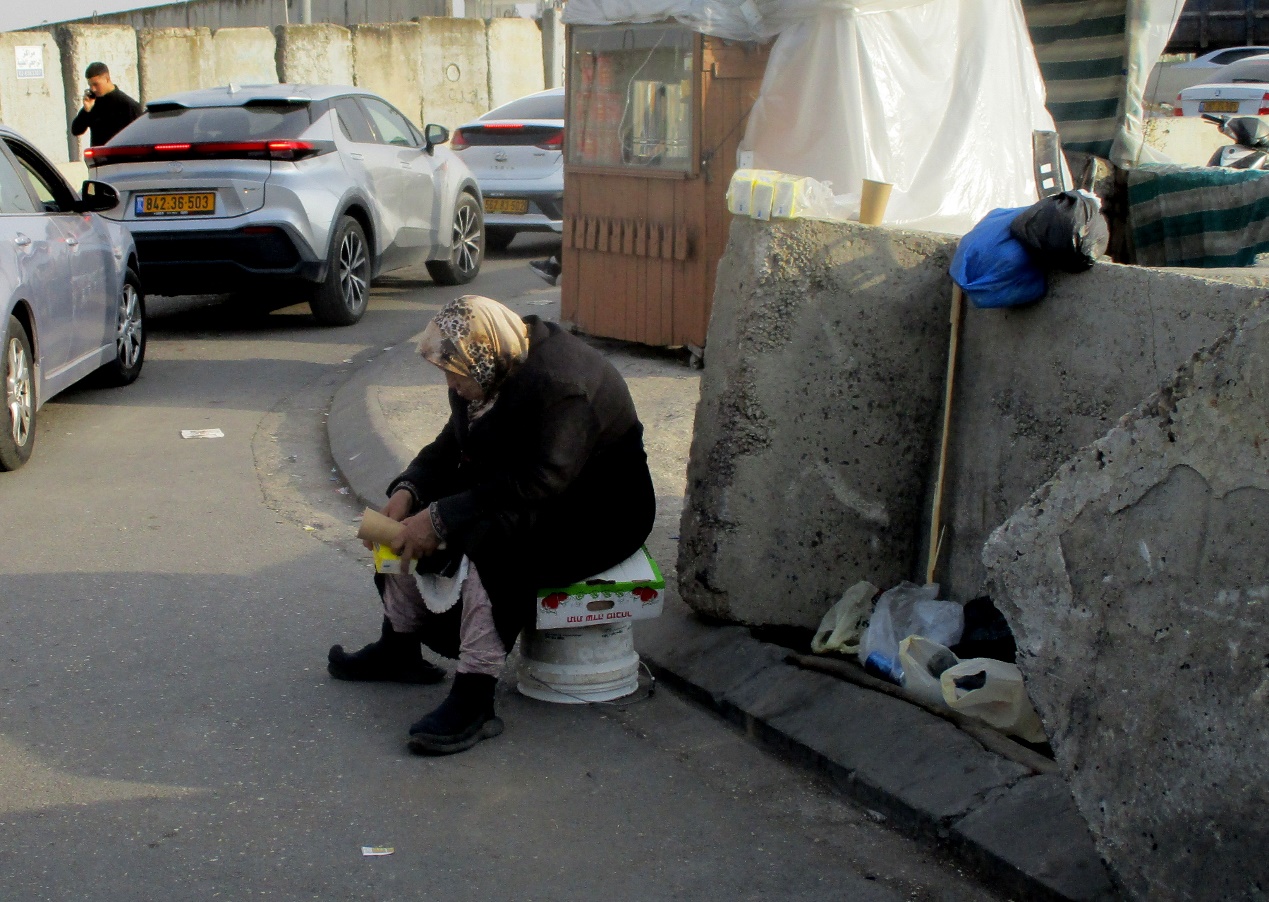 Tamar FleishmanOct-11-2026Qalandiya. Female Beggar
-
