
Qalandiya, Thu 6.11.08, Afternoon
We arrived at Qalandiya at 4:30
pm. I (Eva) had brought along an American friend, Cathrine D', who
had spent 3 weeks picking olives in the West Bank and stayed with me
for 24h before flying back to the States.
The situation we found was “normal”.
People coming in waves, 10-30 at a time. We watched for a while the
first passage through what I call “the cage” before the tunnels
(officially “terminals”). The passage was rather smooth and quick,
there was nothing particular to note. Both Zully and I had our badges
clipped visibly on our shirts.
We stayed about half an hour
in the outside waiting area, watching and explaining things to Catherine,
my friend. After that time (I didn’t take note of the exct hours)
we went inside to watch what was going on inside, before the passage
through the “terminals”.
Two tunnels/”terminals” were
permanently open – although, as usual, the soldiers changed every
now and then which of the four tunnels were open. Most of the time it
was #2 and #5, but sometimes it was also #2 and #4 or #2 and #3. This
is a very usual “game” as many Palestinians call it. The changes
are not always clearly announced. The passage through the last stage,
the checkpoint itself was “as usual” as well, irregular, but all
in all rather smooth and quick. Both Zully and I checked what was going
on when the passage sometimes halted, but there was no particular incident
which would have needed any intervention.
While Zully stayed for a long
time at #5, I stood in the middle space with my friend Catherine, watching
what was going on in #2 and explaining the functionment of the checkpoint
to my friend.
As it had been a long time that
I wanted to take pictures, mainly to illustrate a Blog I intend to write
about my impressions and feelings when I came to Qalandia for the first
time (I joined MachsomWatch only about 2-3 month ago), I decided to
do it this time. I had hesitated doing it in the beginning, as I did
not know if it was allowed or not. In the meantime, in meetings and
discussions I had heard that it was allowed, I nevertheless went to
ask Zully again if I could take pictures of the check-point. As her
answer was “yes”, I decided to go ahead.
I took 3 pictures. One of the
watch-tower inside, behind bars and barbed wire, one of an empty “terminal”
(I don’t like to photograph people, anywhere, without asking their
permission) and one of the shield in the tunnel/”terminal” ordering
people to keep the “terminal” clean and to keep quiet. Cathrine
also took out her camera, but finally did not take any pictures.
After a few minutes, a youngsters
voice came through the loudspeaker ordering (in English): “You with
the camera, come over here to number 4”. As I, as a person, I’m
rather allergic to orders and as the “order” wasn’t clear to whom
it was addressed, I waited if something more specific would come and
didn’t react. The order was repeated the same way several times. Finally
a female soldier from the bomb shelter next to the “cage” (=the
first passage) came out and said something in English I didn’t understand.
I asked her in Hebrew what she was saying. (I want to stress that I
had my MachsomWatch very visibly on my shirt). She asked me if I spoke
Hebrew – to which I answered “Yes”. She then told me that it was
not allowed to take pictures there. I answered that I knew that it was
allowed. She then asked if I was member of an organization. I said “yes,
MachsomWatch”. She asked if Catherine was member as well, I said no,
she asked again if I was alone – I answered “no, my collegue is
over there” pointing to tunnel #5. Then she explained that it was
forbidden to photograph soldiers, and I told her that I did not photograph
any soldier – to which she retreated into her shelter again.
I then turned again to watch
tunnel #2. The youngsters voice came again, speaking Arabic. I don’t
know what he said (I don’t understand Arabic), but I guess he spoke
about me, as everyone turned and looked at me.
A little later, Zully and I decided
to pass the checkpoint and leave. Catherine and I then entered the line
of tunnel #2. We passed rather normally after about 5-10 minutes (about
15 people had been in front of me). When it was my turn, I put my bags
into the x-ray machine and showed my Israeli ID card, the badge of MachsomWatch
still visibly on my chest. The girl soldier addressed me in English
again, and I asked her in Hebrew why she spoke English to me. She asked
if I spoke Hebrew, which I obviously did. She also asked something which
made me repeat that I was member of MachsomWatch. Then she asked me
if I was Jewish and told me that she did not understand why I was here,
that the checkpoint was for our security, and more… I stopped her
by saying (in Hebrew now) that I was sorry, but that I had a different
view of all this. Then she told me to return and go to tunnel #4. I
asked her “why”? She told me: “I’m a soldier, I don’t know
why.” I replied: “But I am NOT a soldier, and I want to know why!”
– Then she suddenly knew why I should go to #4, and told me that “police”
wanted to interrofate me because I had taken pictures. Telling her that
I was allowed to do so was useless, I had to go back and go to #4.
There about 5 young soldiers
(I don’t know why in #2 she had told me they were policemen – but
I must admit that I can’t tell the difference between a army and border
police), one of them a girl, told me again that it was forbidden to
take pictures. I told them again that I was from MachsomWatch, and that
we were allowed to take pictures, that I hadn’t taken any picture
of a soldier, etc. He told me that HE knew it was forbidden. I told
him that I knew it was allowed. He said he knew better, and we argued
yes-no-yes-no for a few seconds. Then the girl from behind told me to
delete the pictures I had taken, and I said: “Fine, then I’ll download
them from the internet”. After that they let me go. I expected them
to come out and oblige me to delete my pictures, but nothing happened,
and I left the check-point after a delay of about 15-20 minutes that
the whole issue had taken me.
Eva Ferrero, Nov. 8, 2008
Qalandiya Checkpoint / Atarot Pass (Jerusalem)
See all reports for this place-
Click here to watch a video from Qalandiya checkpoint up to mid 2019 Three kilometers south of Ramallah, in the heart of Palestinian population. Integrates into "Jerusalem Envelope" as part of Wall that separates between northern suburbs that were annexed to Jerusalem in 1967: Kafr Aqab, Semiramis and Qalandiya, and the villages of Ar-Ram and Bir Nabala, also north of Jerusalem, and the city itself. Some residents of Kafr Aqab, Semiramis and Qalandiya have Jerusalem ID cards. A terminal operated by Israel Police has functioned since early 2006. As of August 2006, northbound pedestrians are not checked. Southbound Palestinians must carry Jerusalem IDs; holders of Palestinian Authority IDs cannot pass without special permits. Vehicular traffic from Ramallah to other West Bank areas runs to the north of Qalandiya. In February 2019, the new facility of the checkpoint was inaugurated aiming to make it like a "border crossing". The bars and barbed wire fences were replaced with walls of perforated metal panels. The check is now performed at multiple stations for face recognition and the transfer of an e-card. The rate of passage has improved and its density has generally decreased, but lack of manpower and malfunctions cause periods of stress. The development and paving of the roads has not yet been completed, the traffic of cars and pedestrians is dangerous, and t the entire vicinity of the checkpoint is filthy. In 2020 a huge pedestrian bridge was built over the vehicle crossing with severe mobility restrictions (steep stairs, long and winding route). The pedestrian access from public transport to the checkpoint from the north (Ramallah direction) is unclear, and there have been cases of people, especially people with disabilities, who accidentally reached the vehicle crossing and were shot by the soldiers at the checkpoint. In the summer of 2021, work began on a new, sunken entrance road from Qalandiya that will lead directly to Road 443 towards Jerusalem and Tel Aviv. At the same time, the runways of the old Atarot airport were demolished and infrastructure was prepared for a large bus terminal. (updated October 2021)
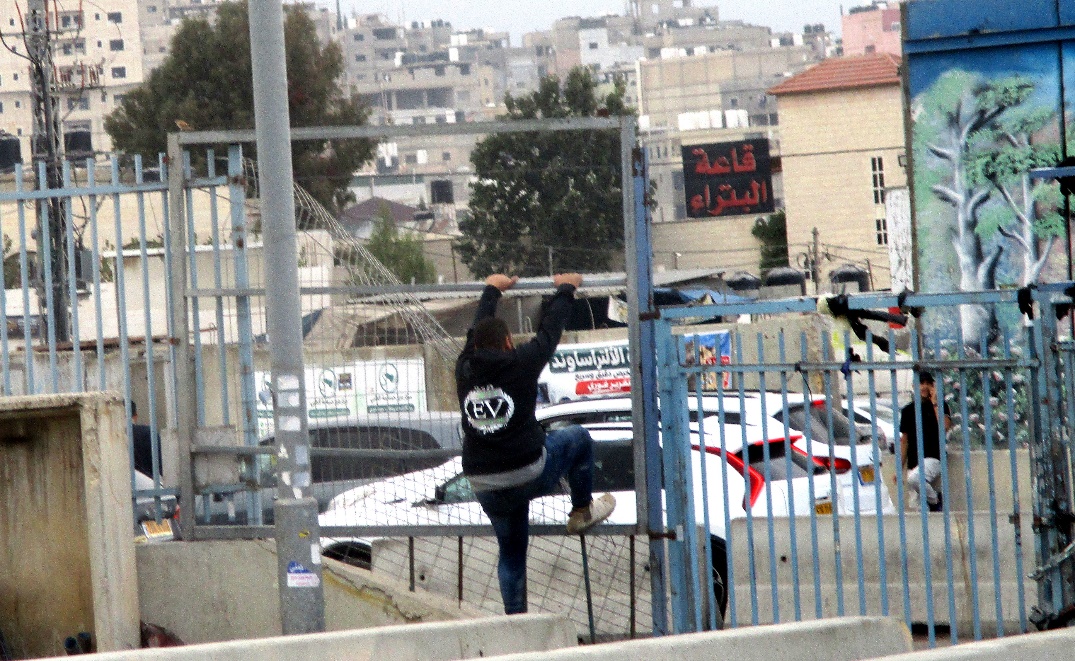 Tamar FleishmanOct-27-2026Qalandiya. Closure – Climbing over the fence
-
