
Qalandiya. Thursday PM, 12.5.2011
From 1:30 till 4:30 PM
Atarot and Qalandiya CP
After a long lapse of time we had wanted to visit the beautiful Industrial Secondary School compound above the Border Police Base in the Atarot Industrial area, but the director, Mr. Wasfi Tamimi was away so we drove around to observe the ‘renewal’ of the industrial area and chanced upon another Vocational Secondary School housed in a former industrial plant, The Technological High School Sakhnin in Atarot under the auspices of the Israeli Ministry of Education. A group of boys was just going home with their physical education teacher and they all greeted us very politely and directed us to Ahmad Khalil, the director on the top floor of the pink building.
And extremely nice man who used to work as a plasterer, then studied computer sciences at the Hebrew University and obtained a teaching diploma and taught for some time, since there was no longer a future for him in Hi-Tec. He then went to the States to continue his studies and was offered a job as the principal of the school. He hails from Sakhnin and dreams of returning there, since the work in the school is too demanding. However, he recounted a number of success stories and it seems that this very challenging job gives him a lot of satisfaction. He told us of a former mechanics’ student who had paid him a visit with eight men, all in their forties whose boss he is in a garage in Talpiyot. His students are all residents of East Jerusalem and are bussed to the school. Those from Qalandia have to get off the bus on the north end of the Qalandia CP, walk through the CP and board the bus again on the Southern side of the checkpoint. Sometimes they are delayed for an hour or more and might even fail to arrive in time for their matriculation exams. The students from East Jerusalem are not used to being interrogated or stopped as had happened to one boy from Wadi Joz who had forgotten his birth certificate at home when all the kids had to get off the bus at the impromptu checkpoint at the entrance to the Atarot Industrial Zone. He personally had to drive over and release the boy and gave the soldiers hell. Another boy had given him a note with the telephone number of a soldier who had kept and interrogated him for hours after he had told the soldier that he would be punished by the school principal.
He also managed to get the Hebrew instruction forms for math exams translated into Arabic, since he very strongly feels that his students are being discriminated against by the Education Ministry. He told us that he is a strong believer in discipline and will not tolerate bad behavior and said that his iron fist had proved successful. He made a wonderful impression and we were sad to hear how bleak he sees the future for Israel, both for the Jewish and Palestinian population, explaining to us why there is no solution whatsoever. His weekend had started and we felt we had delayed the trip back to his beloved home town Sakhnin.
In Qalandia we joined a rather long queue and were asked to call to speed up the line, but it moved rather quickly. One person asked for Netanya and someone else for Phyllis. Within twenty minutes we were past the inspection where our Id’s were scrutinized thoroughly
'Atarot
See all reports for this place-
Atarot
Atarot was a workers' settlement destroyed during the War of Independence, where the Arab village of Qalandiya now stands, in the southwestern part of Atarot Airport, built by the British Mandate. After 1967, the Atarot industrial zone was established nearby, and until the completion of the wall from the Qalandiya checkpoint to Road 443, a checkpoint was in place. A new Jewish neighborhood is currently planned for the old airport area.
-
Qalandiya Checkpoint / Atarot Pass (Jerusalem)
See all reports for this place-
Click here to watch a video from Qalandiya checkpoint up to mid 2019 Three kilometers south of Ramallah, in the heart of Palestinian population. Integrates into "Jerusalem Envelope" as part of Wall that separates between northern suburbs that were annexed to Jerusalem in 1967: Kafr Aqab, Semiramis and Qalandiya, and the villages of Ar-Ram and Bir Nabala, also north of Jerusalem, and the city itself. Some residents of Kafr Aqab, Semiramis and Qalandiya have Jerusalem ID cards. A terminal operated by Israel Police has functioned since early 2006. As of August 2006, northbound pedestrians are not checked. Southbound Palestinians must carry Jerusalem IDs; holders of Palestinian Authority IDs cannot pass without special permits. Vehicular traffic from Ramallah to other West Bank areas runs to the north of Qalandiya. In February 2019, the new facility of the checkpoint was inaugurated aiming to make it like a "border crossing". The bars and barbed wire fences were replaced with walls of perforated metal panels. The check is now performed at multiple stations for face recognition and the transfer of an e-card. The rate of passage has improved and its density has generally decreased, but lack of manpower and malfunctions cause periods of stress. The development and paving of the roads has not yet been completed, the traffic of cars and pedestrians is dangerous, and t the entire vicinity of the checkpoint is filthy. In 2020 a huge pedestrian bridge was built over the vehicle crossing with severe mobility restrictions (steep stairs, long and winding route). The pedestrian access from public transport to the checkpoint from the north (Ramallah direction) is unclear, and there have been cases of people, especially people with disabilities, who accidentally reached the vehicle crossing and were shot by the soldiers at the checkpoint. In the summer of 2021, work began on a new, sunken entrance road from Qalandiya that will lead directly to Road 443 towards Jerusalem and Tel Aviv. At the same time, the runways of the old Atarot airport were demolished and infrastructure was prepared for a large bus terminal. (updated October 2021)
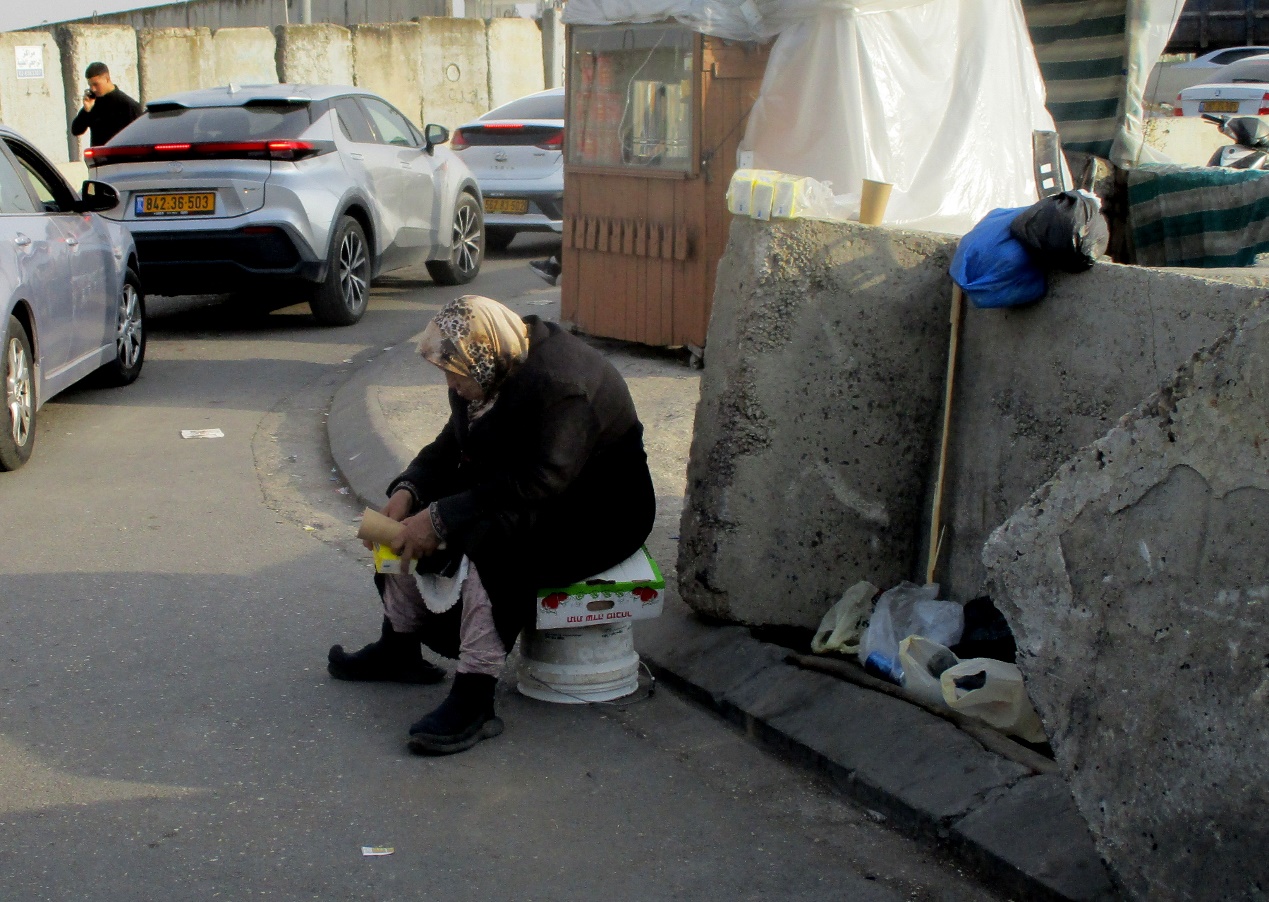 Tamar FleishmanOct-11-2026Qalandiya. Female Beggar
-
