
Qalandiya, Tue 1.1.13, Afternoon
 Translation: Ruth Fleishman
"Sooner or later there must be an end to this"
Shots of joy were heard from the direction of the refugee camp, celebrating 48 years to the foundation of the Fatah.
"It's not real bullets, it's just for the noise", a young man said and added: "They have permission to shoot. They have permission to do anything, they even have permission to throw stones". 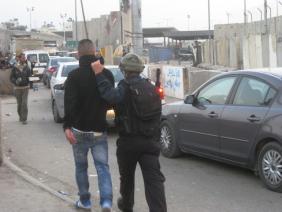
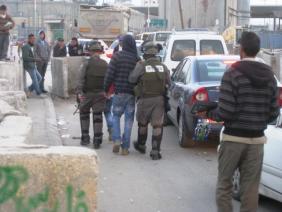
When the celebrations were over young and enthusiastic lads came out of the refugee camp and assaulted the checkpoint compound.
Armed soldiers came out towards them and fired in attempt to shove them back.
A different group of soldiers marched towards the refugee camp. In order to cross the busy road they fired at the center of it, and alarmed vehicles on both sides stopped and: "… all Israel was passing over…" When they returned they had with them three detainees: a pair and another one.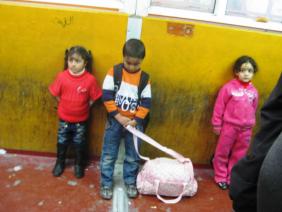
The third detainee was Ahmen, who was taken from the Falafel stand where he works and led towards the checkpoint as a soldier's hand gripped his neck while he was eating. For years, ever since his father was murdered by soldiers, Ahmen had been working to provide for his mother and young brothers.
When people asked the soldiers why they were taking Ahmed the replay was: "He'll be back today after being interrogated". But he wasn't.
On the next day his mother received a phone call from him and learned that her son was being held at Atarot.
She hadn't heard from him since. On the Thursday that followed his arrest the lawyer that his mother had hired found out that Ahmed was being held at Ofer and was accused of throwing stones and Molotov bottles.
I requested to hand over to the lawyer the photos that refute the allegations. I would be happy to testify.
– The fact that no one knew the other two lads who were arrested is peculiar.
And at the checkpoint– the crossing from one side to the other took fifty minutes.
Tens of people stood cramped, waiting patiently without pushing or being pushed, children stood by their parents and only one baby was whipping. She too will come to learn that this is a checkpoint, and here you don't raise your voice.
And a young man told me that two years ago when his wife was nine months pregnant she went into labor two days before the date expected by her doctors, which was the date on her permit to pass to the hospital in Jerusalem where she being treated.
When the woman arrived with her husband at the checkpoint a soldier said to them: "It's for two days from now, so come back in two days!".
"I said to her: but she is giving birth now", said the man- "There's nothing I can do. Come again in two days", answered the soldier who then called a police officer who backed her up.
But the labor wouldn't stop. And there, in front of the bullet proof window and before the eyes of the soldiers and the police officer, the water broke and spilled on her legs, but still: "There's nothing I can do. Come again in two days!".
Only once the Red Crescent ambulance that her husband had called arrived, did she pass and so she managed to get to hospital on time.
A young man expressed the sentiment of us all when mumbled to himself as he was buckling his belt back after successfully going through the inspections:
"Sooner or later there must be an end to this"
Qalandiya Checkpoint / Atarot Pass (Jerusalem)
See all reports for this place-
Click here to watch a video from Qalandiya checkpoint up to mid 2019 Three kilometers south of Ramallah, in the heart of Palestinian population. Integrates into "Jerusalem Envelope" as part of Wall that separates between northern suburbs that were annexed to Jerusalem in 1967: Kafr Aqab, Semiramis and Qalandiya, and the villages of Ar-Ram and Bir Nabala, also north of Jerusalem, and the city itself. Some residents of Kafr Aqab, Semiramis and Qalandiya have Jerusalem ID cards. A terminal operated by Israel Police has functioned since early 2006. As of August 2006, northbound pedestrians are not checked. Southbound Palestinians must carry Jerusalem IDs; holders of Palestinian Authority IDs cannot pass without special permits. Vehicular traffic from Ramallah to other West Bank areas runs to the north of Qalandiya. In February 2019, the new facility of the checkpoint was inaugurated aiming to make it like a "border crossing". The bars and barbed wire fences were replaced with walls of perforated metal panels. The check is now performed at multiple stations for face recognition and the transfer of an e-card. The rate of passage has improved and its density has generally decreased, but lack of manpower and malfunctions cause periods of stress. The development and paving of the roads has not yet been completed, the traffic of cars and pedestrians is dangerous, and t the entire vicinity of the checkpoint is filthy. In 2020 a huge pedestrian bridge was built over the vehicle crossing with severe mobility restrictions (steep stairs, long and winding route). The pedestrian access from public transport to the checkpoint from the north (Ramallah direction) is unclear, and there have been cases of people, especially people with disabilities, who accidentally reached the vehicle crossing and were shot by the soldiers at the checkpoint. In the summer of 2021, work began on a new, sunken entrance road from Qalandiya that will lead directly to Road 443 towards Jerusalem and Tel Aviv. At the same time, the runways of the old Atarot airport were demolished and infrastructure was prepared for a large bus terminal. (updated October 2021)
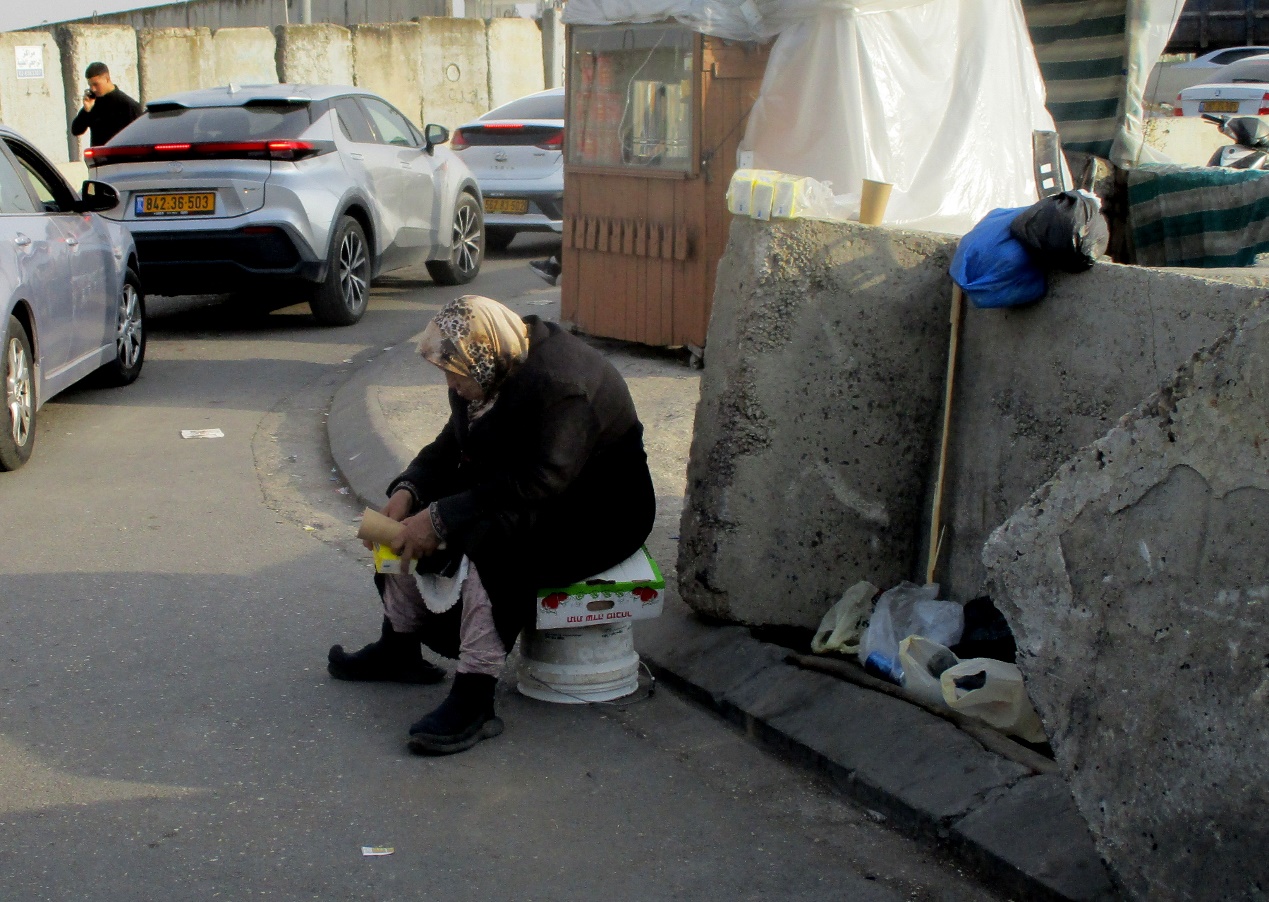 Tamar FleishmanOct-11-2026Qalandiya. Female Beggar
-
