
Qalandiya, Tue 13.11.12, Morning
Translator: Charles K.
An explanation of the mystery of why there’s no lighting in the shed at Qalandiya
When we arrived at the checkpoint at 06:15 it was still dark outside, and it was easy to see that the lights in the shed weren’t on.
It was just before we left the checkpoint that Ina finally received a two-pronged explanation:
1. Drunks and homeless people come to the shed at night. When they finish drinking they break everything, throw bottles everywhere and particularly at the guards.
2. A crane is needed to change the bulbs. In August they saw that there was a problem with the lighting and ordered a crane – which hasn’t yet arrived!
Qalandiya – 06:15
The vehicle crossing is congested with vehicles coming from the direction of Ramallah.
Three long, crowded lines in the shed, some 400 men. About 30 people wait on the humanitarian line. Inspection lane no. 3 is closed, which is why the lines are long. About 100 people wait at inspection lanes nos. 1, 2, 4 and 5.
As soon as we arrived everyone on the humanitarian line went through. The humanitarian line received priority all morning over the regular lines, where people waited twice as long as on a normal day.
Although 80% of the inspection lanes were open, the single lane that wasn’t open lengthened by 50% the time it took to cross.
All morning the lines in the open inspection lanes were particularly congested.
During the ten minutes after we arrived the revolving gates for the lines outside were closed. And even when they opened, very few people entered. People arrived at the checkpoint at a much more rapid rate than they went through.
Qalandiya – 06:45
In the past half hour 310 people entered inspection, 150 of them through the humanitarian gate.
At first glance there seems to be a balance between the number of people crossing through the regular lines and the number going through the humanitarian gate. But that’s not really the case. There were 400 people on the regular line, and new people kept coming, of whom “only” 160 went through during the past half hour. Everyone who arrived at the humanitarian line crossed in a few minutes.
Soldiers aren’t regulating the crossing and give too much preference to those on the humanitarian line, to the detriment of men on the regular line.
The congestion in the inspection lanes doesn’t ease. People in the outside line can’t see what’s happening within and become very impatient because they think the soldier is holding them up for no reason.
The entire time that the lines were congested the soldier in the booth pressed the button to open the revolving gate primarily after the men on line became fed up and began banging on the metal bars, whistling and shouting to open the gate.
In inspection lane no. 5, used by those coming through the humanitarian gate, sits a female soldier talking non-stop over the loudspeaker.
Her voice is pleasant, quiet, explaining very patiently, like an educator, in Hebrew, what people must do. It’s good to hear the soldier’s pleasant voice, only that today, in the congestion resulting from the closure of inspection lane no. 3, her courteousness seems to slow down the inspection slightly.
“Is this your child”…”How old is he?”…”Does he have a permit?”…”Your child can’t cross now; children older than 5 need a permit”…”Wait here, or go and come back”…”The DCO opens at 9 and they’ll give him a permit”…”Come back at 9, talk to…” …………….
Qalandiya – 07:15
During the past half hour 260 people entered inspection, 90 of them through the humanitarian gate.
Some of the women and children stand by mistake in the regular line. On an ordinary day at this hour the humanitarian gate no longer opens and there are few people on the regular line. Someone coming to the checkpoint can’t know what happened before they arrived, nor that today isn’t an ordinary day.
One inoperative inspection lane slowed the entire system, made it break down.
Qalandiya – 08:00
During the past half hour 240 people entered inspection, 60 of them through the humanitarian gate.
The fact that so many people joined the inner inspection line in 15 minutes doesn’t indicate that people are going through more quickly, but that the revolving gates open more frequently. Now all who entered are crowded in the line to the inspection booths and it will take a relatively long time for them to cross to the Israeli side.
We decided to go through the Lil checkpoint, toward the Hizma checkpoint.
There was no line at the Qalandiya vehicle crossing, but there was a traffic jam going east from the checkpoint toward Highway 60.
The policewoman at the Lil checkpoint stopped the car in front of us for a long time and we anticipated being delayed also. But she just wished us “Good morning” in an Israeli accent and let us through without any problems.
Qalandiya Checkpoint / Atarot Pass (Jerusalem)
See all reports for this place-
Click here to watch a video from Qalandiya checkpoint up to mid 2019 Three kilometers south of Ramallah, in the heart of Palestinian population. Integrates into "Jerusalem Envelope" as part of Wall that separates between northern suburbs that were annexed to Jerusalem in 1967: Kafr Aqab, Semiramis and Qalandiya, and the villages of Ar-Ram and Bir Nabala, also north of Jerusalem, and the city itself. Some residents of Kafr Aqab, Semiramis and Qalandiya have Jerusalem ID cards. A terminal operated by Israel Police has functioned since early 2006. As of August 2006, northbound pedestrians are not checked. Southbound Palestinians must carry Jerusalem IDs; holders of Palestinian Authority IDs cannot pass without special permits. Vehicular traffic from Ramallah to other West Bank areas runs to the north of Qalandiya. In February 2019, the new facility of the checkpoint was inaugurated aiming to make it like a "border crossing". The bars and barbed wire fences were replaced with walls of perforated metal panels. The check is now performed at multiple stations for face recognition and the transfer of an e-card. The rate of passage has improved and its density has generally decreased, but lack of manpower and malfunctions cause periods of stress. The development and paving of the roads has not yet been completed, the traffic of cars and pedestrians is dangerous, and t the entire vicinity of the checkpoint is filthy. In 2020 a huge pedestrian bridge was built over the vehicle crossing with severe mobility restrictions (steep stairs, long and winding route). The pedestrian access from public transport to the checkpoint from the north (Ramallah direction) is unclear, and there have been cases of people, especially people with disabilities, who accidentally reached the vehicle crossing and were shot by the soldiers at the checkpoint. In the summer of 2021, work began on a new, sunken entrance road from Qalandiya that will lead directly to Road 443 towards Jerusalem and Tel Aviv. At the same time, the runways of the old Atarot airport were demolished and infrastructure was prepared for a large bus terminal. (updated October 2021)
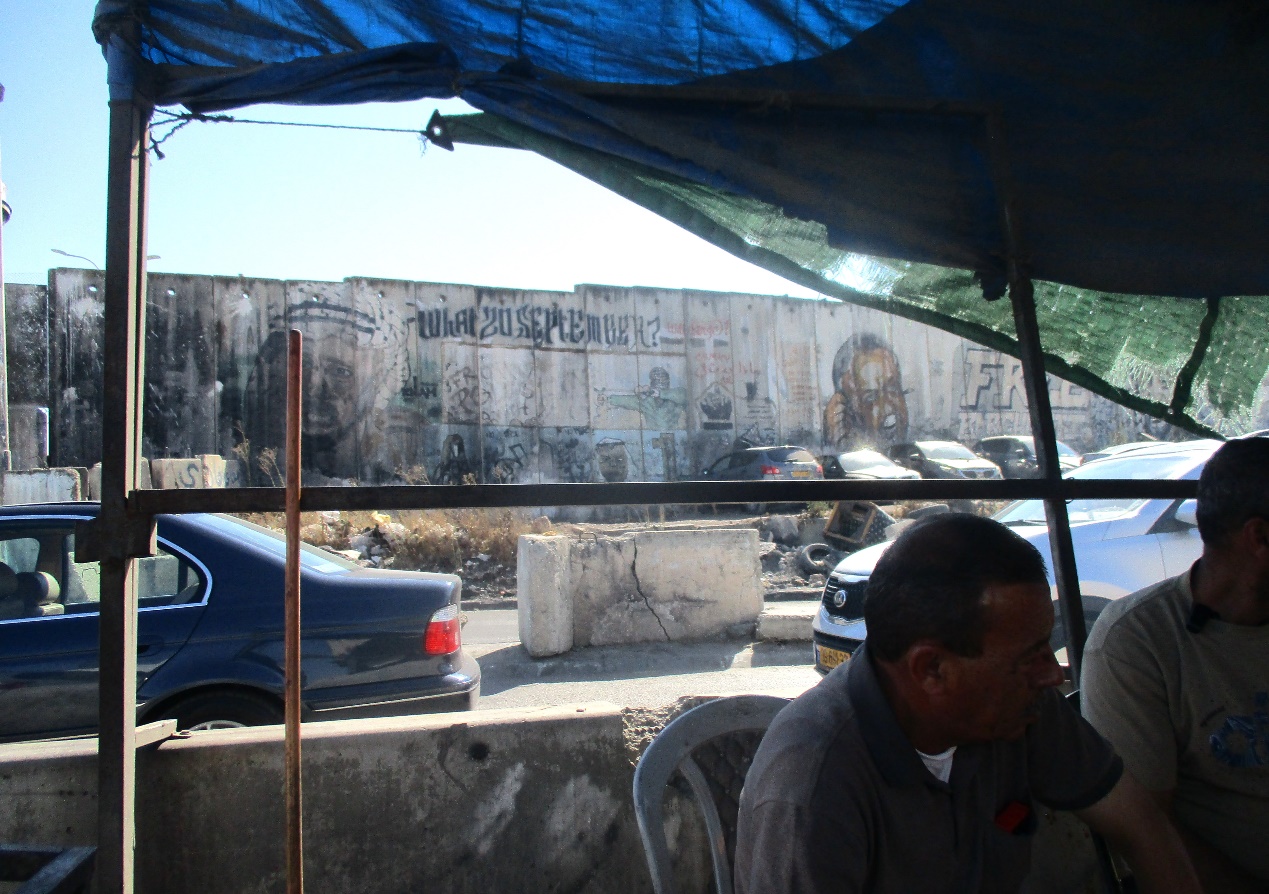 Tamar FleishmanJul-21-2026Qalandiya. Conversation in the shadow of the wall
-
