
Qalandiya, Tue 23.10.12, Afternoon
Translating: Ruth Fleishman
It was announced on the noon news flashes that security forces had caught a terrorist at Qalandiya checkpoint. It was said that the man had tried to pass eight pipe bombs in his bag. It was reported that the terrorist had been taken for questioning, that the bombs were dismantled and that the checkpoint was closed.
The report was suspicious, why would a person who didn't suffer from mental illness or that hadn't been sent by the system to check the alertness of the soldiers, try to pass not one bomb, not two bombs, but eight (!) bombs, when every reasonable person knows that even coins in a man's pocket, earrings on a woman, nails in a laborer's shoes or belt buckles are detected by the sensitive machine and cause it to beep.
I don't know whether it happened or not, I only know that closing the checkpoint and preventing people from passing for three hours is collective punishment which is prohibited by the international law. I also know that under the occupation the time of millions of Palestinians is expropriated from them and the obligation to give an explanation and to apologize falls on no one and on no authority, and neither is anyone held accountable for it.
And regardless of this, or rather in clear relation to it all, on the other side of the checkpoint, the Palestinian side, the war of teenagers against soldiers was in its midst, a war of stones against rifles. Over there the battle persists to exist without being reported on or publicized.
Over there the teenagers continue to attack the checkpoint and the soldiers that come out towards them with grenades and rifles, they aren't deterred and don't stop in face of the shooting and the gas.
It is evident that the Palestinian teenagers determine the intensity of the flames and the location of the battlefield, while the soldiers, who in spite of their being keen to fight, are restricted by orders. Unlike in the past, the soldiers were the ones to respond and not those to initiate.
Atfirst the teenagers arrived from the hill towards which the wall ascends, they created a shaky barricade from a wooden board, behind which they found shelter and over which they threw stones and different kinds of bottles at the soldier. The soldiers got out of the checkpoint complex, crept along the wall and under the cover of gunshots and gas fumes they advanced, they moved the barrier and aimed at the teenagers. The battle continued until the soldiers' commander arrived, an officer at the rank of second lieutenant who received notice through the radio and withdrew his men. The teenagers, drunk on their momentary victory, tailed those retreating and attacked. The soldiers, as though their pride suffered a blow, headed forward again and fired with more rage and force. And the teenagers opened additional fronts at which the soldiers' fire was aimed as well. The soldiers didn't take under consideration all those many people who were forced to cross the main road while tearing, chocking and having trouble breathing. And when a young woman who was caught at the front line with her baby as she was shading his face with a blanket, complained to the officer about the damage that the fire was causing her infant, he waved his hand at her and shouted with frustration: "you don't want us to shoot?- tell them (the teenagers) not to throw stones…".
And so in continual and interval pulses, the young Palestinians attacked and stopped, and then they attacked again and stopped for a few minutes, after which they attacked again.
When the day ended and darkness fell, the teenagers had yet to tire and things still had not settled. The army forces were replaced, new soldiers took to the posts, only the teenagers were the same ones, they attacked with determination, passion and rage, and the battle went on into the night.
It seemed that politicians of both sides are making an effort to keep the quiet, to reduce the amount of arrests and the amount of prisoners, at least until the elections in the USA, at least until the UN assembly discussed the Palestinians' requested to upgrade Palestine's status into a non-member state with recognized borders.
In spite it all, for the meanwhile, at least at Qalandiya, those fighting in the streets are the ones who have the final word.
And I personally had a moment of satisfaction during one of the breaks, when two students from the university of Bir Zeit conversed with me, and Taher, the one amongst the two who spoke English, asked who I was and what and why was I there, and I told them, and they asked that I take their photo with the soldiers behind them and upload the picture to my Facebook account, so I did. And then, Taher handed me a medallion on a string of the map of Palestine that his friend took of his chest and said: "it is a gift, Abdullah wants you to have it!"
Touched and flattered I accepted the gift.
Qalandiya Checkpoint / Atarot Pass (Jerusalem)
See all reports for this place-
Click here to watch a video from Qalandiya checkpoint up to mid 2019 Three kilometers south of Ramallah, in the heart of Palestinian population. Integrates into "Jerusalem Envelope" as part of Wall that separates between northern suburbs that were annexed to Jerusalem in 1967: Kafr Aqab, Semiramis and Qalandiya, and the villages of Ar-Ram and Bir Nabala, also north of Jerusalem, and the city itself. Some residents of Kafr Aqab, Semiramis and Qalandiya have Jerusalem ID cards. A terminal operated by Israel Police has functioned since early 2006. As of August 2006, northbound pedestrians are not checked. Southbound Palestinians must carry Jerusalem IDs; holders of Palestinian Authority IDs cannot pass without special permits. Vehicular traffic from Ramallah to other West Bank areas runs to the north of Qalandiya. In February 2019, the new facility of the checkpoint was inaugurated aiming to make it like a "border crossing". The bars and barbed wire fences were replaced with walls of perforated metal panels. The check is now performed at multiple stations for face recognition and the transfer of an e-card. The rate of passage has improved and its density has generally decreased, but lack of manpower and malfunctions cause periods of stress. The development and paving of the roads has not yet been completed, the traffic of cars and pedestrians is dangerous, and t the entire vicinity of the checkpoint is filthy. In 2020 a huge pedestrian bridge was built over the vehicle crossing with severe mobility restrictions (steep stairs, long and winding route). The pedestrian access from public transport to the checkpoint from the north (Ramallah direction) is unclear, and there have been cases of people, especially people with disabilities, who accidentally reached the vehicle crossing and were shot by the soldiers at the checkpoint. In the summer of 2021, work began on a new, sunken entrance road from Qalandiya that will lead directly to Road 443 towards Jerusalem and Tel Aviv. At the same time, the runways of the old Atarot airport were demolished and infrastructure was prepared for a large bus terminal. (updated October 2021)
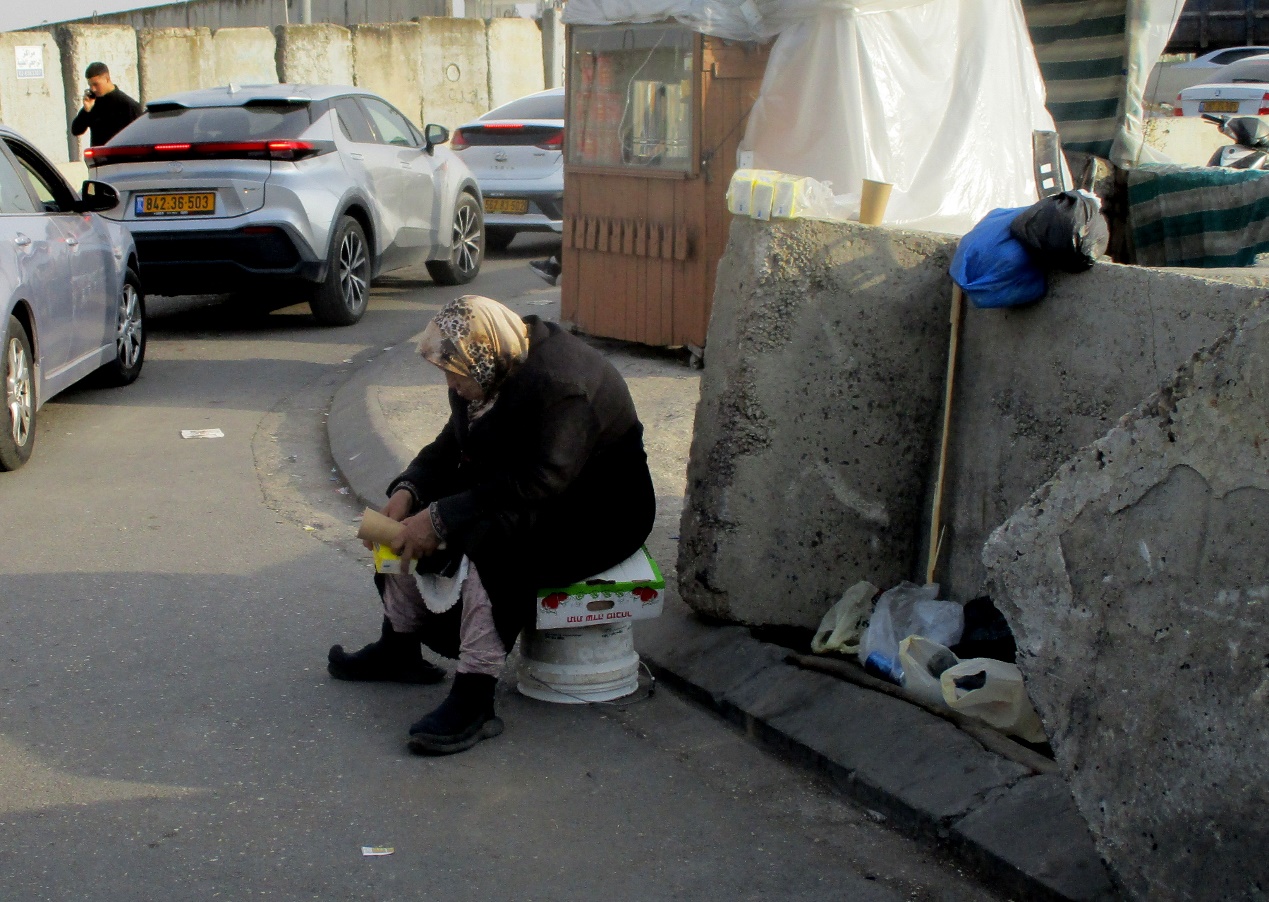 Tamar FleishmanOct-11-2026Qalandiya. Female Beggar
-
