
Qalandiya, Wed 4.5.11, Afternoon
15:40 two sleeves (1 and 4) are open, crowded with waiting people, and witnessing the procedure of recent shifts in which the entrance to the crossing is fed with people from the cage – a drop at a time… The sight of people trapped in the narrow cage is hard to bear: in fact everything humiliates, but within this unnecessary procedure is an additional humiliation upon that of all this behavior from the beginning.
Six people are waiting in line for the DCO.
Almost 16:00, a phone call to the DCO, an officer appears and promises “all will enter.” Will they also be dealt with? Apparently not. Among them a family with an appointment at Hadassah Hospital tomorrow morning. The 19-year-old son was injured in an incident at the entrance to the vehicle crossing, and was hospitalised in Hadassah for a few days. He has now been called back for a routine checkup. They demand police passes. The family runs to get. Finally – a negative answer: “Go to the clinic in Ramallah!”
It’s impossible to approve from today to tomorrow.
A phone call to Chana B., and yes, it’s true , they don’t issue passes from one day to the next and, in any case, the DCO also screens applications to check that there is financial cover (?!)
One of the men let in before 16:00 emerges, of course, without a magnetic card: come again…!
The family comes out with the injured youngster. A hard sight. A long slash across his head and neck. They all have magnetic cards, but they are all Shabak blacklisted because somebody in the extended family is sitting in prison. We promised to follow up. In this case the father had in fact paid cash for the earlier treatment.
At 16:30 another sleeve opens. All the while, crowding and the usual unnecessary wait. A follow up on the passage through the sleeves – 30 minutes not including the wait in the cage and the check inside.
17:00 from a distance the blue ID line appears empty.
And finally, as always, a small test case proves everything. A group of secular students, boys and girls together, passes through. We are right behind them, and while in the check lane having our documents inspected thoroughly, it becomes clear that one of the young women has been delayed 15 minutes in the internal room. She is “released” and emerges with us. Almost in tears. The delay, the fear, the humiliation. In addition to all else, the turnstile suddenly locks giving her a bang on the head!!! Humiliated and mainly fuming. Why? Apparently “no reason.” They study in Nablus and return home each week, which automatically arouses suspicion(!!)
Qalandiya Checkpoint / Atarot Pass (Jerusalem)
See all reports for this place-
Click here to watch a video from Qalandiya checkpoint up to mid 2019 Three kilometers south of Ramallah, in the heart of Palestinian population. Integrates into "Jerusalem Envelope" as part of Wall that separates between northern suburbs that were annexed to Jerusalem in 1967: Kafr Aqab, Semiramis and Qalandiya, and the villages of Ar-Ram and Bir Nabala, also north of Jerusalem, and the city itself. Some residents of Kafr Aqab, Semiramis and Qalandiya have Jerusalem ID cards. A terminal operated by Israel Police has functioned since early 2006. As of August 2006, northbound pedestrians are not checked. Southbound Palestinians must carry Jerusalem IDs; holders of Palestinian Authority IDs cannot pass without special permits. Vehicular traffic from Ramallah to other West Bank areas runs to the north of Qalandiya. In February 2019, the new facility of the checkpoint was inaugurated aiming to make it like a "border crossing". The bars and barbed wire fences were replaced with walls of perforated metal panels. The check is now performed at multiple stations for face recognition and the transfer of an e-card. The rate of passage has improved and its density has generally decreased, but lack of manpower and malfunctions cause periods of stress. The development and paving of the roads has not yet been completed, the traffic of cars and pedestrians is dangerous, and t the entire vicinity of the checkpoint is filthy. In 2020 a huge pedestrian bridge was built over the vehicle crossing with severe mobility restrictions (steep stairs, long and winding route). The pedestrian access from public transport to the checkpoint from the north (Ramallah direction) is unclear, and there have been cases of people, especially people with disabilities, who accidentally reached the vehicle crossing and were shot by the soldiers at the checkpoint. In the summer of 2021, work began on a new, sunken entrance road from Qalandiya that will lead directly to Road 443 towards Jerusalem and Tel Aviv. At the same time, the runways of the old Atarot airport were demolished and infrastructure was prepared for a large bus terminal. (updated October 2021)
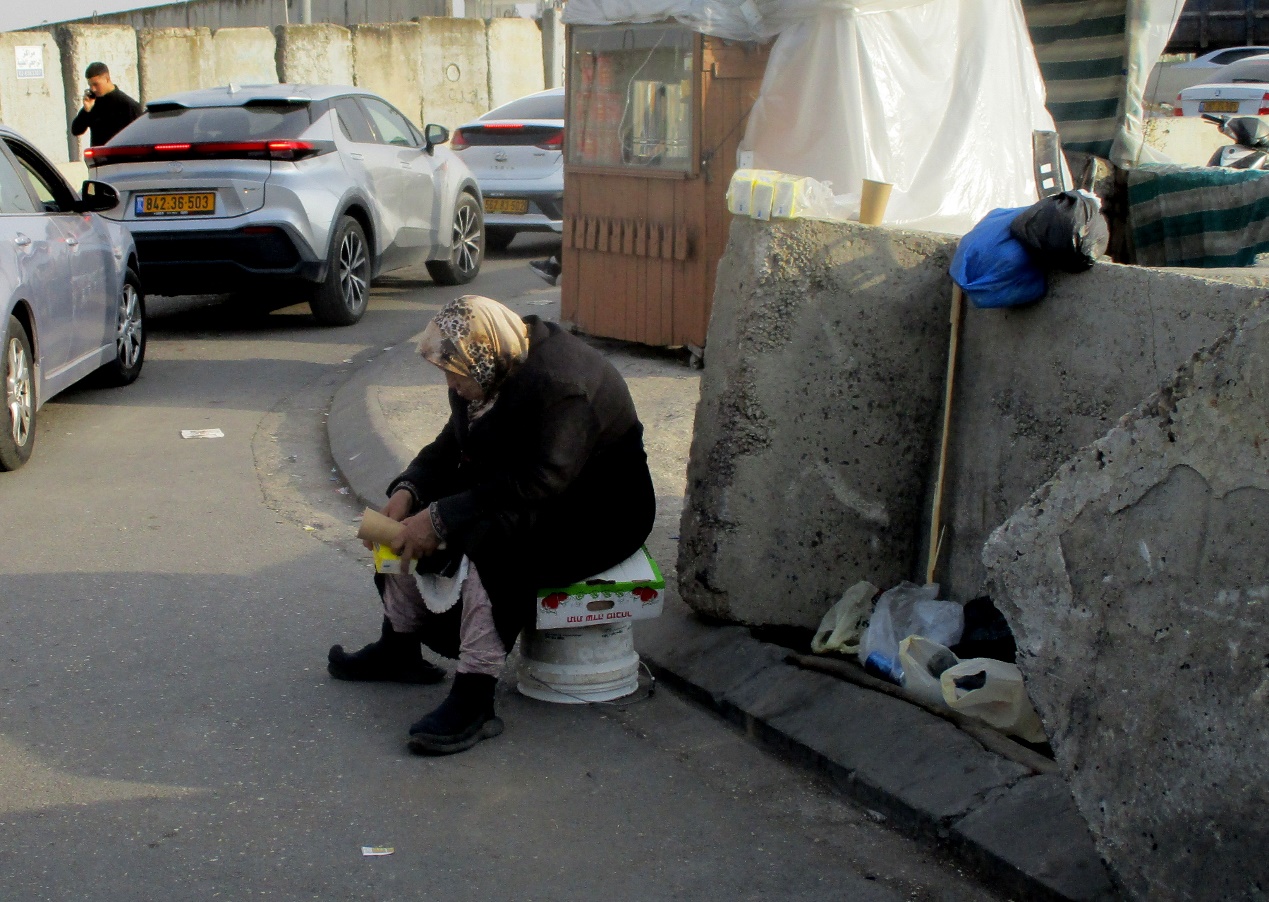 Tamar FleishmanOct-11-2026Qalandiya. Female Beggar
-
