
Qalandiya - West Bank doctors are not coordinated with the Civil Administration and the patients suffer

Just as in an ever-repeated story, same place, same answers, same result and same heartache. Only the names change, the faces, and the heart too is not what it used to be. The ache grows and grows.
Lamar is an ill girl of 4, released not long ago from a West Bank hospital.
Lamar and her mother Nadiya, and her grandmother whose name I do not know, came to the DCO at the checkpoint to receive their permits to continue on home to Gaza.
But their designated transport, delivering patients and their accompaniers to Gaza, left already half an hour ago – since the hospital staff in the West Bank are not coordinated with the Israeli Civil Administration and not exactly subject to the army’s orders and perhaps do not know what the woman-soldier behind the armored window pane said: everyone knows they should be here by 3 p.m., repeating the phrase: there’s nothing to be done now. Come back tomorrow.
Neither Lamar nor her mother Nadiya nor her grandmother whose name I don’t know knew what that soldier was so sure “everyone knows”.
I came to the window and told the soldier that there is indeed something to be done – giving permits like the ones issued people who are not ill, like merchants for example who return to the Gaza Strip on their own.
–But what if she runs away on the way? Asked the soldier.
-Look at her, does she look to you like she’s going to run away? Seriously?
–I am here for them. We serve the Palestinians.
–What you are doing here is screwing the ones who are most screwed anyway.
–When you come to the bank and are told that the bank is closed, you don’t argue. Closed means closed.
When Nadiya, little Lamar’s mother, realized that there were no more chances to get back home that day and that they must look for a place to spend the night in the West Bank, she asked the soldier to be allowed to leave their many bags and belongings at the checkpoint until the following day – and was refused.
(The photo shows some of the belongings,)
-Just as you brought them here now, take them and bring them back tomorrow.
When we turned back, the soldier was approached by a young man asking for a permit to bring his wife to the hospital in East Jerusalem.
A few minutes later, as we carried the heavy bags out of the checkpoint, we met the same man, head hanging in anguish: suddenly I’m blacklisted, he said.
His wife would not make it to her hospital appointment. On the following morning he would come back and wait in front of the door, behind which sits the fake-named secret service captain.
I have a growing collection of photos taken through the round windows of the winding wall leading to the renovated checkpoint.
Photos taken from inside-out.
Every time I choose one of the three tracks and photograph what I see through these round holes.
I pointed my camera towards the watchtower and suddenly an armed man appeared out of nowhere.
Armed man: Don’t photograph me.
I: Why not?
Armed man: I’m a private person.
I: No, you’re not. You serve the public and it is my right to photograph you.
And I did.
Armed man: I forbid you to post the picture!
And here it is.

כשנדיה אמא של למאר הקטנה הבינה שאבדו הסיכויים לשוב הביתה באותו היום ושצריך לחפש בגדה מקום ללון בו, ביקשה שירשו להן, עד לבוקר המחרת להשאיר איפשהו במתחם המחסום את החבילות והשקיות הרבות וסורבה.
(בתמונה חלק ממטענן)
- כמו שהבאתם את זה לפה – תקחו ותביאו מחר.
כשפנינו לאחור, ניגש אל החיילת איש צעיר, ביקש אישור להביא את אשתו לבי”ח במזרח ירושלים.
דקות אחדות אח”כ, כשסחבנו את הצרורות הכבדים מנשוא אל מחוץ לגדרות המחסום, פגשנו את האיש חפוי ראש: פתאום אני מנוע, סיפר.
אשתו של האיש כבר לא הגיעה במועד לבית החולים, בבוקר המחרת הוא ישוב ויחכה לפני הדלת שמאחוריה קפטן בעל שם בדוי.

יש לי אוסף הולך וגדל של צילומים דרך חורי הגדר הפתלתלה שמובילה למחסום המחודש.
תמונות מהפנים אל החוץ.
בכל פעם אני בוחרת באחר משלושת הנתיבים ומצלמת מה שמתגלה מבעד לעיגולים.
כוונתי את המצלמה לעבר מגדל השמירה ולפתע משום מקום הופיע חמוש.
- החמוש: אל תצלמי אותי,
- אני: למה?
- החמוש: אני אדם פרטי
- אני: אתה לא אדם פרטי, אתה משרת ציבור וזכותי לצלם אותך.
צלמתי.
- החמוש: אני אוסר עלייך להעלות את התמונה!
הנה היא.
Qalandiya Checkpoint / Atarot Pass (Jerusalem)
See all reports for this place-
Click here to watch a video from Qalandiya checkpoint up to mid 2019 Three kilometers south of Ramallah, in the heart of Palestinian population. Integrates into "Jerusalem Envelope" as part of Wall that separates between northern suburbs that were annexed to Jerusalem in 1967: Kafr Aqab, Semiramis and Qalandiya, and the villages of Ar-Ram and Bir Nabala, also north of Jerusalem, and the city itself. Some residents of Kafr Aqab, Semiramis and Qalandiya have Jerusalem ID cards. A terminal operated by Israel Police has functioned since early 2006. As of August 2006, northbound pedestrians are not checked. Southbound Palestinians must carry Jerusalem IDs; holders of Palestinian Authority IDs cannot pass without special permits. Vehicular traffic from Ramallah to other West Bank areas runs to the north of Qalandiya. In February 2019, the new facility of the checkpoint was inaugurated aiming to make it like a "border crossing". The bars and barbed wire fences were replaced with walls of perforated metal panels. The check is now performed at multiple stations for face recognition and the transfer of an e-card. The rate of passage has improved and its density has generally decreased, but lack of manpower and malfunctions cause periods of stress. The development and paving of the roads has not yet been completed, the traffic of cars and pedestrians is dangerous, and t the entire vicinity of the checkpoint is filthy. In 2020 a huge pedestrian bridge was built over the vehicle crossing with severe mobility restrictions (steep stairs, long and winding route). The pedestrian access from public transport to the checkpoint from the north (Ramallah direction) is unclear, and there have been cases of people, especially people with disabilities, who accidentally reached the vehicle crossing and were shot by the soldiers at the checkpoint. In the summer of 2021, work began on a new, sunken entrance road from Qalandiya that will lead directly to Road 443 towards Jerusalem and Tel Aviv. At the same time, the runways of the old Atarot airport were demolished and infrastructure was prepared for a large bus terminal. (updated October 2021)
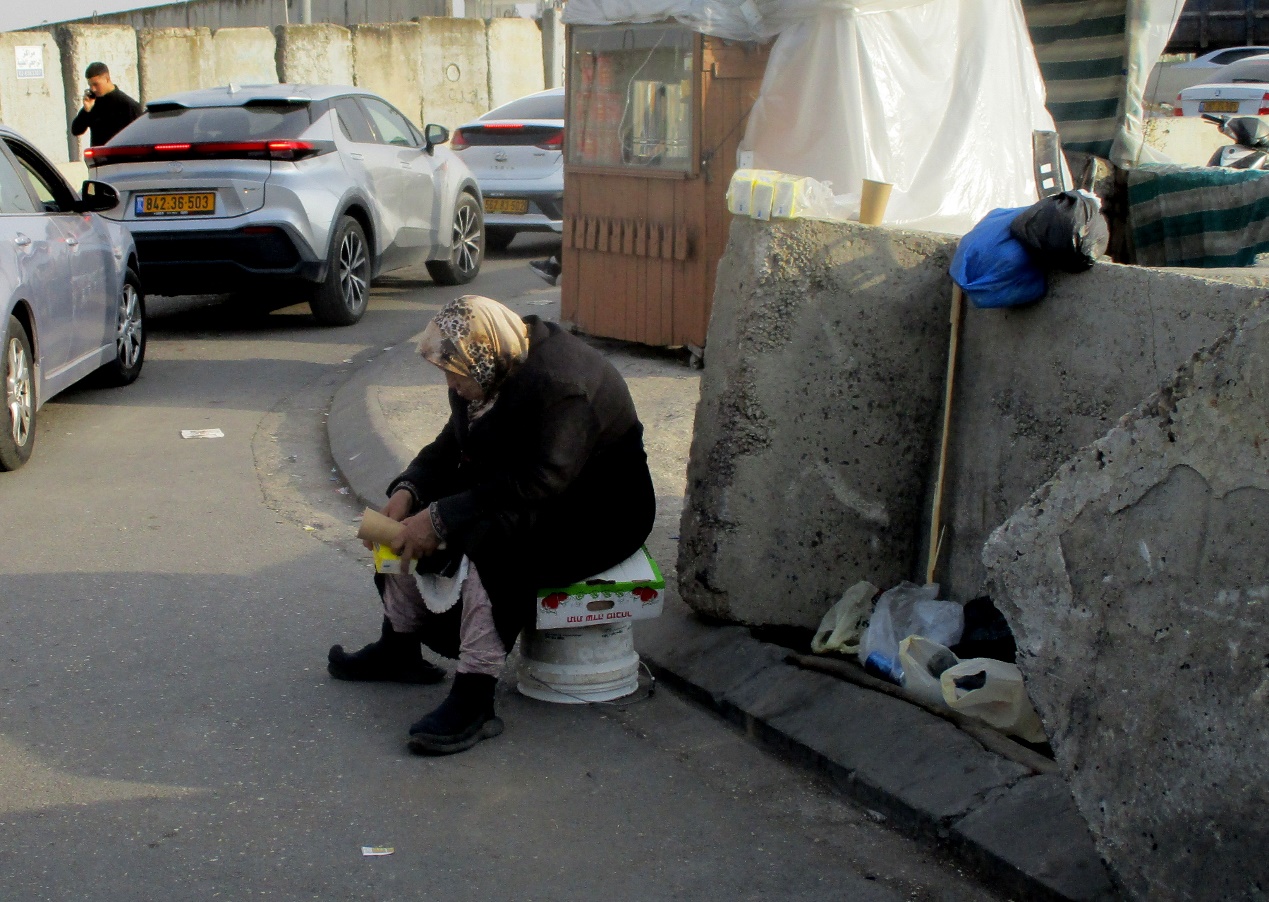 Tamar FleishmanOct-11-2026Qalandiya. Female Beggar
-
