
Sansana (Meitar Crossing), South Hebron Hills
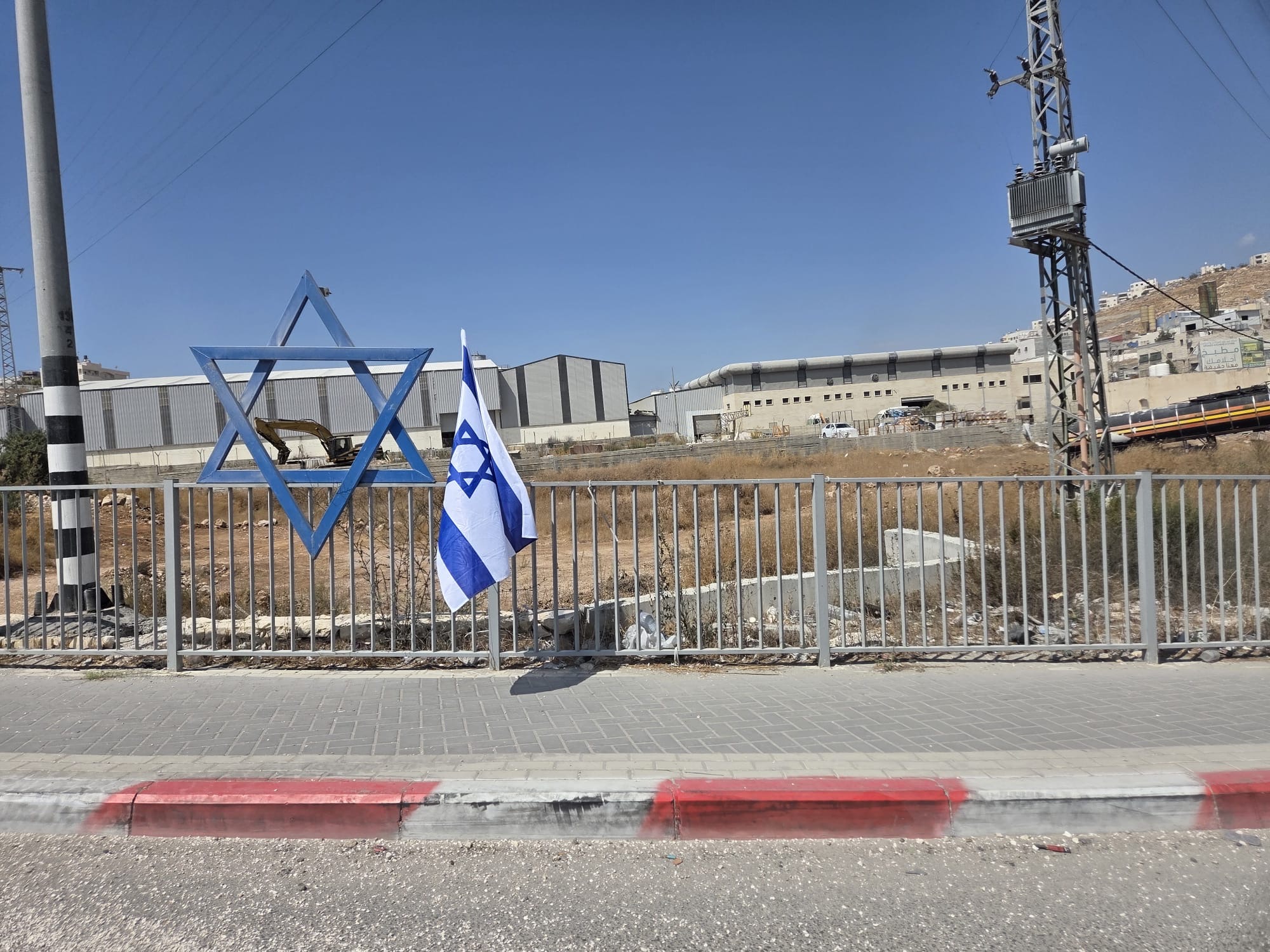
We left late and the Meitar checkpoint was empty: Muhammad reports that in the early morning, it was a usual Sunday morning, despite the Muslim New Year. Route 60 – quite lively, lots of trucks with construction materials, probably for the construction we saw, below. After the checkpoint, the police lurk waiting for illegal workers, a game of cat and mouse. At the side of the road there is a small group of men waiting for the police to leave.
We visited the Hursa – we have already reported on the peaceful village that is all one family: The family of Sakhtit Family with 3000 plus persons.
As mentioned in previous reports. in the middle of the village, next to the family Divan which is a kind of banquet hall for events is, a military observation tower and two checkpoints, which close about 50 meters of the road, that were erected a year ago. The barrier prevents access to the divan and easy access for both car and pedestrian owners and basically divides the village in two. The use of the Divan depends on the DCO’s approval in advance each time
We met Mr. Nasser S. who, for example, said that some time ago, a wedding in Divan was stopped in the middle by soldiers in the area, claiming there was no permit for the celebration. And we saw on a previous visit the torments of the villagers, who wanted to organize a celebration for some reason and were refused. After contacting the DCO, the ceremony was limited to two hours. Nasser also told (and we heard from other people) about obscenities and curses from the female soldiers serving at the base. He also reported harassment of settlers from Negohot, who travel at great speed on the narrow road around the checkpoint, scaring the children on their way to school.
He says the military often runs the “Straw Widow Procedure”: a squad of soldiers invades a house for 24 hours, allegedly to make observations. Family members are imprisoned in one room or driven out of their homes during the “invasion”. The soldiers leave filth behind them and sometimes there are thefts. In addition, there are nightly incursions into homes, searches and again incarceration or family deportation. Nasser says he had to take out his father, who suffers from his heart, in the cold of winter because of one of those searches, which have no real benefit.
In short, ongoing harassment and ongoing humiliation.
Back to “Israel”: Nothing new
Meitar checkpoint / Sansana
See all reports for this place-
Meitar Checkpoint / Sansana The checkpoint is located on the Green Line and serves as a border crossing between Israel and the West Bank. It is managed by the Border Crossing Authority of the Defense Ministry. It is comprised of sections for the transfer of goods as well as a vehicle checkpoint (intended for holders of blue identity cards, foreign nationals or diplomats and international organizations). Passing of Palestinians is prohibited, except for those with entry permits to Israel. Palestinians are permitted to cross on foot only. The crossing has a DCO / DCL / DCL / DCL (District Coordination Office), a customs unit, supervision, and a police unit. In the last year, a breach has been opened in the fence, not far from the crossing. This breach is known to all, including the army. There does not appear to be any interest in blocking it, probably as it permits needed Palestinian workers without the bureaucratic permits to get to work in Israel. Food stalls and a parking area economy have been created, but incidents of violent abuse by border police have also been recorded. Updated April 2022
-
South Hebron Hills
See all reports for this place-
South Hebron Hills
South Hebron Hills is a large area in the West Bank's southern part.
Yatta is a major city in this area: right in the border zone between the fertile region of Hebron and its surroundings and the desert of the Hebron Hills. Yatta has about 64,000 inhabitants.
The surrounding villages are called Masafer Yatta (Yatta's daughter villages). Their inhabitants subsist on livestock and agriculture. Agriculture is possible only in small plots, especially near streams. Most of the area consists of rocky terraces.Since the beginning of the 1980s, many settlements have been established on the agricultural land cultivated by the Palestinians in the South Hebron Hills region: Carmel, Maon, Susia, Masadot Yehuda, Othniel, and more. Since the settlements were established and Palestinians cultivation areas have been reduced; the residents of the South Hebron Hills have been suffering from harassment by the settlers. Attempts to evict and demolish houses have continued, along with withholding water and electricity. The military and police usually refrain from intervening in violent incidents between settlers and Palestinians do not enforce the law when it comes to the investigation of extensive violent Jewish settlers. The harassment in the South Hebron Hills includes attacking and attempting to burn residential tents, harassing dogs, harming herds, and preventing access to pastures.
There are several checkpoints in the South Hebron Hills, on Routes 317 and 60. In most of them, no military presence is apparent, but rather an array of pillboxes monitor the villages. Roadblocks are frequently set up according to the settlers and the army's needs. These are located at the Zif Junction, the Dura-al Fawwar crossing, and the Sheep Junction at the southern entrance to Hebron.
Updated April 2022
 Timna OrevSep-24-2026Replacing flags on Highway 6
-
