
South Hebron
Hebron Hills Sunday AM 30.10.2005Observers Paula R., Elena L (reporting)6:45 -10:15Summary – complete closure obtains at Sansana CP. Hebron is under siege except for ‘humanitarian” cases . There is a slight alleviation of the restrictions on travel along route 35: Palestinian taxis can now use it (though not to enter Hebron) but Palestinians using other vehicles may drive on it only if they are “humanitarian cases”. Idhna CP is closed. There are humanitarian problems in Kilkes village which is completely cut off by barriers. 6:55- 7:15: Sansana CP: we saw about 20 detainees, half of whom were standing in a line when we arrived, but who immediately afterwards were told to go to the second of two large tents (near the outhouses), where they sat down on the ground – the other half of the detainees were already sitting in the first tent when we arrived. The Border Police officer in charge of the CP told us that they had been caught trying to evade the CP and get into Israel to work. But complete closure was in effect and therefore they now had to wait till their IDs had been checked with the GSS [Israeli General Security Service; “Shin Bet”]. He would not allow us to approach the detainees merely to count them, much less leave a phone number with them, claiming that the tents were “a military base” and we needed a special permit to enter it, which he was not about to give us. A telephone call to F. who had been the CP commander last week produced no results as F. said that the officer G.A. (who did not try to hide his name or tag number (we have them) outranked him.We then approached three Bedouin men waiting by their pickup truck on route 60, which was pointed in the direction of Beersheba. They told us that one of the detainees in the tents was their father who had a heart condition and that he had been driving the pickup. They said they had bought 20 kilos of meat in East Jerusalem for the end of Ramadan and that the soldiers had summoned an inspector from the Ministry of Agriculture whom they expected to arrive at about 8:00 am. They claimed that they had been waiting since 5:00 am. We gave then our telephone number and asked them to call us when their father was released. They did not call us, but when we returned through Sansana at 10 :10 they had gone and the two tents were empty.7:25 Ramadin CP: 4 high school kids (two boys and two girls) from Dahariya were approaching the CP when we arrived . The soldiers asked to see the school bags of the two boys The checking was cursory and the four were allowed through quickly. We asked the soldiers (there were 2) whether the DCC [District Coordinating Office of the IDF Civil Administration, in charge of issuing passage permits] had provided, as promised, authorized lists of suppliers for lorries carrying goods to Ramadin (see the report of a couple of weeks ago). The soldier in command said that he had asked the DCC again and again for such a list, but had received nothing. Meanwhile he simply used his own discretion and usually let the truck through, first taking the driver’s ID and then handing it back when the latter returned. 7: 55 Dura –al Fawwar: The crossing is open to cars. On route 60 there is a manned road block consisting of cement cubes (instead of the spikes)- but there were no detainees.8:00 Sheep’s Crossing: Open to pedestrians (of whom there were very few). No soldiers on the ground.8:15. Shiyukh –Hebron Crossing: Open to pedestrians (of whom there were many especially school children). One of the adults coming from Shiyuch told us that two days ago there soldiers had been there in the morning who had checked everyone’s IDs, making them stand in a line in the sun for “a long time”. Paula met a cab driver whom she knows (on the Hebron side of the crossing) and he told her that he and his wife would have loved to go to Jerusalem to pray in the Al Aksa mosque during Ramadan but that he preferred not to risk it : “I have a family to support” he said.Sair- East Halhul Crossing: closed in both direction with a manned road block on route 60 . The soldiers were checking both cars and pedestrians pretty efficiently (there were no long queues) . The commander of the CP refused to answer our questions (we had asked if any Palestinian cars were being let through) and also refused to tell us what unit he belonged to. A call to Operations-Judea Brigade got no answer. Neither the commander nor the other soldier at the roadblock had heard of MachsomWatch . The commander ordered the other soldier to hand back the copy of MW’s “Letter to the Soldiers” which I had just given him. However, at the very end of our exchange, without otherwise changing his hostile attitude, he took it back from me and said he would read it.Route 35: It is now open to Palestinian taxis and, according to the soldiers at the Humanitarian Gate, also to other Palestinian vehicles if they are “humanitarian cases”, although they would not be allowed to enter Hebron via their CP. At Idhna CP we were told by a resident of Kirkes village (see below) that any Palestinian vehicle “with a special permit” could now use route 35. We observed several taxis on the road and one or two Palestinian trucks.Hebron – Halhul bridge: open to motor trafficJust before the bridge on the Hebron side of route 35 we saw a taxi stuck on a dirt barrier.Idhna CP: Closed with a high dirt barrier. No soldiers on the ground. Pedestrians were crossing route 35 and walking towards the low range of hills on its northern side. The owner of a taxi company whom we met at the barrier told us that they were making for the taxis that stood out of sight on the far side of the hill which would take them to Hebron by a very roundabout route through Dura. He said that the CP had been closed for about a month. What the trek over the hill would entail when it rains beggars description. 9:30 Humanitarian Gate: A Palestinian car in which there were two doctors was observed passing through to Hebron with only a few minutes’ wait. Other vehicles coming out of Hebron were also observed. There were no detainees and no long queues of vehicles . The soldiers at the CP had not heard about us, but were not hostile and were happy to receive our “Letter to the Soldiers”9:45 Kilkes viilage: While we were at Idhna CP we were approached by a man who said he was from Kilkes village which is about 1.5 km south of the Hebron DCO (and Manoach hill) on the left side of route 60, going south towards Bet Haggai. He said that the village was completely cut off by barriers (there was no military presence there) and that there were two patients with kidney disease who needed to get treatment in Hebron. We gave him the phone number to contact “Physicians without Borders” and also our card and a number to reach us. He in turn gave us his name and phone number. (He also reminded us that the army had shot and killed one of the children of the village at the beginning of the Intifada. The army, he said, had acknowledged that there had been “an error”). On the way back to Shoket we stopped to observe the village – there was no one crossing route 60 at that hour (9:45) and when I foolishly wanted to climb the dirt barriers and enter the village, our driver I. stopped me, saying: “They don’t know you – wait till you have met them crossing the road.” He was right, of course.
Hebron
See all reports for this place-
According to Wye Plantation Accords (1997), Hebron is divided in two: H1 is under Palestinian Authority control, H2 is under Israeli control. In Hebron there are 170,000 Palestinian citizens, 60,000 of them in H2. Between the two areas are permanent checkpoints, manned at all hours, preventing Palestinian movement between them and controlling passage of permit holders such as teachers and schoolchildren. Some 800 Jews live in Avraham Avinu Quarter and Tel Rumeida, on Givat HaAvot and in the wholesale market.
Checkpoints observed in H2:
- Bet Hameriva CP- manned with a pillbox
- Kapisha quarter CP (the northern side of Zion axis) - manned with a pillbox
- The 160 turn CP (the southern side of Zion axis) - manned with a pillbox
- Avraham Avinu quarter - watch station
- The pharmacy CP - checking inside a caravan with a magnometer
- Tarpat (1929) CP - checking inside a caravan with a magnometer
- Tel Rumeida CP - guarding station
- Beit Hadassah CP - guarding station
Three checkpoints around the Tomb of the Patriarchs
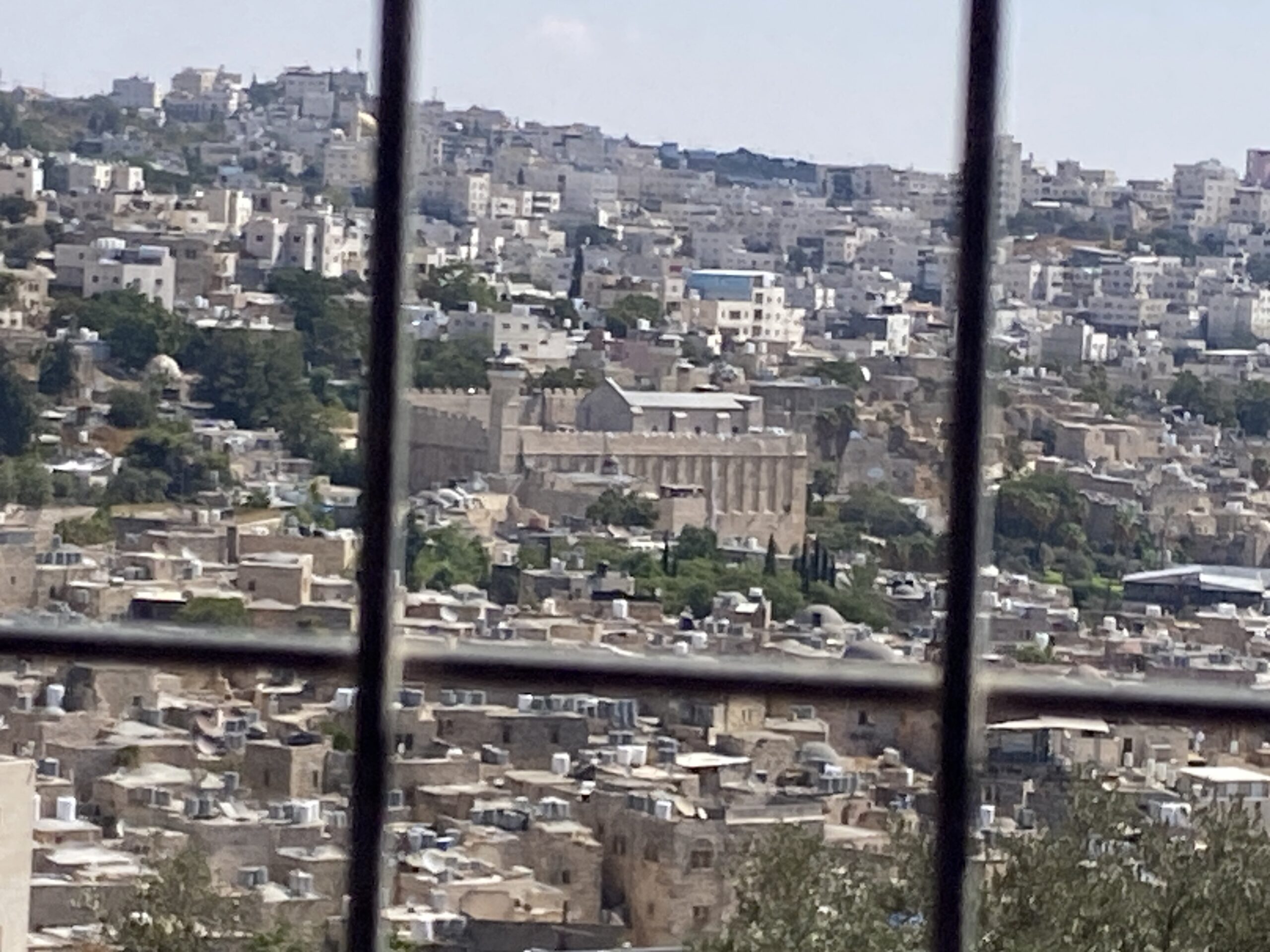 Yael ZoranSep-24-2026Hebron and the Cave of the Patriarchs from Beit Hashalom
-
