
South Hebron
South Hebron and Hebron, Thursday 10/11/05, AMObservers: Y.L., Z.B-P, E. B-L.Departure Tsomet Shoket 06:50, return 11:30Summary: We drove straight to Hebron to observe children going to school. Very few Palestinian cabs on the roads. Military presence slightly reduced from what it was after the attack on the hitch-hikers stop (trempiada) in Gush Etzion. Hebron is not under curfew. We have been attacked by a young settler in Hebron, and because of the time spent reporting to the police we could not complete the round of the roadblocks/checkpoints.Sansana checkpoint: one Israeli Palestinian vehicle was stopped by soldiers. We didn’t stop to find out why. As he passed us later he had been detained only a few minutes after we saw him.Earth piles on the entrance to Samoa’s dirt road. The earth was flattened so that it would allow passage to a private car, though a difficult one. Soldiers stop cars that try to get on road 60. On the way back there was a rolling checkpoint on this spot.Daharia checkpoint – the iron gate was open. It is necessary to go inside and see if there are other roadblocks, where and of which kind.Dura-Al Fawar: cars can pass from Dura to Al Fawar. New deep scratches on Road 60 in both directions. Concrete obstacles on the road. On the road to Hebron we saw soldiers who selectively stopped cars that used road 60. No soldiers observed on the way back.Shaap J.: no soldiers.Hebron:We arrived at the checkpoint at the foot of the road to Tel Rumeida with the last boys going out and the girls going in thru the magnometre on their way to school. Police was stationed near the steps that serve the teachers and pupils of Kordova School, across from Beit Hadassa to protect the Palestinians. A group of elderly well dressed women, their bags decorated with orange strings stood there watching the Palestinians. They didn’t want to speak with us but it was evident that these were visitors. The policemen and soldiers felt under pressure because of the presence of the 2 groups and requested that we move further away in order to avoid trouble. Nearby stood a young Swedish volunteer, member of a Christian North-European organization (EAPPI), whose members live in Hebron and oversee the girls coming and going. Another EAPPI volunteer told us that the girls stopped fighting the passage thru the magnometre. We saw a mother crossing to the Palestinian part, leading her ca 4 years old daughter from the side. There are doors that allow passage as well. She moved fast and naturally and this didn’t cause any problem. The volunteer said they were spending the day on the school premises in order to accompany the younger students thru the areas controlled by the Jews. Students are not allowed to go unaccompanied and the volunteers organize activities for them when they have to wait for the older students so that all can go together. Sometimes the young girls take the risk of going straight and unattended. Because Palestinans are not allowed on the road between Beit Hadassa and Avraham Avinu girls that live east of the school must walk for 45 minutes instead of 5.The army forbids the presence of the EAPPI volunteers on this road as well, because their presence causes “provocations.”A little later we are harassed by settlers and attacked by one.While we were talking with one of the soldiers a woman stopped her car and asked the soldier “who are these Nazis?”. When we started going back she turned her car and followed us slowly all the way to Avraham Avinu neighborhood, busily talking on the phone. We stopped and took some photographs and she ‘retaliated’ by taking our pictures. Once there a man with a good camera took our pictures. We smiled and took his picture as well.After we left them and went underneath the arch of the WAKF on our way out, a building block (hollow brick) was thrown on the road behind us. It was shattered and we were mildly hurt by pieces. We didn’t see who threw it. We stopped to tell the soldiers who were stationed near the place about the incident, and then a young man whom we saw already at the parking lot during the picture-taking scene came carrying a plastic bag and looking strangely at us. When asked if he has more stones to throw he said ‘yes’ and threw 2 eggs that hit two of us and a soldier. He then escaped running and was not caught.The police treated our complaint seriously and tried to identify the attacker. They were courteous and efficient.Is it possible that soon we won’t be allowed into Hebron because our presence creates a ‘provocation’? we have to be aware and cautious.
Hebron
See all reports for this place-
According to Wye Plantation Accords (1997), Hebron is divided in two: H1 is under Palestinian Authority control, H2 is under Israeli control. In Hebron there are 170,000 Palestinian citizens, 60,000 of them in H2. Between the two areas are permanent checkpoints, manned at all hours, preventing Palestinian movement between them and controlling passage of permit holders such as teachers and schoolchildren. Some 800 Jews live in Avraham Avinu Quarter and Tel Rumeida, on Givat HaAvot and in the wholesale market.
Checkpoints observed in H2:
- Bet Hameriva CP- manned with a pillbox
- Kapisha quarter CP (the northern side of Zion axis) - manned with a pillbox
- The 160 turn CP (the southern side of Zion axis) - manned with a pillbox
- Avraham Avinu quarter - watch station
- The pharmacy CP - checking inside a caravan with a magnometer
- Tarpat (1929) CP - checking inside a caravan with a magnometer
- Tel Rumeida CP - guarding station
- Beit Hadassah CP - guarding station
Three checkpoints around the Tomb of the Patriarchs
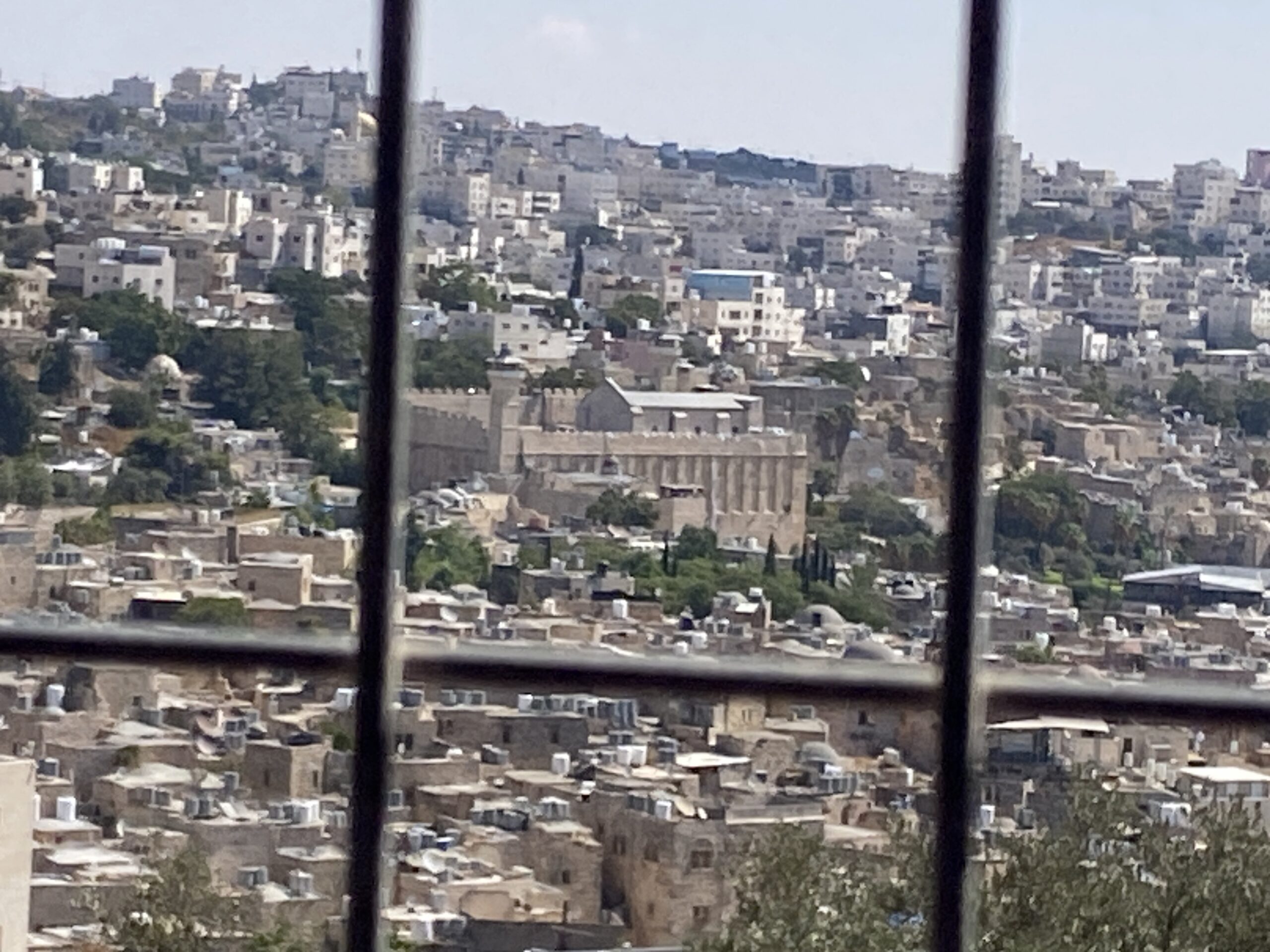 Yael ZoranSep-24-2026Hebron and the Cave of the Patriarchs from Beit Hashalom
-
