
South Hebron
Hebron and Hebron Hills Thursday 12/1/06 AMObservers: Illit, Natanya G, Hanna S, Elena L (reporting)6:45-10:30Summary Today is the last day of the feast of Id al Adha, but there is almost no traffic: very few pedestrians and even fewer vehicles. Light ran fell at intervals and it was very cold. The most significant information we obtained was: (1) the use of gas grenades and dogs at the Beit Awwa CP (according to what we were told at Idhna CP) and (2) The passages along the sides of the Pharmacy CP in Hebron have been blocked and pregnant women have to go through the scanner (magnometer).Sansana CP: There are no detainees. 3-4 Palestinian workers went through to Israel. A transit van was waiting for them.7:10 Just after Karame on route 60 : 2 soldiers man a flying roadblock (spikes on both sides of the road) The soldiers and the roadblock were still there on our return at 10 :30. There were no detainees. Beit Haggai: 4 soldiers were manning a flying roadblock – no detainees. They made us stop but didn’t ask for our IDs and allowed us to continue on our way.Dura – al-Fawwar Crossing: the gates on wither side of the crossing are closed and there is very sparse pedestrian traffic. Ther are unmanned plastic barriers on the main road to slow traffic down.Sheep’s Crossing: 6 soldiers were on the Hebron side. No detainees. There were almost no pedestrians at all. On the Hebron side there are new cement blocks arranged in two lines so as to create narrow passageways.On our return to Shoket at about 10:10 we again saw 6 soldiers there and very few pedestrians. There were no detainees.Junction of route 60 and route 317: surprisingly, the roadblock mentioned in the report of the 3rd January 2006 was no longer there.Shiyukh –Hebron Crossing: Open to pedestriansas usual.Sa’ir –East Halhul: Open to vehicles in both directions. No soldiers on the ground.Route 35The Humanitarian gate (Ras al Jura): Closed; and no one was there.Halhul- Hebron bridge: open to traffic in both directions.Idhna: The gate was closed and in addition large cement cubes had been piled up against it. One of the pedestrians who were coming through from Idhna asked us to send MW shifts to Beit Awwa CP , because “there were a lot of problems there”. The soldiers demand that people get out of their cars and then check their persons ( they have to raise their shirts etc) with the aid of a dog. Yesterday –so he told us –the soldiers had thrown two gas grenades at the Palestinians. We said we would try to get to the CP. HebronWe (I. our driver and I) met our colleagues from Jerusalem at the entrance to Kiryat Arba. We hardly saw a living sould during the entire shift. Because of the holiday the schools were closed and no children were about in Shuhada street. It drizzled sporadically and was very cold. The wholesale market: everything was very quiet there and we saw only one male settler moving about. No one could have guessed that the eviction of the settler families who were squatting there was soon to take place.Casba CP: The iron gate was locked. No soldiers were visible. There were no detainees.Tel Romeida CP: No soldiers were visible and therefore no one prevented us from walking up to the illegal outpost at top of the hill (tel). On our way back down the hill we were accompanied by an elderly Palestinian wearing an impressive galabiya and leaning heavily on a walking stick. He told us he had come by bus from Bethlehem where he lived. As far as we understood (he only spoke Arabic) he was visiting relatives during the holiday. It was clear to us however that he was walking down the steep descent despite the rain and despite his obvious physical difficulties for the “simple” reason that all Palestinian vehicles are forbidden in the Israeli section of Hebron. Why? For ‘security reasons’ of course!The Pharmacy CPThere were no detainees and only 3-4 Palestinians passed through while we were there. These included two women who passed through the scanner.The pathways along the sides of the shed with the scanner have been blocked off. On one side by a cement wall and barbed wire coils, and on the other side by new jersies (batonadot) backed up by barbed wire coils. When we asked a soldier who emerged from the CP how pregnant women would be able to get through it without having to go be subjected to the scanner, he replied that they had to go through the scanner like every one else. When we said that there were orders to allow pregnant women to go along the side of the CP, he replied: “Who says there are such orders?”. And when we pointed out that it was dangerous for pregnant women to have to go through the scanner- he said: “Who says it’s dangerous?” He then turned his back on us and went away. He refused to identify himself. A Palestinian man who came through the CP told us that the passages along the sides of the CP were closed at the end of Ramadan and that since then everyone has to go through the scanner. It is clear therefore that passage along the side which took place during the shift of 3.1.06 only because one of the Palestinian women was in possession of the letter, explicitly permitting such passage, which Limor Yehudah received from the Hebron DCO and because our colleague Yaela handed the letter to the officer who had previously refused to receive it from the hands of the Palestinian woman. (see report of Tuesday 3/1). Since there were’nt any pregnant women refusing to go through the scanner during our shift we left the CP without contacting the DCO or the battalion CO.The usual racist graffiti decorating the locked doors of the empty houses along Shuhada steet have been painted over but in their stead posters have been stuck up with messages (written in large black letters) directed at the soldiers.Examples: “Soldier! You joined up to defend and to guard – don’t collaborate with corrupt politicians. Don’t expel Jews!” “Soldier! Your uniform does not cover up crimes –so don’t expel Jews!” Would that one could deduce from these appeals that the eviction from the market, and not only from there, is really going to happen.
Hebron
See all reports for this place-
According to Wye Plantation Accords (1997), Hebron is divided in two: H1 is under Palestinian Authority control, H2 is under Israeli control. In Hebron there are 170,000 Palestinian citizens, 60,000 of them in H2. Between the two areas are permanent checkpoints, manned at all hours, preventing Palestinian movement between them and controlling passage of permit holders such as teachers and schoolchildren. Some 800 Jews live in Avraham Avinu Quarter and Tel Rumeida, on Givat HaAvot and in the wholesale market.
Checkpoints observed in H2:
- Bet Hameriva CP- manned with a pillbox
- Kapisha quarter CP (the northern side of Zion axis) - manned with a pillbox
- The 160 turn CP (the southern side of Zion axis) - manned with a pillbox
- Avraham Avinu quarter - watch station
- The pharmacy CP - checking inside a caravan with a magnometer
- Tarpat (1929) CP - checking inside a caravan with a magnometer
- Tel Rumeida CP - guarding station
- Beit Hadassah CP - guarding station
Three checkpoints around the Tomb of the Patriarchs
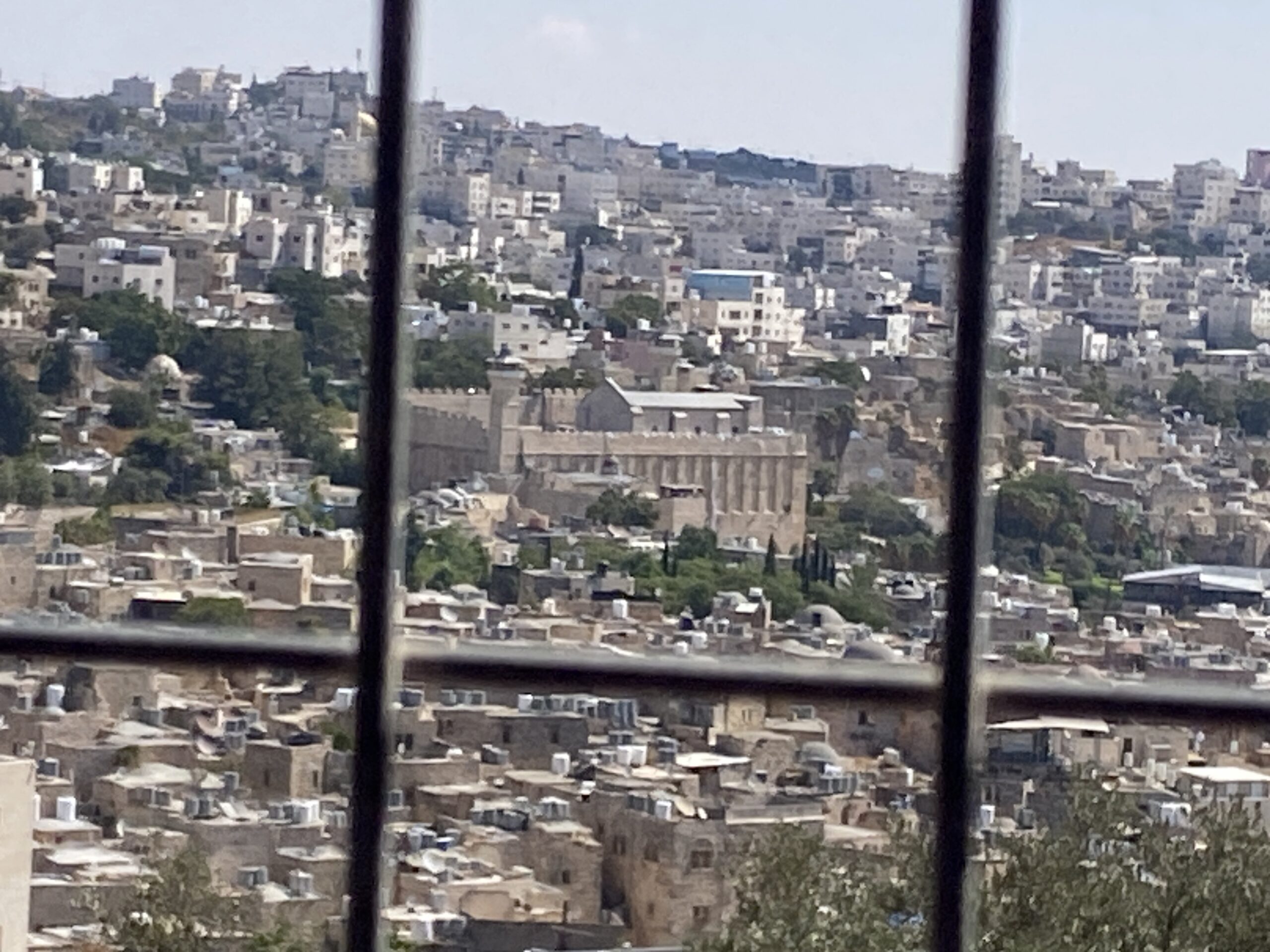 Yael ZoranSep-24-2026Hebron and the Cave of the Patriarchs from Beit Hashalom
-
