
South Hebron
South Hebron Hills and Hebron Thursday 27.4.06 AMObservers: Mira B, Elena L (reporting)6:30 -10:45Summary: In Hebron settlers have torn up the new paving stones from the path leading to Cordoba school. The girls will once again have to walk though dust and mud. The CO who abandoned his CP tried to blame us on his return for the fact that Palestinians had passed freely through the CP during his absence. We were told about a long series of vandalistic behavior by soldiers who, during the last 8 years, have periodically taken over the house of a Palestinian gynecologist.South Hebron HillsThe “security” wall: It begins a little before Shim’ah on the north-est isde of route 60 and prevents any possible access onto route 60 from that direction. But this low wall ( it is 80 cms high) does provide useful cover to snipers.Route 317: On the way home we again saw the wall which begins near Yatir Camp and continues for about8 kms along the northers side of the road. The intention is to continue the erection of the wall for we saw the concrete blocks waiting to be positioned (each one is some 5 meters long). Indeed the wall started again on nearthe approach to the junction with route 60.The necessity of walking long distances to schoolSchool children were observed walking long distances along route 60 in the direction of Dura and al –Fawwar. A very small child was observed walking alone as well.Dahariya CP – closed. A car which had turned off from route 60 tried to get through but had to turn backDura – al-Fawwar: Open to traffic in both directions.No soldiers on the ground. Cement blocks to slow traffic on route 60.Sheep’s Crossing: Open to pedestrians as usual – and to riders on donkeys.A little before Kiryat Arba an army jeep was observed guarding a bulldozer which was blocking access to route 60 with bouldersZif CP: open.HebronTel Romeida (Tarpat -1929) CP: When we arrived at 7:15 there was one detainee- a young man standing on the Israeli side of the CP. The CP was manned by two parachutists. The CO refused to talk to us beyond expressing a basic hostility towards us. The Palestinian man had already been there fore 20 minutes and we began to telephone various army authorities. Although we were unable to get more than recorded answers the activity may have helped because the young man was released while we were still at it.We continued standing there and observed the passage of children and adults through the CP . A CPT volunteer told us that the teachers were now allowed through the side – avoiding the scanner-without any problems. She also told us about the tearing up of the paving near Cordoba school ( see below).We are made responsible for the management of the CP!At about 7:30 the CO of the CP suddenly began to run with gun at the ready towards the Palestinian street. There we saw a Palestinian police car which had stopped. From afar we saw the CO (together with the second soldier) bending down and arguing with the passengers in the police car. The argument continued for about 30 minutes. Meanwhile Palestinians passed through by the side of the CP without any difficulty. When the CO returned to his post he interrogated us as follows: Did you let people go through by the side? Did you talk to any of the persons who went through? We told him that we were not responsible for managing the CP, that we don’t speak Arabic and that anyway he had no right to interrogate us. We walked up to the top of Tel Romeida and encountered a few settlers (three women and a man ) who attacked us verbally in the wildest manner. It is possible that they were induced not to become physical by the presence of a soldier in an army post who was watching them.The house of Dr T.Z. – and the behavior of the army and the settlers On the way down from Tel Romeida we stopped to find out what was happening to a big house covered in part by army netting. The owner invited us inside in order to tell us (and show us evidence) of the activities of the army in his house. He said that since 1998 the army had periodically taken over the house. Recently however they had been coming every day for a few hour only. During the “last holiday”(Passover) they had entered his house and placed an Israeli flag on the roof. Only after a CPT volunteer pleaded with them to take it down did they agree to do so. However, they chose to turn up at 11:30 pm at night to take it down! We went up to the roof (the view across the city is magnificent) and we saw the broken glass of the solar panels (these panels had been repaired more than once by the owner in the past) . Dr Taisir Zahra said the soldiers had thrown the glass shards into the house. He also said that they urinated onto the balcony under the roof. He is a gynecologist whose clinic had been in the house, but the clinic had been closed for the last 8 years because of the difficulty in reaching it; he now maintains his practice in the Palestinian section of the city. He told us about the attacks on his house by settlers and about the constant pressure to get him to move – including the offer of 10 million dollars by an army officer in uniform some years ago, and the offer by someone in the DCO to give him Israeli citizenship on condition that he emigrated to Canada. When he rings the police when the settlers throw stones at his house, he gets no help. The uprooting of the bricks paving the path to Cordoba school and differing versions about the presence of the army We walked up the newly repaired stairs leading to the school and saw that the bricks which had been used to pave the dirt path leading to the school entrance had been torn up and thrown down into the clearing at the bottom of the hill or were strewn along its sides. A woman who worked as a cleaner in the school told us that settlers had done this on Wednesday 26/4/ between 17:00 and 21:00 hours. ‘Apparently they don’t want us to be comfortable” she said in English, and of course without the paving the children and the teachers will once again have to plough through mud in winter on their way to the school.Opposite the hill is an army post which was manned by a parachutist and a border policeman. We asked them why soldiers had not stopped the settlers from carrying our their three-hour act of vandalism the day before. They replied that by chance the post had not been manned at the relevant time. Palestinians whom we spoke to in Shuhada street told us that the army post had been manned but that the soldiers had done nothing.
Hebron
See all reports for this place-
According to Wye Plantation Accords (1997), Hebron is divided in two: H1 is under Palestinian Authority control, H2 is under Israeli control. In Hebron there are 170,000 Palestinian citizens, 60,000 of them in H2. Between the two areas are permanent checkpoints, manned at all hours, preventing Palestinian movement between them and controlling passage of permit holders such as teachers and schoolchildren. Some 800 Jews live in Avraham Avinu Quarter and Tel Rumeida, on Givat HaAvot and in the wholesale market.
Checkpoints observed in H2:
- Bet Hameriva CP- manned with a pillbox
- Kapisha quarter CP (the northern side of Zion axis) - manned with a pillbox
- The 160 turn CP (the southern side of Zion axis) - manned with a pillbox
- Avraham Avinu quarter - watch station
- The pharmacy CP - checking inside a caravan with a magnometer
- Tarpat (1929) CP - checking inside a caravan with a magnometer
- Tel Rumeida CP - guarding station
- Beit Hadassah CP - guarding station
Three checkpoints around the Tomb of the Patriarchs
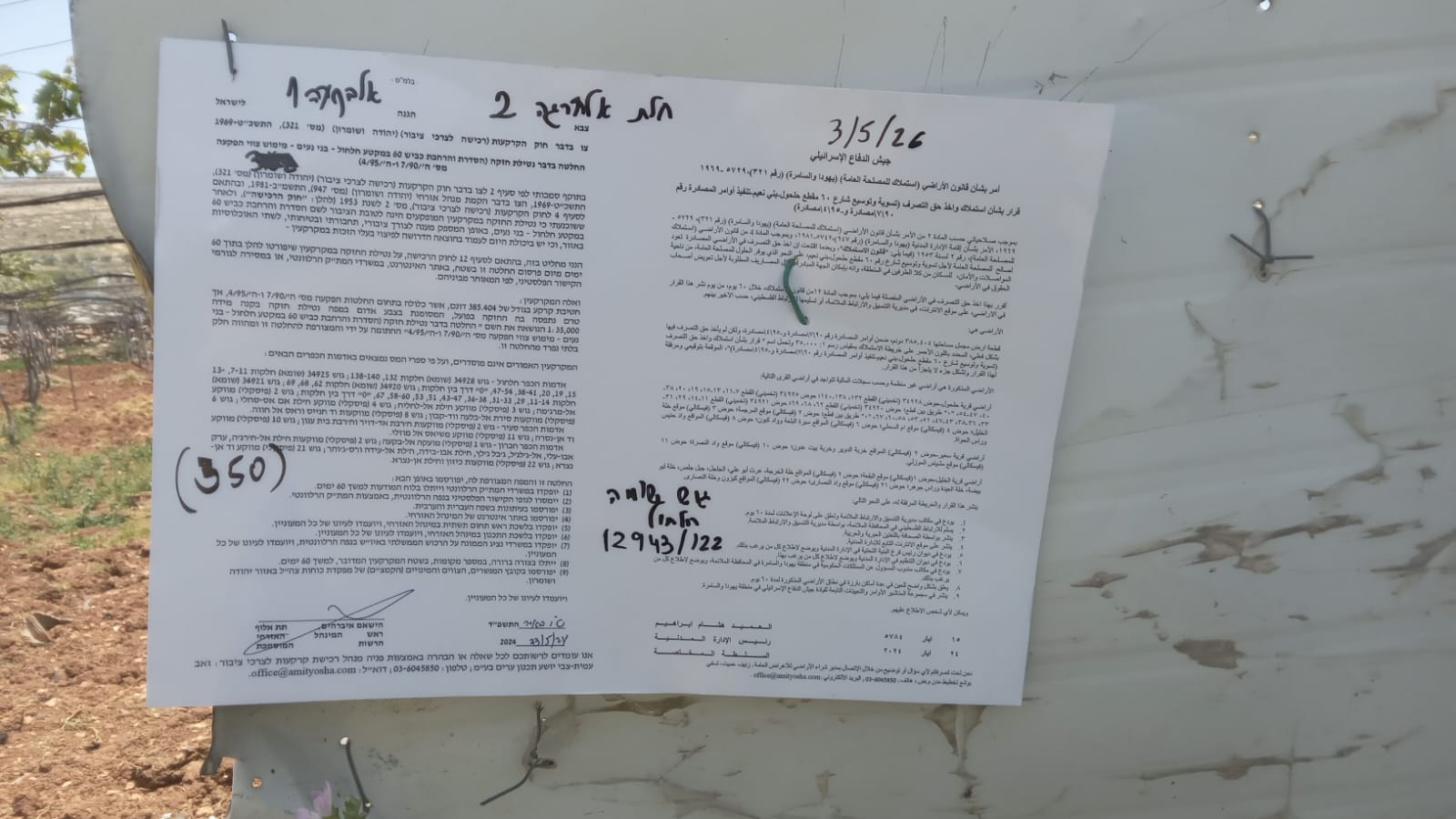 Muhammad D.May-13-2026Hebron - Request for compensation for land expropriation
-
South Hebron Hills
See all reports for this place-
South Hebron Hills
South Hebron Hills is a large area in the West Bank's southern part.
Yatta is a major city in this area: right in the border zone between the fertile region of Hebron and its surroundings and the desert of the Hebron Hills. Yatta has about 64,000 inhabitants.
The surrounding villages are called Masafer Yatta (Yatta's daughter villages). Their inhabitants subsist on livestock and agriculture. Agriculture is possible only in small plots, especially near streams. Most of the area consists of rocky terraces.Since the beginning of the 1980s, many settlements have been established on the agricultural land cultivated by the Palestinians in the South Hebron Hills region: Carmel, Maon, Susia, Masadot Yehuda, Othniel, and more. Since the settlements were established and Palestinians cultivation areas have been reduced; the residents of the South Hebron Hills have been suffering from harassment by the settlers. Attempts to evict and demolish houses have continued, along with withholding water and electricity. The military and police usually refrain from intervening in violent incidents between settlers and Palestinians do not enforce the law when it comes to the investigation of extensive violent Jewish settlers. The harassment in the South Hebron Hills includes attacking and attempting to burn residential tents, harassing dogs, harming herds, and preventing access to pastures.
There are several checkpoints in the South Hebron Hills, on Routes 317 and 60. In most of them, no military presence is apparent, but rather an array of pillboxes monitor the villages. Roadblocks are frequently set up according to the settlers and the army's needs. These are located at the Zif Junction, the Dura-al Fawwar crossing, and the Sheep Junction at the southern entrance to Hebron.
Updated April 2022
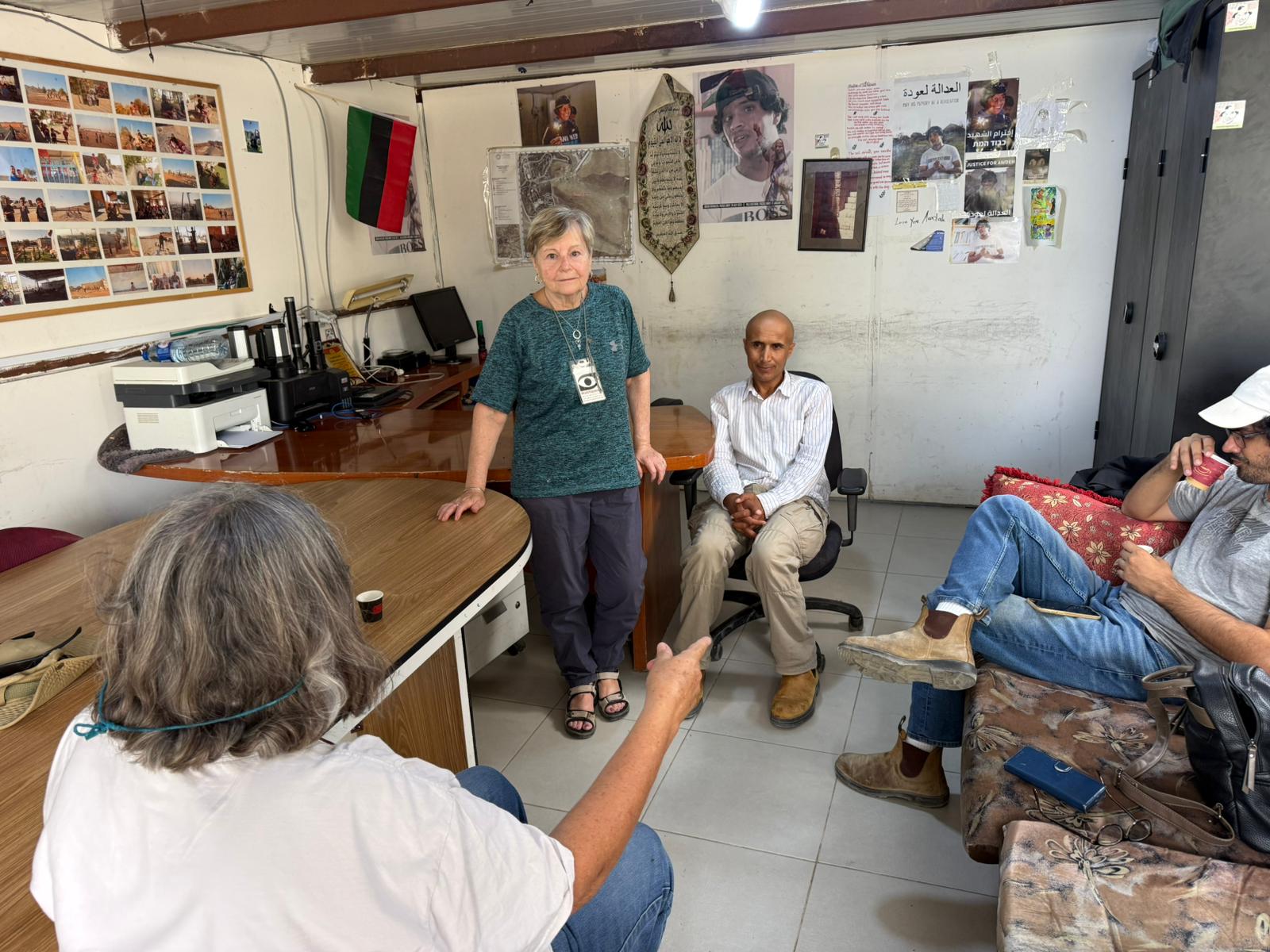 Muhammad D.Aug-30-2026Umm al-Khair, Smadar with Eid, Or and Timna, in the Situation Room
-
