
South Hebron Hills
Southern Hebron Hills and Hebron, Monday, October 16, 2006 Watchers: Hagar L., Nurit W, Hannah A., Ada H. (Tel Aviv group), Judy S., Roni P. ( Jerusalem group), Josie and Hagit B. (southern group) (who also reported).The shift today was combined with a tour of the southern checkpoints.08:15 – 13:30Tarqumiya – the building beyond the border which is actually on the green line continues to be constructed at the present crossing. The last of the families visiting their relatives in prison are passing along the sleeve. While writing this report I hear on the radio that one of the female visitors attempted to stab a female prison guard in Nafha Jail (next to Mitzpe Ramon) and they canceled the visits – and indeed the buses were packed with women and children – maybe due to Ramadan or maybe because they have not yet gone back to school in the Palestinian Authority. Whatever happens at Tarqumiya, the Red Cross representative claims that there are no problems… and so we continue on. The Ministry of Transportation area is empty of cars and the truck passage area only has two trucks – maybe this is a sign of the scope of the poverty…Route 35Idna – Tarqumiya – the gates are open and taxis are moving back and forth – the pillbox is manned by Border Policemen – very little traffic.Halhoul Hebron Bridge – the pillbox is manned – at the glass factory store we met a Christian trader from Jerusalem who told us that he has no problem with the Jewish people, but the Zionists want to expel him from here and because of this there are all the problems at the checkpoints and because of this he as a Christian from Jerusalem is unable to visit the Church of the Nativity in Bethlehem. It is always difficult to hear this and it is always worth holding back from entering into a discussion about this. There was very little traffic. Humanitarian Checkpoint – the pillbox was manned. The checkpoint was closed but from the direction of Route 35 – this is a completely apartheid road – there is nobody to stop because Palestinian cars do not travel here and settler vehicles never stop.We saw no military vehicles at all on the road – there were blockades in place, some of them new – the bulldozer was working.Route 60Eastern Halhoul – the pillbox was manned – there were taxis passing and a few pedestrians.Sair – Hebron ( Girls School ) – very few pedestrians and also very few taxis on both sides.On the road between Shiyuch and the entrance to Kiryat Arba where the small children sell home-style tomatoes a bulldozer is working and a military jeep is protecting it. A long line of cars on Route 60 formed – we did not stop to see because if cars are delayed on this part of the road it is because they are Israeli vehicles and the line was due to road works.HebronTo my innocence I believed that now after the holidays there would be no problem with entering Hebron , but I was wrong. We were unable to complete the tour because I and I. , our driver, were detained. A police patrol accompanied us in the small part that we were able to visit. The presence of eight women – “a left-wing demonstration” scared the military and police and in their opinion we should have obtained a permit. It began at the entrance to Kiryat Arba – as always the guard notified of the fact that we entered and immediately afterwards, when we were next to the pillbox at the beginning of the worshippers route they were already prepared for our presence, so that at the exit a police patrol was waiting for us after asking us whether we had been permitted to enter the worshippers route by foot. I. should have been waiting for us at the parking lot of the Cave of the Patriarchs. When we arrived, he was not there. He had been detained by an army patrol jeep. I could not allow him to be detained and I ran up to him. They took our identity cards away from us and gave them back to us only on condition that we leave Hebron . According to the soldiers, we Jews could remain in Hebron but I. had to remain with the soldiers. This situation was intolerable in my view and I decided we should give up and leave. I. could have continued on the tour. The women “missed” the pharmacy checkpoint, the police man checkpoint, the Abraham the Patriarch neighborhood, the Cardova School , Shuhada Road – the awful abandonment of Hebron .Some of the things we saw – a resident of the house, the second floor of which is under the control of the army at the junction of the Worshippers Route, asked us to come into the house and see how much she is suffering. We will do so on our next visit when we are not accompanied by the police. Apart from this, I know the family and some people are profiting from the military presence there and I am unsure of what intervention is desirable.Another thing I noticed was that they are continuing to lay an electricity wire to the cameras on the road leading from Kiryat Arba to the Cave of the Patriarchs – a digging vehicle was working, guarded by soldiers. The soldiers in Hebron are from the Lavie Brigade and I got angry with them more than was necessary – but the fact that I. our driver had been detained when he was alone simply because he was an Arab made me furious. When I got home I received a call in apology from the commander of the Hebron Police – Eli Zamir. I also received a call from the deputy division commander’s office – maybe they have respect for old women… or for human rights.Route 356An abandoned car in the neighboring fields – an IDF patrol returns from there. There is no traffic and no temporary checkpoints. The cameras above the road are filming us as usual.Route 317The usual blockades are present, reinforced by cement blocks – next to the Zif junction. They removed one block to make it easier to walk to the mosque at the junction.Hirbat Tawani – an Oxfam distribution point – distribution of food. Villagers are waiting with tractors. The road to Liata is open on the fence of the road.There is no vehicle traffic whatsoever – we are “queens of the road”.Beit Yatir Checkpoint – there are no people – construction of the crossing is in full swing. Anti-aircraft soldiers. There is a new list of the A”K family – this time M’ cannot cross – last time it was his brother. I have no intention of intervening in family disputes.Sansana Checkpoint – vehicles to Beersheba freely pass – there are no workers, no people.End of tour. For the most part what we saw was that there were no people. Life goes on in the villages and towns where we cannot go…Thanks to those who came with us – Hagit.
Hebron
See all reports for this place-
According to Wye Plantation Accords (1997), Hebron is divided in two: H1 is under Palestinian Authority control, H2 is under Israeli control. In Hebron there are 170,000 Palestinian citizens, 60,000 of them in H2. Between the two areas are permanent checkpoints, manned at all hours, preventing Palestinian movement between them and controlling passage of permit holders such as teachers and schoolchildren. Some 800 Jews live in Avraham Avinu Quarter and Tel Rumeida, on Givat HaAvot and in the wholesale market.
Checkpoints observed in H2:
- Bet Hameriva CP- manned with a pillbox
- Kapisha quarter CP (the northern side of Zion axis) - manned with a pillbox
- The 160 turn CP (the southern side of Zion axis) - manned with a pillbox
- Avraham Avinu quarter - watch station
- The pharmacy CP - checking inside a caravan with a magnometer
- Tarpat (1929) CP - checking inside a caravan with a magnometer
- Tel Rumeida CP - guarding station
- Beit Hadassah CP - guarding station
Three checkpoints around the Tomb of the Patriarchs
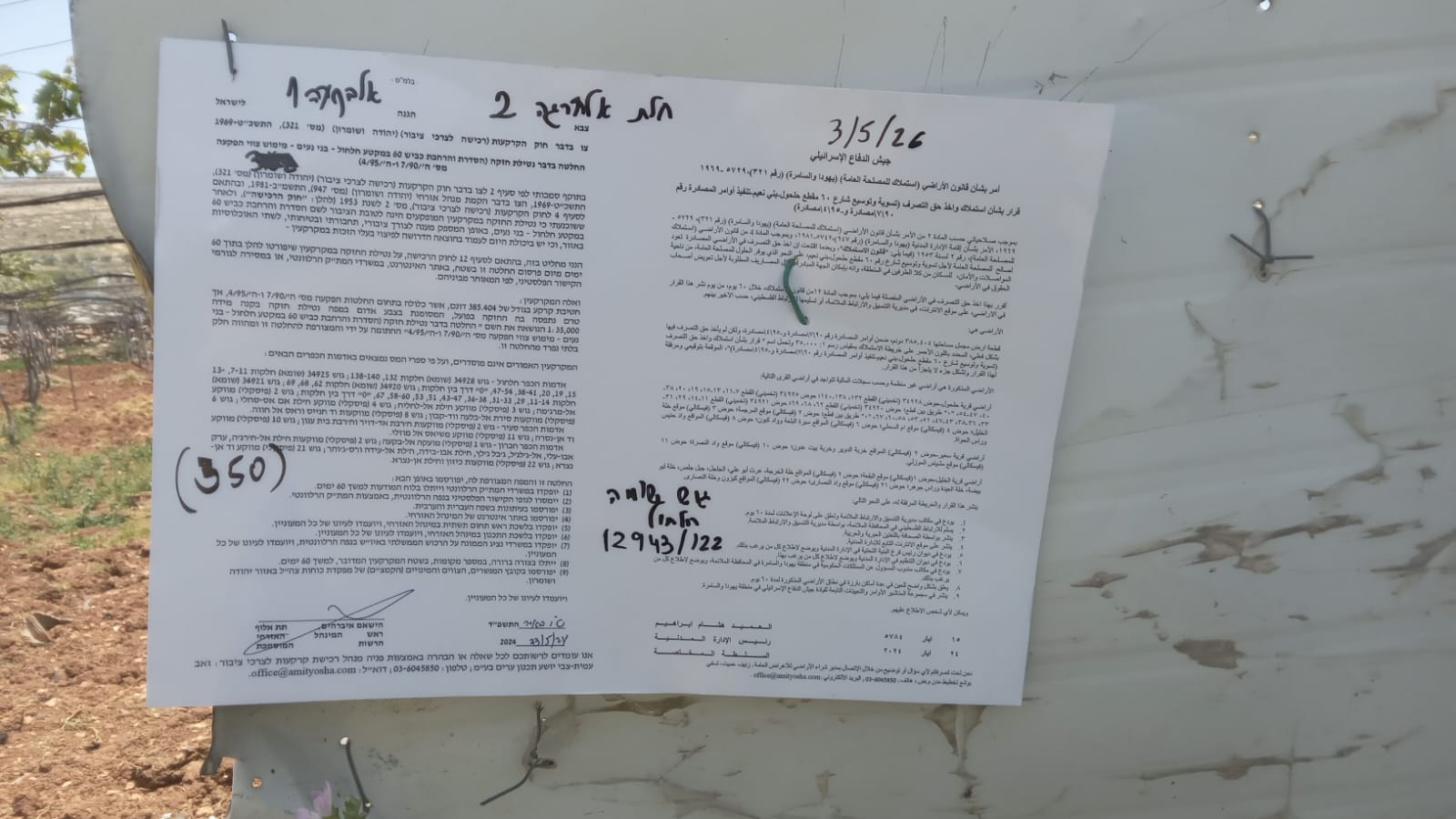 Muhammad D.May-13-2026Hebron - Request for compensation for land expropriation
-
Jerusalem
See all reports for this place-
The places in East Jerusalem which are visited routinely by MachsomWatch women are Silwan and Sheikh Jarrah. During the month of Ramadan, also the Old City and its environs are monitored.
-
