
South Hebron Hills: Independence Day Eve on Route 60, flags on the road and homes under siege
-
- Road 60 as well as 317 are lined with Israeli flags all along. That is what de-facto annexation looks like (accompanied by ethnic cleansing).
- Entrances to Palestinian localities are blocked by metal yellow gates: Samu’a, Simiya, Dhahariya, Abdah. Palestinian vehicles that try to bypass such barriers via dirt tracks are stopped by the Israeli army. Their keys are confiscated, the drivers punished by standing for many hours, keys are either given back or not. In the meantime, the stopped vehicle blocks the breakthrough. We are told of the trick: hold another key in your pocket and try to get away. At the Dura / Al Fawwar Junction we meet R., of the Ifqayaqis clan near Negohot settlement, the compound of which is blocked on all sides by the settlers. Since one cannot get to them with food, we give them cash which the mother sends with her brother. She and her sisters work at Dura and rent an apartment there. Since October 7, 2023 she has nearly never been home. She printed the final certificates for Huda’s kindergarten children as they graduate and face first grade at school. Mohammad will bring the certificates to the kindergarten next week.
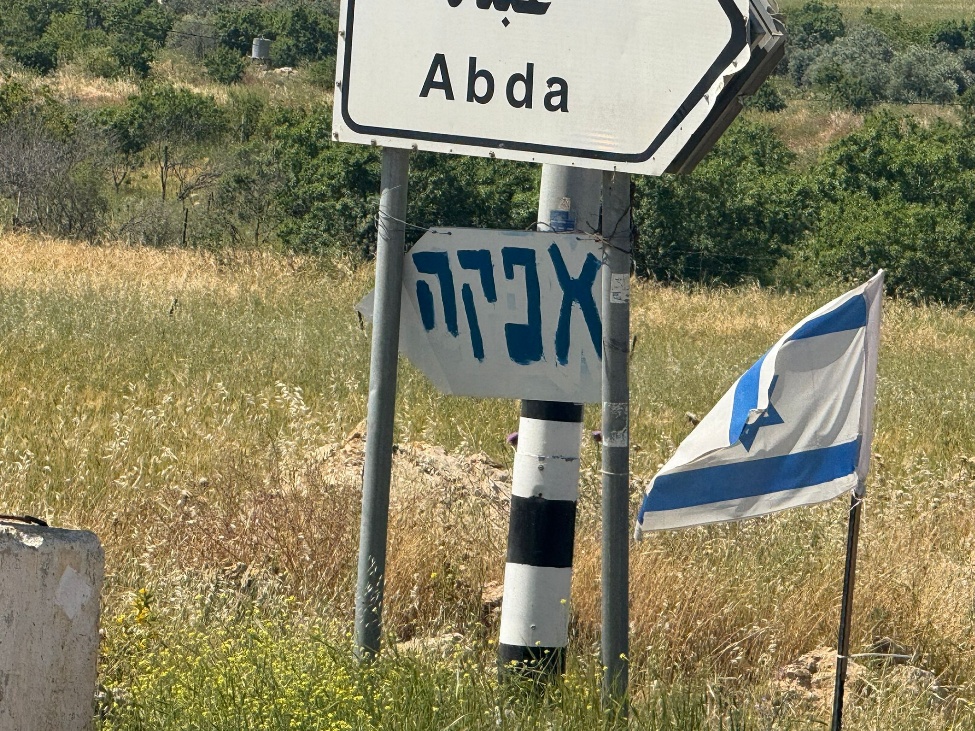
- At Adorayim Junction, a sign directs us to a new outpost, Mitzpe Reuven, south of Adorayim across the road. Opposite Abdah, too, stands a new sign directing one to a new outpost, Afeka. The entire area is filled with new such outposts.
4. Visiting F. in Simiya: This village has two schools both sides of Road 60. His wife operates the kiosk in one of them, while his son works there as a janitor. F. personally has a hard time eking out a livelihood from farming. He used to have a taxi cab but there is no work at present so that is no solution. He has ground near the road which he cannot tend because people pass there and trample it. Opposite us, on the other side of the road, G.’s compound, settlers have introduced cattle that finished off all the potatoes he used to grow. F. reports two incidents:
On the eve of Independence Day, two settlers placed Israeli flags along the road. One of them rode and placed them there while the other followed and suck them in the ground.
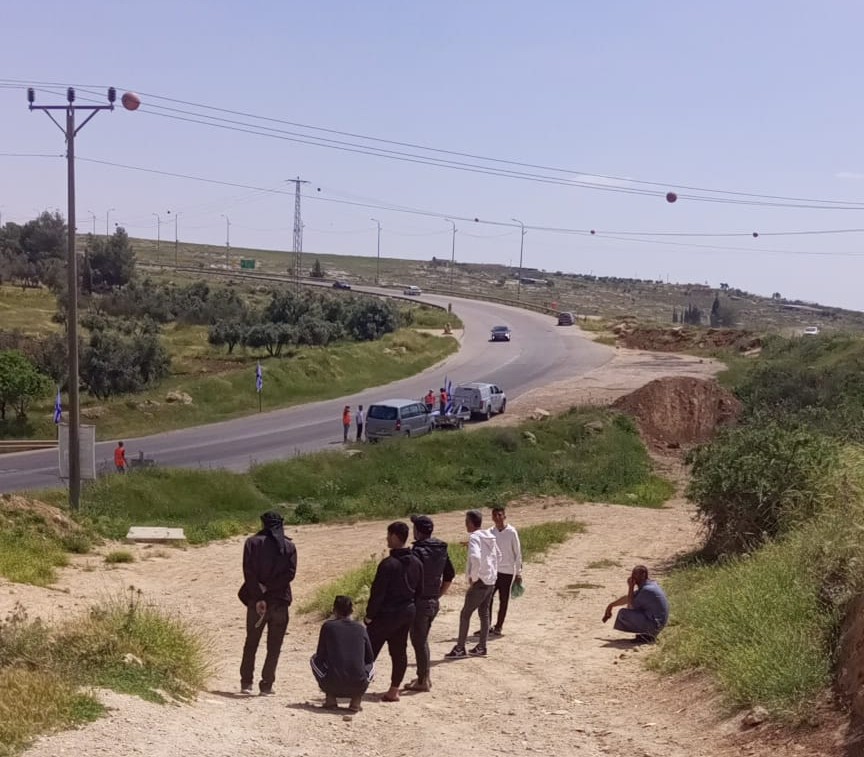
the settlers ran after children in the village, claiming they had stolen the flags.
They tried to break into F.’s house. His daughter was home and locked the door, so they emptied the drinking water buckets outside.
Their neighbors have a pump for getting water from the water hole, and a settler took it apart and tried to steal it. F. was in his greenhouses at the time. They called him and he came home immediately. The settlers demanded IDs, so his brother- in-law gave his, while F. refused. Settlers chased his grandson who was walking toward the shop near the road. F. showed them a flag with which girls had been playing, not stealing anything. The army was summoned, F. reported that his ID was taken, the army took the ID from the settler and gave it back to its owner. One of the settlers apologized, perhaps for fear of the army…
Yesterday afternoon saw an incident in nearby Deir Shams, of which F. knows through their regional communication network. A. from Shweika has an olive grove there. He came to chase away a settler who keeps entering the tree grove with his vehicle. The settler invited an auxiliary force of more settlers. They beat up A. and his son. The army came and arrested A., his son is now hospitalized in Soroka. Out of fear, Palestinians did not video this attack. The settlers ruined all the olive trees. Incidentally, M.’s brother once purchased a plot with a house at Deir Shams when it was lucrative to do so, but does not really go there.
5. A flock of cattle belonging to Yinon Levy of the Meitarim outpost (this is the murderer of Aude Hadhaleen from Umm al Khair) now grazes where Zanuta was once situated and has been depopulated, displaced.
Location Description
South Hebron Hills
See all reports for this place-
South Hebron Hills
South Hebron Hills is a large area in the West Bank's southern part.
Yatta is a major city in this area: right in the border zone between the fertile region of Hebron and its surroundings and the desert of the Hebron Hills. Yatta has about 64,000 inhabitants.
The surrounding villages are called Masafer Yatta (Yatta's daughter villages). Their inhabitants subsist on livestock and agriculture. Agriculture is possible only in small plots, especially near streams. Most of the area consists of rocky terraces.Since the beginning of the 1980s, many settlements have been established on the agricultural land cultivated by the Palestinians in the South Hebron Hills region: Carmel, Maon, Susia, Masadot Yehuda, Othniel, and more. Since the settlements were established and Palestinians cultivation areas have been reduced; the residents of the South Hebron Hills have been suffering from harassment by the settlers. Attempts to evict and demolish houses have continued, along with withholding water and electricity. The military and police usually refrain from intervening in violent incidents between settlers and Palestinians do not enforce the law when it comes to the investigation of extensive violent Jewish settlers. The harassment in the South Hebron Hills includes attacking and attempting to burn residential tents, harassing dogs, harming herds, and preventing access to pastures.
There are several checkpoints in the South Hebron Hills, on Routes 317 and 60. In most of them, no military presence is apparent, but rather an array of pillboxes monitor the villages. Roadblocks are frequently set up according to the settlers and the army's needs. These are located at the Zif Junction, the Dura-al Fawwar crossing, and the Sheep Junction at the southern entrance to Hebron.
Updated April 2022
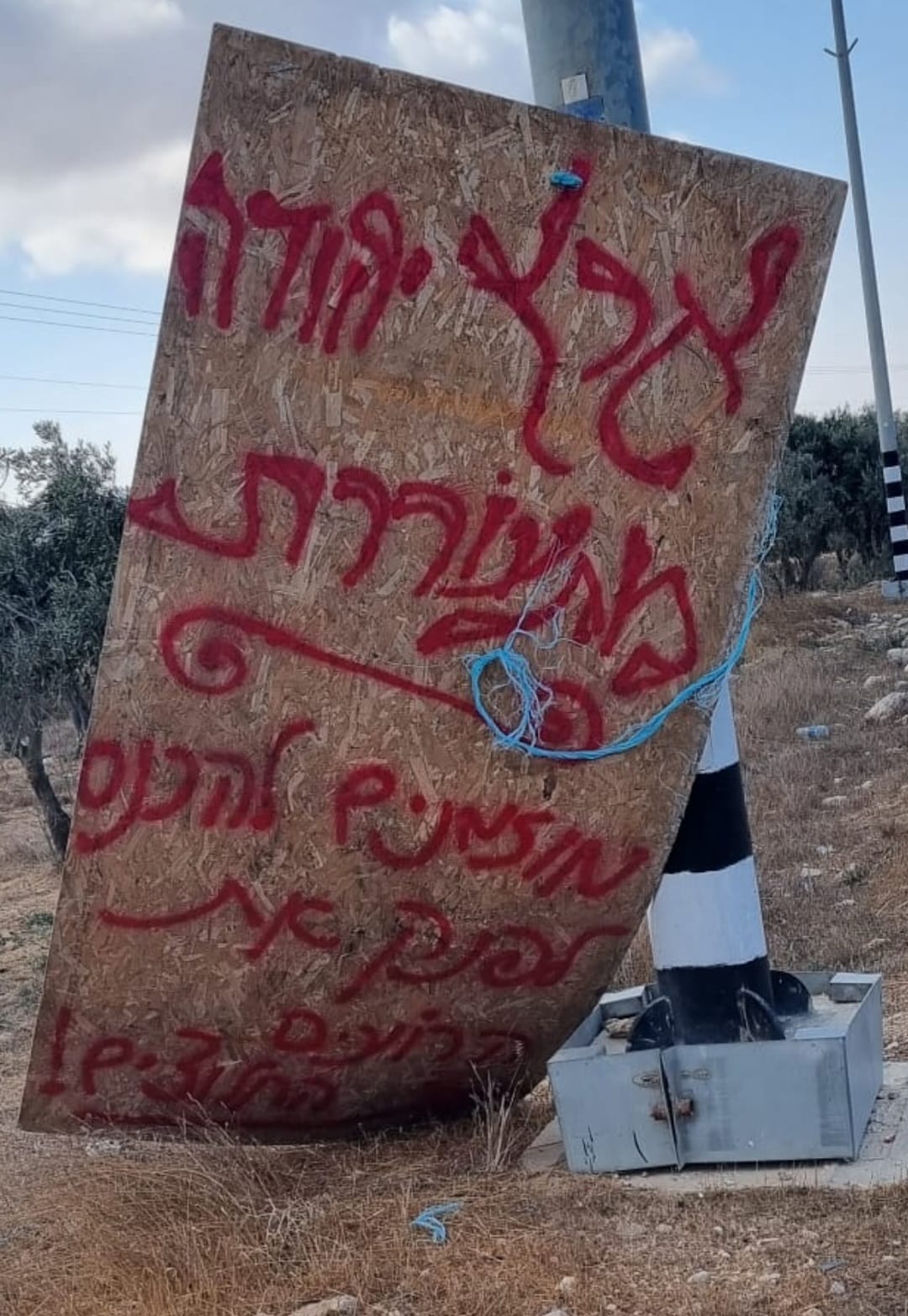 Smadar BeckerOct-17-2026A sign placed by those who call themselves the Pioneer Shepherds, at the outpost adjacent to Qawawis
-
