
South Hebron Hills, Mon 2.8.10, Morning
Southern Hebron Hills, Monday
Translator: Charles K.
Construction continues apace in the "Meitarim" industrial zone. Many laborers adding a second and third storey to an industrial building.
Southern Hebron Hills
We stopped at Haj Shuad's tent next to the rear fence of the Carmel settlement, among those on the margin of the village of Umm al Hir. The first to arrive came from the Tel Arad region in 1948, and stayed there.
A few days ago Haj held a celebration for one of his sons who'd completed his studies and successfully passed his test. The celebration, including music and fireworks, annoyed the neighbors from Carmel, so soldiers from the Israel Defense Forces were sent to the tent. The party stopped, all the men were taken to the nearby road , and the soldiers also searched the tent and its vicinity for weapons.
Pipes carrying water to irrigate olive trees in Carmel and for chicken coops outside the settlement's fence run past the tent. Water for the Bedouin? None.
The UN's Mutihada organization helps Bedouin students study in university. Haj Shuad has three sons studying – medicine, agricultural engineering and construction engineering. It's very hard to find a job in the area.
Hashem al Daraj
Eid, a nice 26 year old man who's in contact with all the peace organizations, joined us on our way to the kindergarten in Hashem al Daraj. The village mukhtar and Huda, the lovely kindergarten teacher, already awaited us there. The mukhtar said the Bedouin had gotten along with all the Israeli governments until 2003, and there's nothing new about Israelis coming to the area. The desperately need help because of the difficult situation; God willing it will improve, because the village is now recognized in Area C and they're seeking contributors. There's an urgent need to construct buildings for the kindergarten and the clinic. The villages have no contact with the outside world, which is why every visit is a happy and encouraging occasion. The kindergarten was built by UNRWA. It's a room 4 meters square, a blackboard on the wall and 25 plastic chairs. Very few games. The first impression is not of a kindergarten. Mira suggested coming to run an art workshop, paint the kindergarten together with them, inside and out. Any activity would be welcome. The mukhtar and the villagers will be happy to host us and other in the village. They want us to keep coming. To arrange a meeting, call Eid, who speaks fluent Hebrew. He'd be happy to get calls at 052-204-5664.
South Hebron Hills
See all reports for this place-
South Hebron Hills
South Hebron Hills is a large area in the West Bank's southern part.
Yatta is a major city in this area: right in the border zone between the fertile region of Hebron and its surroundings and the desert of the Hebron Hills. Yatta has about 64,000 inhabitants.
The surrounding villages are called Masafer Yatta (Yatta's daughter villages). Their inhabitants subsist on livestock and agriculture. Agriculture is possible only in small plots, especially near streams. Most of the area consists of rocky terraces.Since the beginning of the 1980s, many settlements have been established on the agricultural land cultivated by the Palestinians in the South Hebron Hills region: Carmel, Maon, Susia, Masadot Yehuda, Othniel, and more. Since the settlements were established and Palestinians cultivation areas have been reduced; the residents of the South Hebron Hills have been suffering from harassment by the settlers. Attempts to evict and demolish houses have continued, along with withholding water and electricity. The military and police usually refrain from intervening in violent incidents between settlers and Palestinians do not enforce the law when it comes to the investigation of extensive violent Jewish settlers. The harassment in the South Hebron Hills includes attacking and attempting to burn residential tents, harassing dogs, harming herds, and preventing access to pastures.
There are several checkpoints in the South Hebron Hills, on Routes 317 and 60. In most of them, no military presence is apparent, but rather an array of pillboxes monitor the villages. Roadblocks are frequently set up according to the settlers and the army's needs. These are located at the Zif Junction, the Dura-al Fawwar crossing, and the Sheep Junction at the southern entrance to Hebron.
Updated April 2022
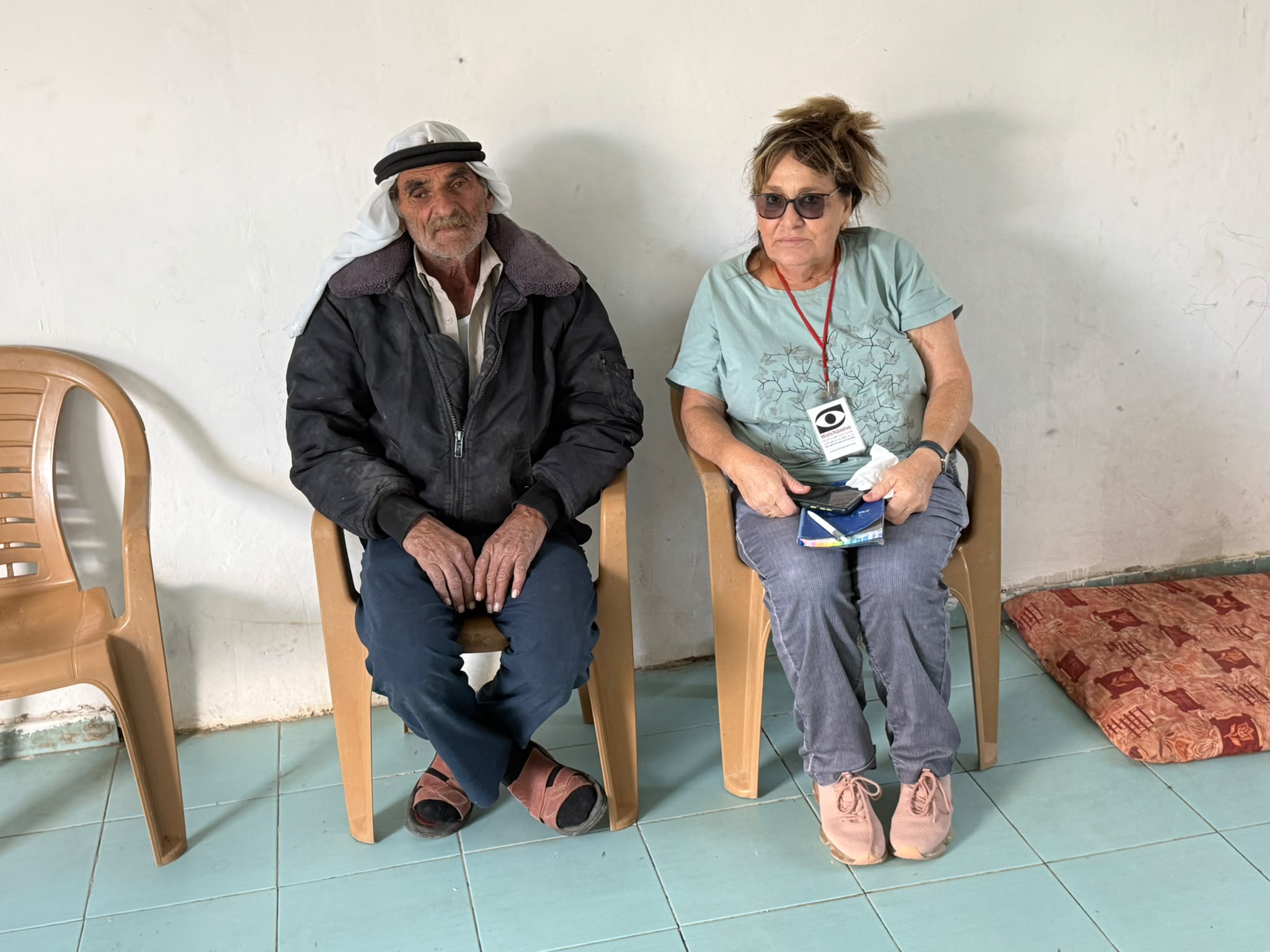 Muhammad D.Oct-29-2026Michal in Shaab Al-Butum with Ishaq Jabarin
-
