
South Hebron Hills, Sat 18.4.09, Morning
Sansana-Meytar CP:
CP is almost empty and looks rather deserted.
Road 60:
The activity of several leftists enlivens the district today. Several police Sufa vehicles (Israeli-made Jeeps) and several military vehicles drive back and forth. We try to understand what happened, that might explains such massive presence of security forces and gather that several activists tries to do some agriculture works next to the illegal settlement of Assael, whose residents are recently busily engaged in attempts to extend.
Obviously, such activity awakens the entire district. The Brigade commander has signed several decrees and effectively, the entire South Hebron mount is under a closed-military-zone decree.
The policemen proudly present us with the valid and properly signed decree.
Sousia: a large group of Israelis and Palestinians is present here: they've arrived here with a guided tour of "Breaking the Silence" and "Fighters for Peace" (two Israeli peace NGO). The policemen, as part of a special gesture, have allowed them into Sousia, but will now not allow the tour to proceed, insisting it must return to Jerusalem. Following some negotiations, the tour proceeds regardless, under heavy military escort. At the observation point, next to the illegal outpost Avigail, the soldiers prohibit stopping, as they do at the highest spot, next to the transit station at the entry to Ma'on Farm and, obviously along the side of the road too. In short, both soldiers and policemen make the lives of the tour participants and guides alike so unbearable that they can nothing but turn back home. As they leave Sousia, follows some more negotiations between the tour's guides and the policemen, one of the guides' ID, as well as those of the bus drivers are confiscated. This is how the policemen ensure "good behavior" and obedience.
The tour goes on now, to its end-point at Simiya, where Israelis and Palestinians sit together under the olive trees for a joint lunch. As the buses leave for Jerusalem, the guide from "Breaking the Silence" is handed back his ID. The drivers, however, are not treated likewise — their IDs stay with the policemen who promise to escort the buses and hand them over to the drivers when they leave the area. At the Sheep's Juncture, the bus driver stops the vehicle: the police van has vanished, and his ID – what's with it?!
After waiting for about 15min., a police van drives past at high speed. The bus driver chases it. At the entry to Halhul, the policemen stop. Following some talk, it transpires that the documents are not with them anyway. Let the driver wait some more.
15min. later, a second van drives past. The IDs are returned to their owners and the tour's participants can finally make their way back home.
The quantities of fuel burnt by police cars that day are difficult to estimate, but they were considerable – and all, at our expense of course, citizens of this clumsily administered country.
South Hebron Hills
See all reports for this place-
South Hebron Hills
South Hebron Hills is a large area in the West Bank's southern part.
Yatta is a major city in this area: right in the border zone between the fertile region of Hebron and its surroundings and the desert of the Hebron Hills. Yatta has about 64,000 inhabitants.
The surrounding villages are called Masafer Yatta (Yatta's daughter villages). Their inhabitants subsist on livestock and agriculture. Agriculture is possible only in small plots, especially near streams. Most of the area consists of rocky terraces.Since the beginning of the 1980s, many settlements have been established on the agricultural land cultivated by the Palestinians in the South Hebron Hills region: Carmel, Maon, Susia, Masadot Yehuda, Othniel, and more. Since the settlements were established and Palestinians cultivation areas have been reduced; the residents of the South Hebron Hills have been suffering from harassment by the settlers. Attempts to evict and demolish houses have continued, along with withholding water and electricity. The military and police usually refrain from intervening in violent incidents between settlers and Palestinians do not enforce the law when it comes to the investigation of extensive violent Jewish settlers. The harassment in the South Hebron Hills includes attacking and attempting to burn residential tents, harassing dogs, harming herds, and preventing access to pastures.
There are several checkpoints in the South Hebron Hills, on Routes 317 and 60. In most of them, no military presence is apparent, but rather an array of pillboxes monitor the villages. Roadblocks are frequently set up according to the settlers and the army's needs. These are located at the Zif Junction, the Dura-al Fawwar crossing, and the Sheep Junction at the southern entrance to Hebron.
Updated April 2022
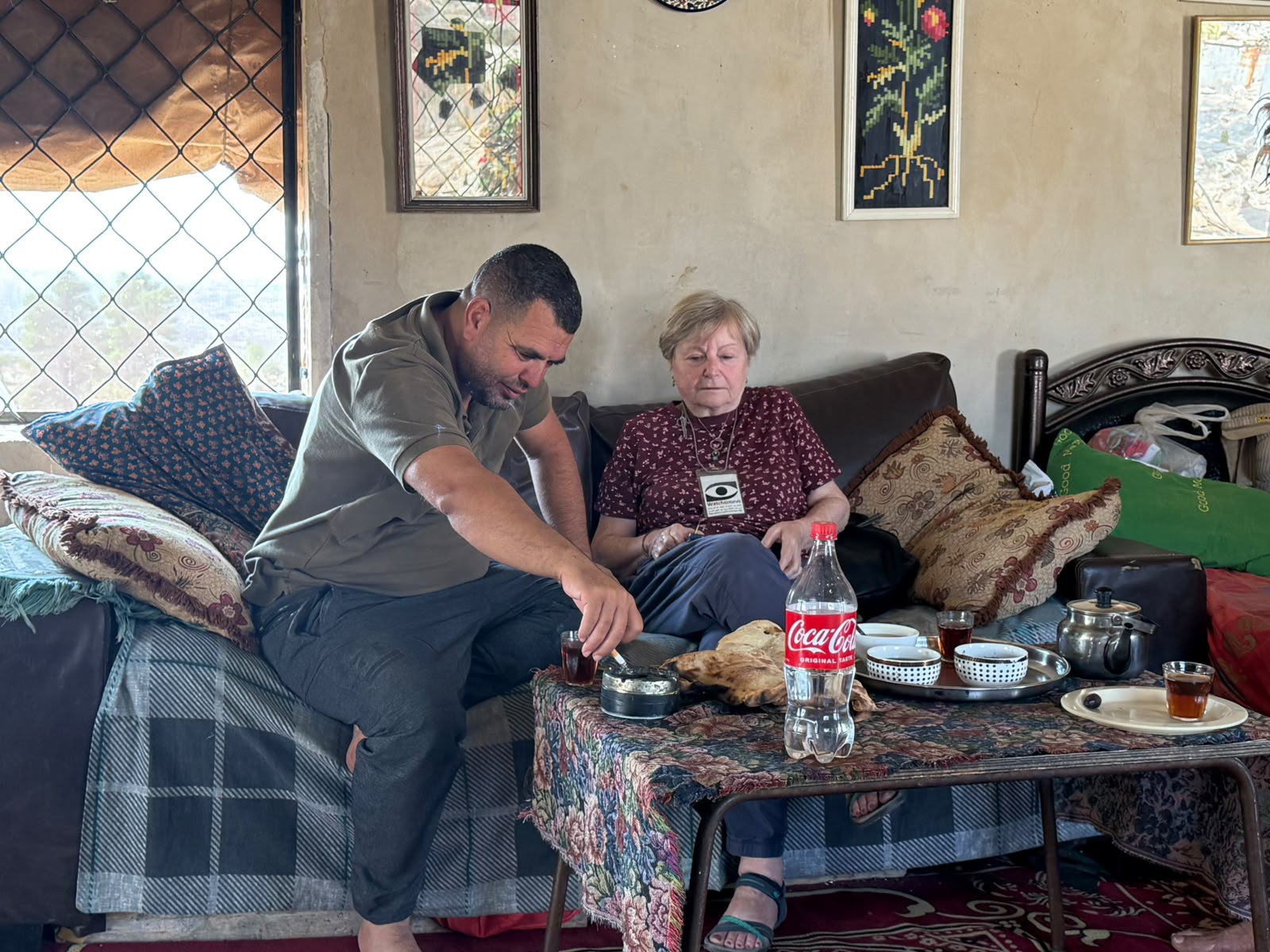 Muhammad D.Oct-24-2026Smadar with Nasr Nawaja'a, in Susiya
-
