
South Hebron Hills, Sun 10.2.13, Morning
Translator: Charles K.
Meitar-Sansana crossing
We arrived at the Meitar crossing at 06:37. The crossing was quiet until they began allowing the wives of inmates to cross. Then, even though it was already 07:00 and the last of the laborers had arrived, a small knot of people formed. We drove back to the Israeli side where Yuval Shitrit, the shift manager, opened an additional lane and eased the congestion. More than 5000 people crossed today. Even though the number of laborers crossing to work in Israel is rising, the crossing process proceeds fairly rapidly.
Southern Hebron Hills
We drive to Tawwani to see whether the children traverse the route between the Ma’on settlement and Ma’on farm with no problems. We decided to go into the school, arriving during morning exercise. We were invited to the office of the principal, Iyad Masri, whose family came from Egypt about 150 years ago.
He told us that transportation for the children from Al Fajjar, Sussiya and Karmel is organized by the Palestinian Authority; only the children from Umm Tuba still walk between the Ma’on settlement and Ma’on farm. The Palestinian liason officers haven’t been able to arrange transportation for the children from Umm Tuba.
South Hebron Hills
See all reports for this place-
South Hebron Hills
South Hebron Hills is a large area in the West Bank's southern part.
Yatta is a major city in this area: right in the border zone between the fertile region of Hebron and its surroundings and the desert of the Hebron Hills. Yatta has about 64,000 inhabitants.
The surrounding villages are called Masafer Yatta (Yatta's daughter villages). Their inhabitants subsist on livestock and agriculture. Agriculture is possible only in small plots, especially near streams. Most of the area consists of rocky terraces.Since the beginning of the 1980s, many settlements have been established on the agricultural land cultivated by the Palestinians in the South Hebron Hills region: Carmel, Maon, Susia, Masadot Yehuda, Othniel, and more. Since the settlements were established and Palestinians cultivation areas have been reduced; the residents of the South Hebron Hills have been suffering from harassment by the settlers. Attempts to evict and demolish houses have continued, along with withholding water and electricity. The military and police usually refrain from intervening in violent incidents between settlers and Palestinians do not enforce the law when it comes to the investigation of extensive violent Jewish settlers. The harassment in the South Hebron Hills includes attacking and attempting to burn residential tents, harassing dogs, harming herds, and preventing access to pastures.
There are several checkpoints in the South Hebron Hills, on Routes 317 and 60. In most of them, no military presence is apparent, but rather an array of pillboxes monitor the villages. Roadblocks are frequently set up according to the settlers and the army's needs. These are located at the Zif Junction, the Dura-al Fawwar crossing, and the Sheep Junction at the southern entrance to Hebron.
Updated April 2022
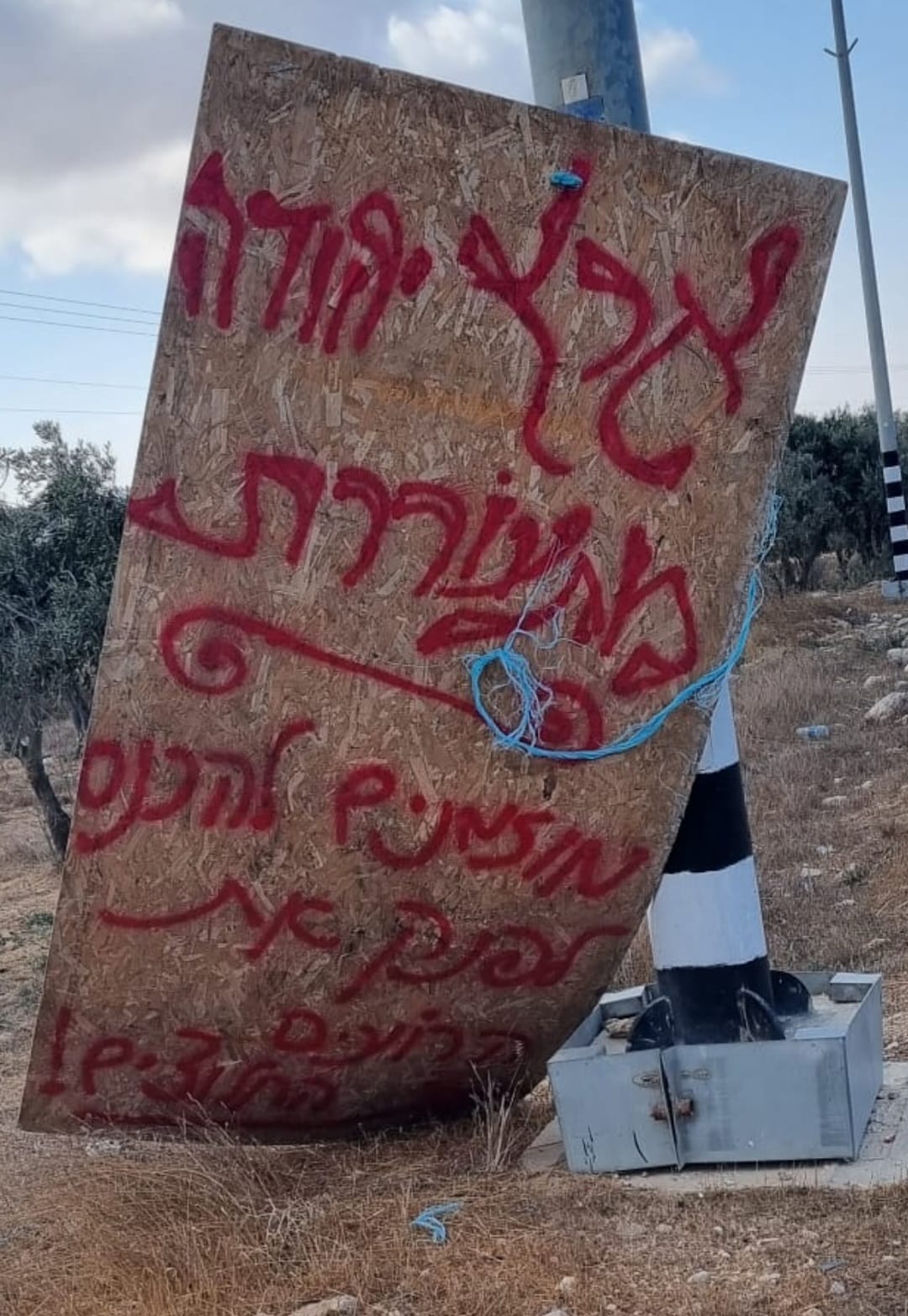 Smadar BeckerOct-17-2026A sign placed by those who call themselves the Pioneer Shepherds, at the outpost adjacent to Qawawis
-
