
South Hebron Hills, Thu 15.12.11, Morning
Huda' kindergarten Workshop
8:45-13:30
Purpose of Shift: Activity in Huda' kindergarten for the 6th time this year, with the assistance of Eid & Huda.
Road 317:
The bus stop at the entrance to the illegal outpost Eshtamoa has been upgraded.
Hashem Al-Darj:
Construction on the new building being built by UNRWA is progressing. The walls have been plastered. It seems that they've agreed to our position of first completing the first floor, so that the preschool would finally be able to move to a suitable facility (which would also allow us to store supplies for preschool activities). About 16 children are present in the preschool. Huda and the children are happy to see us. Some of them gladly shake our hands. Gradually we become friends.
Activity Topic: Illustrative activity using music and movement, utilizing games and percussion instruments. The activity is partly based on instruction by L., who is a music therapist. We brought percussion instruments and a real xylophone with us.
Activity Plan: The illustrative activity is focused on “wind”. Reading of a topical story, illustrating types of wind using voice, movement, and musical playing. As usual, all activity is documented in detail on a page in both Hebrew and Arabic. Our hope is that by the end of the year we will have a rich collection of preschool activities that can be used by future preschools in the Southern Hebron Hills (and will serve to strengthen the Palestinian residents' foothold).
Huda read the story of “Rasha's Hat”: Which Blew in the Wind. This story has been read previously – we used it in the activity about the Winter season. It was clear that the children recognized the story, and participated. At the end, Huda organized the children well, in making vocal impressions of different types of wind (see photos).
From this point on, the activity focused on the song about calm and stormy winds which was translated also into Arabic. The main point here is the mood created by the song: It is easy to distinguish, by the song's melody, between calm and stormy winds.
1. We played a game requiring different behavior depending on the type of wind in the song: A sheet held by the children which is shaken according to the level of the wind in the song. Other versions of the game involve a ball as well as a child on the sheet (see photos).
2. We demonstrated the percussion instruments. We asked the children to play the instruments following the wind intensity in the melody — play softly when it's a calm wind and wildly — when the wind is so.
3. Finally, it was the xylophone's turn. We played the same song and explained how the sounds are generated. Then, each child, as well as the adults, took their turn playing (see photos). Playing the xylophone was quite moving.
To conclude the activity: Huda asked the children questions on methods of movement and voice which depict various types of wind. Throughout the activity we saw a clear tendency of the children to loosen up both vocally and in movement. Toward the end, the children demonstrated winds at different intensities almost without inhibition.
Photos (Nurit, Muhammad): December 15th album:
https://picasaweb.google.com/115469912026094971633?authkey=Gv1sRgCPzNi8HWpLaXzgE
“Staff” meeting:
After the children left we sat comfortably and had coffee, courtesy of Muhammad, ate cookies, and discussed the takeaways from the activity. We were all fairly enthusiastic. The next workshop: Thursday, Dec. 29. The next workshop topic: My Home. It will include “construction” of a house out of milk cartons. It will necessitate more help from the staff, because the construction is a bit complex. It will also have an aspect of conscious choice by the children of how to decorate the house.
Our Own Summary: We feel satisfaction. We feel that something has been created here, and that we are providing a significant contribution to this community and its children, who, as a result of the occupation and of leaving and being displaced from the Arad area, have been forgotten by the wayside.
South Hebron Hills
See all reports for this place-
South Hebron Hills
South Hebron Hills is a large area in the West Bank's southern part.
Yatta is a major city in this area: right in the border zone between the fertile region of Hebron and its surroundings and the desert of the Hebron Hills. Yatta has about 64,000 inhabitants.
The surrounding villages are called Masafer Yatta (Yatta's daughter villages). Their inhabitants subsist on livestock and agriculture. Agriculture is possible only in small plots, especially near streams. Most of the area consists of rocky terraces.Since the beginning of the 1980s, many settlements have been established on the agricultural land cultivated by the Palestinians in the South Hebron Hills region: Carmel, Maon, Susia, Masadot Yehuda, Othniel, and more. Since the settlements were established and Palestinians cultivation areas have been reduced; the residents of the South Hebron Hills have been suffering from harassment by the settlers. Attempts to evict and demolish houses have continued, along with withholding water and electricity. The military and police usually refrain from intervening in violent incidents between settlers and Palestinians do not enforce the law when it comes to the investigation of extensive violent Jewish settlers. The harassment in the South Hebron Hills includes attacking and attempting to burn residential tents, harassing dogs, harming herds, and preventing access to pastures.
There are several checkpoints in the South Hebron Hills, on Routes 317 and 60. In most of them, no military presence is apparent, but rather an array of pillboxes monitor the villages. Roadblocks are frequently set up according to the settlers and the army's needs. These are located at the Zif Junction, the Dura-al Fawwar crossing, and the Sheep Junction at the southern entrance to Hebron.
Updated April 2022
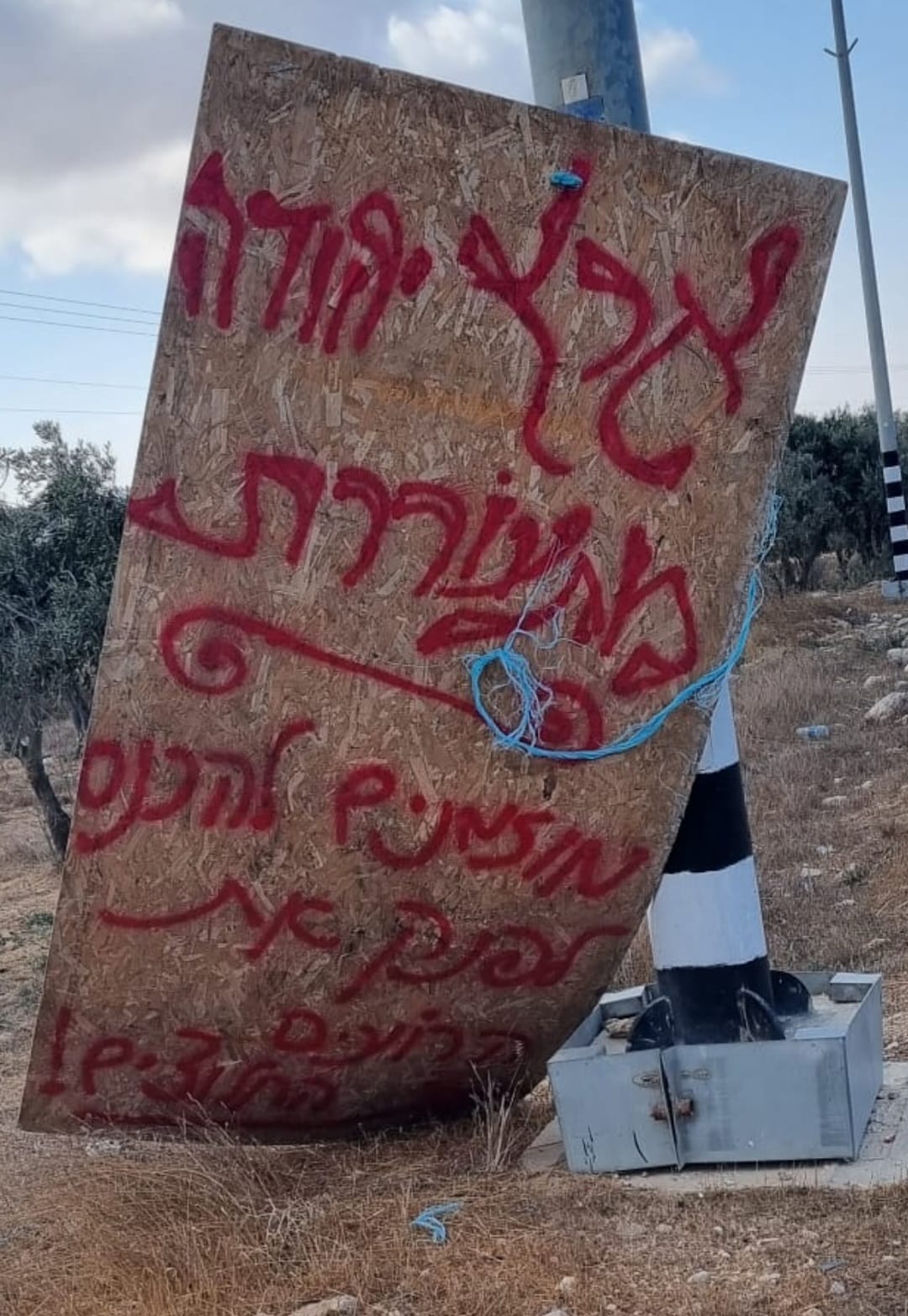 Smadar BeckerOct-17-2026A sign placed by those who call themselves the Pioneer Shepherds, at the outpost adjacent to Qawawis
-
