
South Hebron Hills, Tue 27.7.10, Morning
Southern Hebron Hills,
Translator: Charles K.
The Jabbar family's struggle to survive in the Biq'a (the agriculture area below Kiryat Arba)
After the events of recent days (cf. reports from 19-20.7.10), Mekorot staff, accompanied by the Border Police, again showed up to tear out and remove irrigation pipes and drip irrigation devices. We decided to focus on the family's story.
Karin, who also volunteers for "Makom," joined the shift in order to hear exactly what the family has been going through, at first hand, to see whether there's anything they can do to help the family in its struggle.
We sat with the family for about two hours, during which Atta and his brothers recounted the history of the family's contacts with the settlers and the state from the day Kiryat Arba was established in 1972, until today. Since Karin is writing the detailed report, we'll provide only a brief account.
The state of Israel is systematically chewing up their land. First to build the "Giv'at Ha'harsina" neighborhood, then to construct Route 60. Later, the vineyards "were too close" to the neighborhood, according to the Israeli authorities, so they were cut down and the family was forbidden to cultivate the land. Recently a large, productive orchard was destroyed to construct the terraces surrounding the "Nofey Mamreh" neighborhood. The family stubbornly remains on its land and lives off its produce, but now they've become water thieves – in an attempt to get rid of them. Maybe that will make them tired of living?! Why don't they understand that they have to leave because Kiryat Arba has to grow?
Their explanations – that the water comes from a well and from tanker trucks they pay for – don't help, nor is there any way they're able to connect to water coming from Mekorot. So, the state of Israel sends soldiers and police, armed and protected, to allow "our stalwart lads" to uproot, tear and dismantle any equipment that enables the Jabber family to raise squash, beans, tomatoes and grapes. Thus, in a small house to which temporary additions have been stuck to house three brothers crowded in with their families, they cling to their land and refuse to leave. They even showed us the bill of sale from Turkish times and the cave in which their grandfather lived. Yasser Jabber showed us how a family of five crowds into one room, with a kitchenette, shower and toilet. He showed us the torn-up drip irrigation equipment, the water pipe he moves from plot to plot to find some way to water his crops. He says that this wastes much more water, but that they have to eat and sell the vegetables in order to pay their debts, because they bought a large amount of equipment in order to work the fields.
Now "they want us to ask for money from bodies that I don't want to approach," says Yasser; "They're just waiting for me to turn to them." Atta also says that he forcibly restrains the younger members of the family, to prevent their anger from bursting forth. "We only want to live in peace on our land, we don't understand the reason for this violence, the abusiveness and wickedness. What wrong did we do?!" One hundred five years ago our grandfather bought these lands with gold coins, and lived in a cave adjacent to which we built our house. He bequeathed to us the right to build a house and live here. "Is this Jewish justice?," they ask.
South Hebron Hills
See all reports for this place-
South Hebron Hills
South Hebron Hills is a large area in the West Bank's southern part.
Yatta is a major city in this area: right in the border zone between the fertile region of Hebron and its surroundings and the desert of the Hebron Hills. Yatta has about 64,000 inhabitants.
The surrounding villages are called Masafer Yatta (Yatta's daughter villages). Their inhabitants subsist on livestock and agriculture. Agriculture is possible only in small plots, especially near streams. Most of the area consists of rocky terraces.Since the beginning of the 1980s, many settlements have been established on the agricultural land cultivated by the Palestinians in the South Hebron Hills region: Carmel, Maon, Susia, Masadot Yehuda, Othniel, and more. Since the settlements were established and Palestinians cultivation areas have been reduced; the residents of the South Hebron Hills have been suffering from harassment by the settlers. Attempts to evict and demolish houses have continued, along with withholding water and electricity. The military and police usually refrain from intervening in violent incidents between settlers and Palestinians do not enforce the law when it comes to the investigation of extensive violent Jewish settlers. The harassment in the South Hebron Hills includes attacking and attempting to burn residential tents, harassing dogs, harming herds, and preventing access to pastures.
There are several checkpoints in the South Hebron Hills, on Routes 317 and 60. In most of them, no military presence is apparent, but rather an array of pillboxes monitor the villages. Roadblocks are frequently set up according to the settlers and the army's needs. These are located at the Zif Junction, the Dura-al Fawwar crossing, and the Sheep Junction at the southern entrance to Hebron.
Updated April 2022
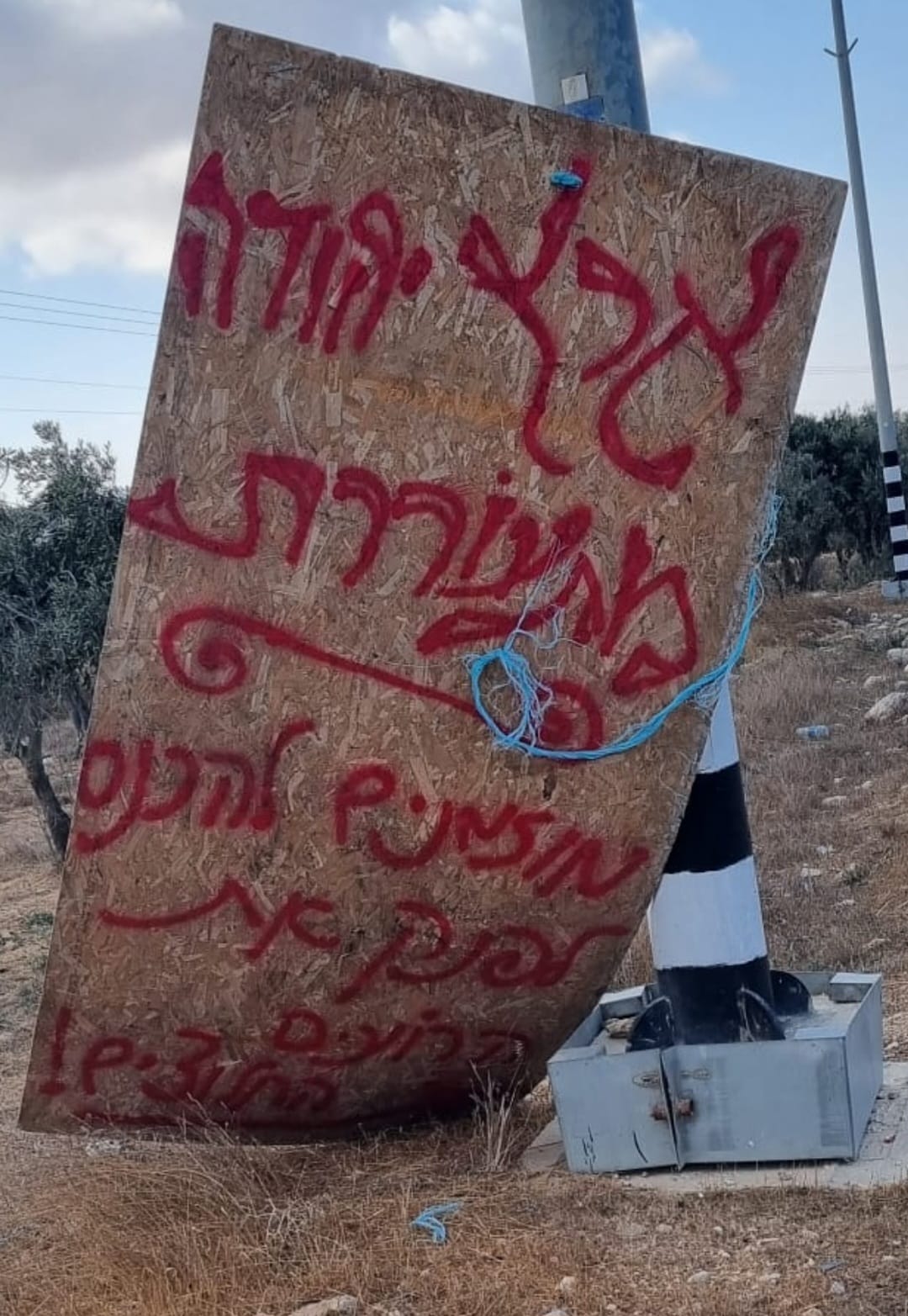 Smadar BeckerOct-17-2026A sign placed by those who call themselves the Pioneer Shepherds, at the outpost adjacent to Qawawis
-
