
Tarkumiya, Hebron
Tarkumiya, Hebron, 8:00 – 11:00 , 24.5.07 Hagit B. and Ofra B. 8:15 Mahsom Sansana. No people except for soldiers.8:30 Tenne Omarim – we traveled in the direction of the settlement, and we saw the huge earth mounds blockade that was set up on the road in the direction of Dahariya and Hebron.We tried to get to the illegal outpost which can be seen from Road #60. The soldiers let us go through into the settlement itself without checking. But the gate to the outpost was closed (entrance to privileged only). 8:45 Mahsom Ramadim2 soldiers playing in the shade. From afar we can see a group of 5 Palestinian men standing dozens of meters from the Mahsom without approaching. Our presence apparently gives them encouragement, and they start to walk towards the Mahsom. We get close to the Mahsom and the border policewoman shouts out to us “come over here”. We ignore them and walk back to the vehicle. The (male) soldier comes closer and wants to chat. We thank him for his polite overture and explain to him that we are too old to be given orders. The two soldiers try to understand what we are doing. They may not be familiar with our organization; we give short explanations and return to the vehicle.9:30 Girls schoolWe stop for a few minutes and chat a bit with the taxi drivers who tell us that the army arrives in general in the morning and the afternoon. We go on.10:10 TarkumiyaThis is the day when families go to visit their families in prison. 4 buses are standing in the parking lot. We discovered that people had arrived at 7:30, but they haven’t moved yet because one bus hadn’t been checked yet. 5 buses to Ramle Prison have already left; the four left are waiting for the unchecked bus and will then go to Kitziot Prison in the Negev. Hagit and I wonder why so many buses leave on the same day. It turns out that it isn’t the IRC which decides on the days but the prison service. This is something that needs to be investigated.The Mahsom is the cleanest we’ve seen (Anat – you succeeded!) and the soldiers seem relaxed. Several minutes after we arrive the last bus arrives, people get off, and present their papers to the Red Cross official and the military police. Hagit helps carrying a baby whose mother is loaded down with packages. After about 15 minutes, we start to see people getting on the Israeli bus. 10:45 we leave, but the buses haven’t left yet.11:30 Givat Harsina (Hebron)We walk through the neighborhood to show our presence and walk to the closed gate then return to the vehicle. On the way to Hebron we witness the back-to-back unloading of construction iron poles (from one side of the concrete barrier to the other).12:00 The Disputed HouseThe settlement continues. The army overhang had been upgraded, but the soldiers prefer to sit on chairs in the shade of the building. We continue towards a TIPH (Temporary International Presence in Hebron) vehicle that is parked on the other side of the concrete barrier. One of the soldiers yelled at us to stop, telling us that we were forbidden to cross over. We answer that we are allowed, and continue walking. There’s no one in the car. In the background we hear the soldiers talking on the wireless with their officers. They leave us alone. We continue walking towards the main street towards the Cave of the Patriarch on the worshippers’ route. A big group of American tourists are coming out of the site. We get to the Border police Mahsom. A young man has been detained. We ask him how long he has been there, for about ½ hour. The soldiers at the station show disrespect. One can imagine the way they relate to the Palestinian.During our visit to the city we notice many [Palestinian?] children in the streets carrying containers with water. We go on our way to the upper neighborhoods of Hebron above Tel Rumeida, and stop at Tarpat Junction. Two international volunteer women are standing at the site. We chat with them, and then also meet a group of CPT (Christian Peacemaking Team) that asks to take our photograph. This is a group of 40 from Colorado. They tell us about an enlightening lecture they heard from Roni Hammerman, and ask that we send regards and thank her.They continue on to the Kasbah. One of the people accompanying them, an east Jerusalem Arab, returns with another two from the group. He is not allowed to enter because he has an Israeli ID.Near Sansana past Shim’a we saw a Palestinian truck carrying a tractor with a shovel attachment that had been stopped by the army. As usual ID cards presented, etc. When the soldier heard that they were there at the invitation of the head of security at the settlement they let them go. There are cases in which the settlers can help the Palestinians more than we can. Symbiosis.
Hebron
See all reports for this place-
According to Wye Plantation Accords (1997), Hebron is divided in two: H1 is under Palestinian Authority control, H2 is under Israeli control. In Hebron there are 170,000 Palestinian citizens, 60,000 of them in H2. Between the two areas are permanent checkpoints, manned at all hours, preventing Palestinian movement between them and controlling passage of permit holders such as teachers and schoolchildren. Some 800 Jews live in Avraham Avinu Quarter and Tel Rumeida, on Givat HaAvot and in the wholesale market.
Checkpoints observed in H2:
- Bet Hameriva CP- manned with a pillbox
- Kapisha quarter CP (the northern side of Zion axis) - manned with a pillbox
- The 160 turn CP (the southern side of Zion axis) - manned with a pillbox
- Avraham Avinu quarter - watch station
- The pharmacy CP - checking inside a caravan with a magnometer
- Tarpat (1929) CP - checking inside a caravan with a magnometer
- Tel Rumeida CP - guarding station
- Beit Hadassah CP - guarding station
Three checkpoints around the Tomb of the Patriarchs
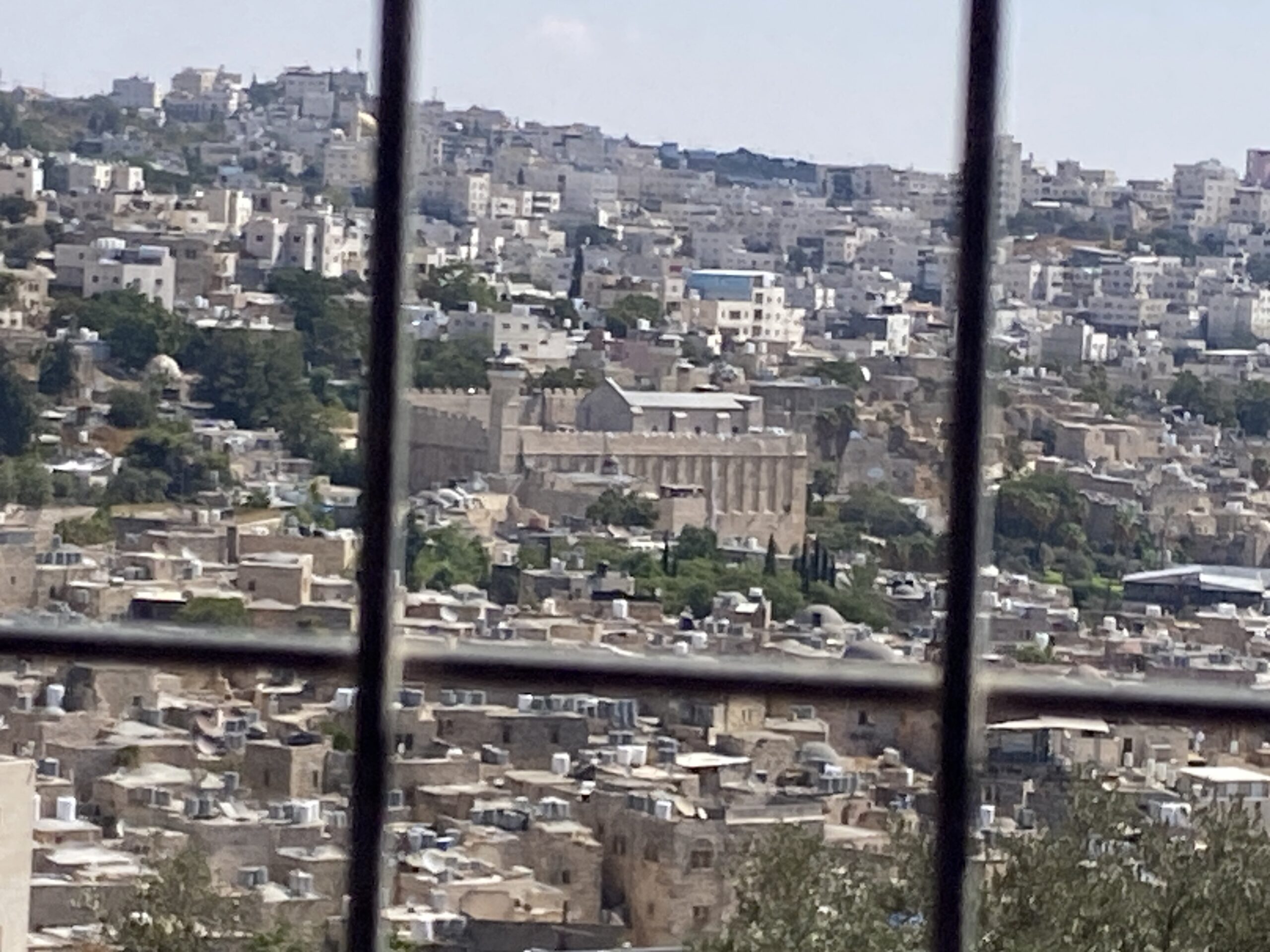 Yael ZoranSep-24-2026Hebron and the Cave of the Patriarchs from Beit Hashalom
-
