
The Central West Bank: Delays, Closed Gates, and Arbitrary Enforcement
We entered via Road 55. We decided to see the passage in the Habla agricultural checkpoint that leads to the nurseries. We came in time for the gate’s opening, at 13:00.
A vehicle with 4 female soldiers came and the gates were opened on time, but people were only allowed through about 10 minutes later. The soldiers sat and talked, getting organized to allow people and vehicles through, while people waited in the sun or inside their cars.
As we waited people told us that sometimes everything goes well, but at others, especially when the officer in charge was not there, soldiers behave badly, swearing etc.
This time inspections were very thorough, although most vehicles belonged to the nurseries and were filled with plants. Only when a single person or vehicle went through could the next one approach the soldiers who check the IDs and then the objects or the vehicle. This time there were no problems or untoward behavior on the part of the soldiers.
At 13:35, after all the waiting people on foot or in vehicles had passed, the soldiers approached us and asked who we were and what we were doing there, and do we know that this is the seam zone and out of bounds. We explained who we are and clarified that we are allowed to be here, and have no intention of passing the fence… They began to close the gate (although officially it was supposed to close only at 14:00) and we left.
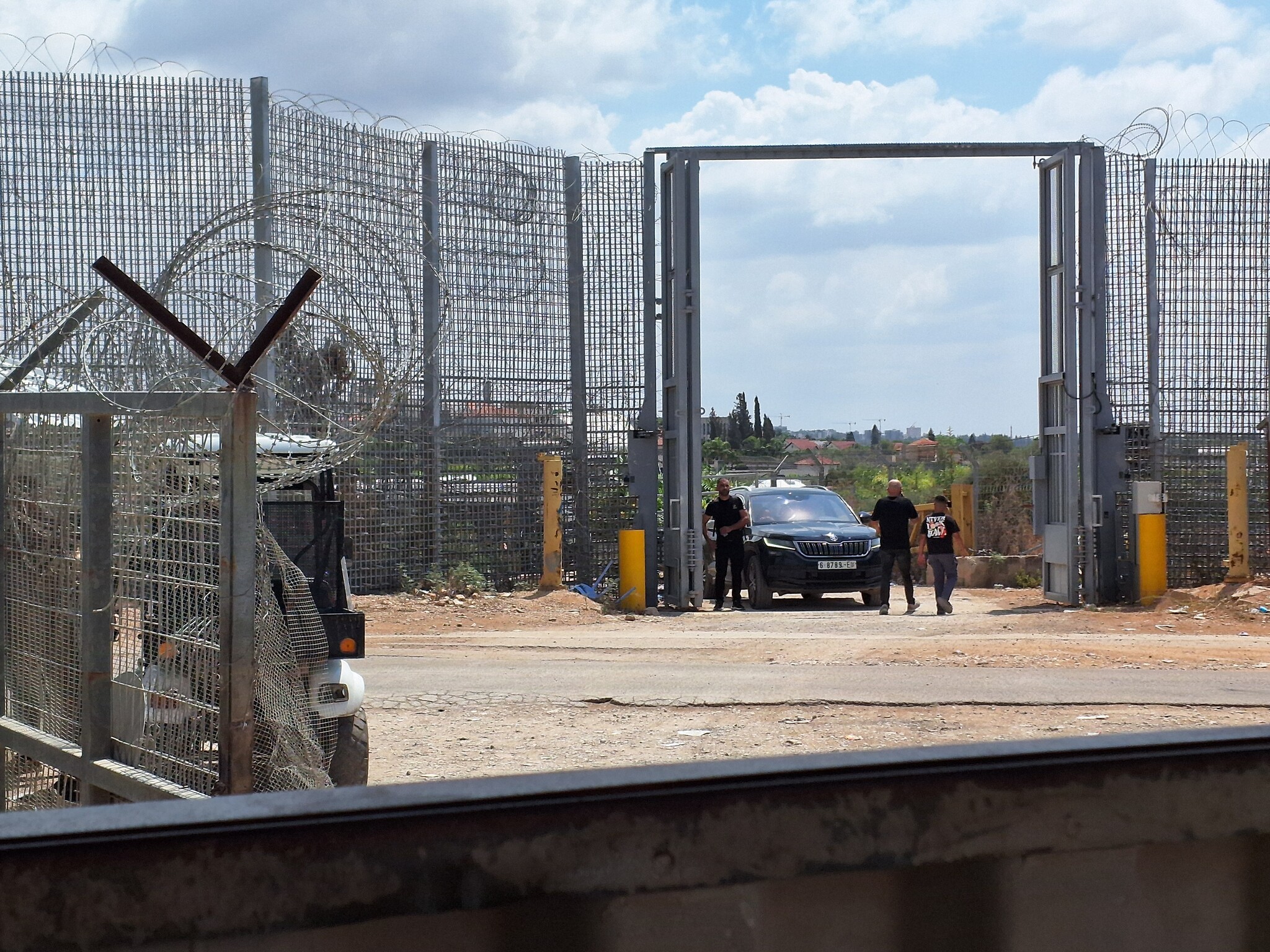
We continued eastward, and at 13:45 came to Nabi Elias. We stopped for the gates were closed, no entry nor exit by car. We were told this has been the situation for a week, and it is unclear how long it will stay that way. We saw vehicles parked inside the village along the road leading to the exit. People leave their car and continue either on foot, in a taxi or with another vehicle that picks them up.
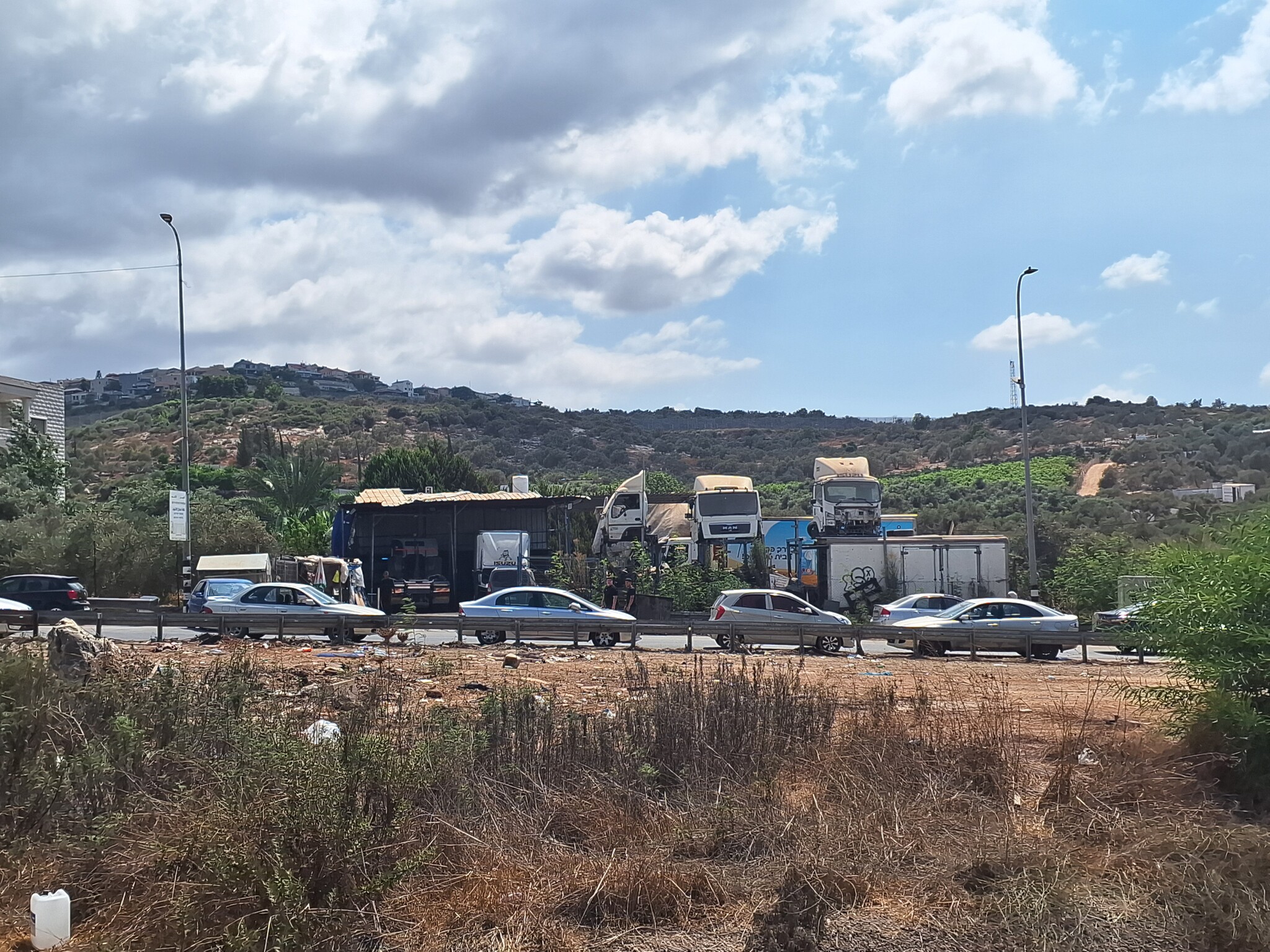
There were many vehicles on site, some of them loaded with goods, coming from both sides of the closed gates. People and good were passed “back-to-back” on both sides, many wandering around in the seething sun. Some passed under the iron gate, or around it.
Some of the drivers tried the bypassing trails among the trees, but this a very lengthy drive. In order to reach Nablus or anywhere else, they had to drive nearly to the checkpoint area, turn around and then go back toward their destination.
While we were there an elderly man from Jordan arrived. He bore three large suitcases and looked exhausted. Youngsters present helped him pass under the gate.
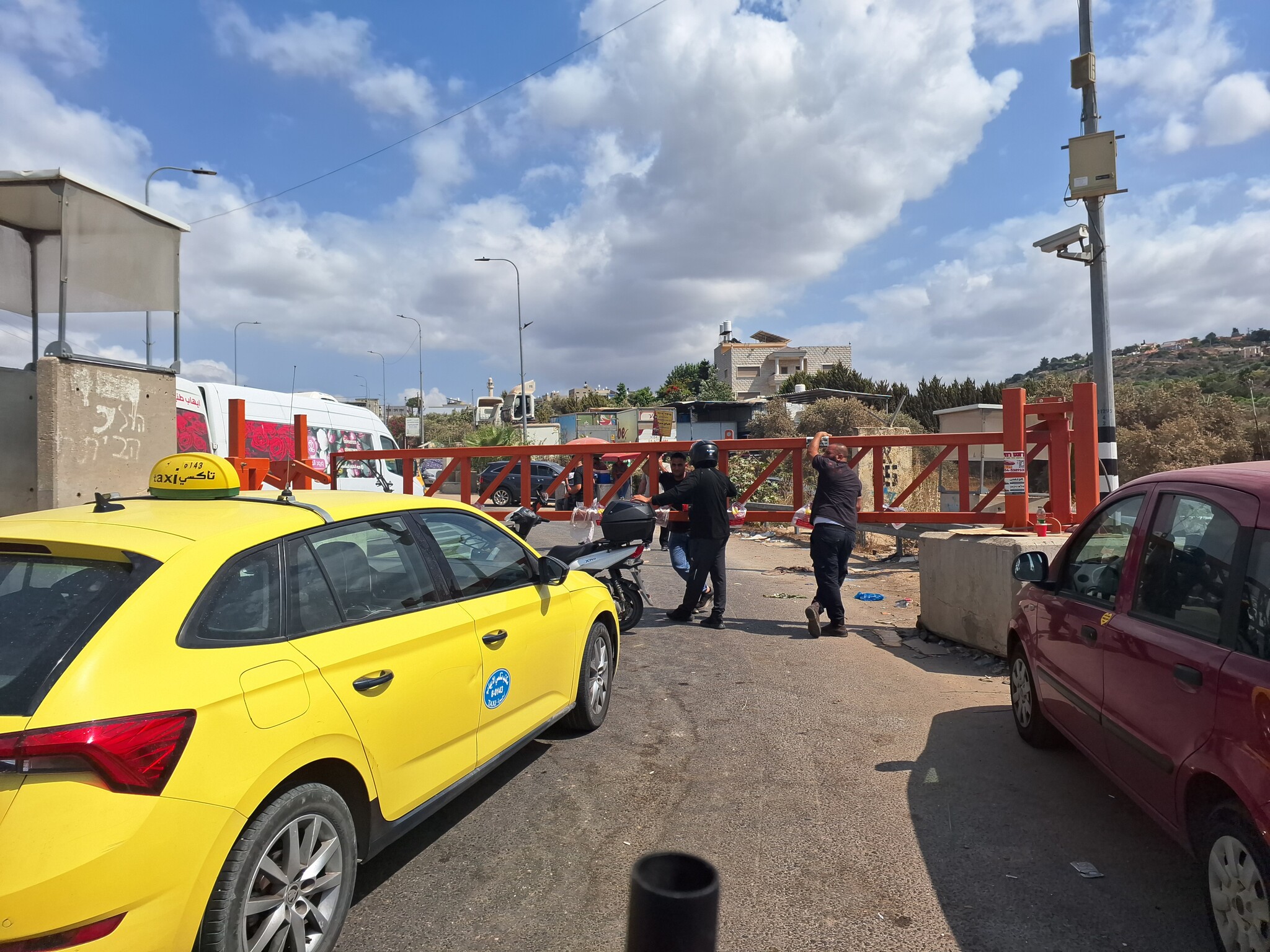
When we returned to the car, a young man approached and said that there is a problem with one of our wheels and it’s dangerous to keep driving. He said he was a mechanic and could fix the problem. After taking the wheel apart and checking, we found out we needed to change a certain part on both sides. Since we were close to the gate and had no choice, we stayed there and waited for the parts to arrive.
As we waited, an army jeep arrived with two young soldiers. They disembarked and began to yell at children standing by the gate, claiming they saw in their cameras that the children had fiddled around with the gate and tried to open it. One of the soldiers approached the mechanic and swore at him vulgarly for fixing our vehicle in place. The soldiers continued to yell at people, and a driver whose passengers had disembarked near the gate had his reverse camera broken for no apparent reason.
An Israeli vehicle was there with young Israelis from Kfar Sava who wanted to wash their car and were disappointed to find a closed gate. They heard the explanation that driving was possible along the dirt track but it would be pointless since the car would only fill up with dust again. The young man next to the driver was smoking a rolled cannabis cigarette. The soldiers approached the car to find out what it was doing there. The mechanic told us later that the passengers gave the soldier that kind of cigarette and the soldiers offered to follow them so they could open the eastern gate (closed since 7.10.23) for them to enter and exit. We do not know whether this actually took place. They left us alone for the wheel of our car was in pieces when they arrived, and we could obviously not go anywhere until the problem was fixed.
The whole story with our car took a long time, longer than we thought, so we drove directly to Burin to visit our friend Doha. She said they suffer daily from the settlers who walk around among the homes and bother the residents, and are backed up by soldiers.
Location Description
A-Nabi Elias
See all reports for this place-
A-Nabi Elias this is a Palestinian village in the northern West Bank, east of Qalqilia on Road 55, north-east of Alfei Menashe colony and west of Karnei Shomron colony and the Palestinian city of Nablus. As of 2016, the village was populated by 1,458 inhabitants.
Near the village is a maqam (holy site memorializing a sanctified person) - the prophet Elisha. Until 2021 Road 55 crossed the village. Then a bypass road was paved through olive groves that were sequestered from the villagers. Consequently, the farmers were left with small olive groves that they could not access nor cultivate. Inhabitants protested against the road for weeks, supported by peace activists, but nothing helped and the road is now a given fact.
The village's main street had been a shopping center for all residents, including colonists. We even saw a Kashrut (kosher food) inspector in a butcher shop close to the falafel stand… The bypass road, according to tradesmen, has impacted their businesses and clients, while others claim that there are customers now for parking has become easier.
Alfei Menashe and Tzofim colonies nibble at the village lands from the north and south and get closer to it all the time. Colonists of Alfei Menashe have outdone themselves, sending their surplus sewage from the oxygenation pools toward a-Nabi Elias land, even reaching the houses.
The villagers are known as seekers of peace. For years there was no hostility towards Israelis. On the contrary, we were always welcomed warmly and stopped there to enjoy their delicious, inexpensive falafel.
-
Habla CP (1393)
See all reports for this place-
Habla CP (1393)
The Habla checkpoint (1393) was established on the lands of the residents of Qalqilya, on the short road that
connected it for centuries to the nearby town of Habla. The separation barrier intersects this road twice and cut off the residents of Qalqilya from their lands in the seam zone.(between the fence and the green line).
There is a passage under Road 55 that connects Qalqilya to the sabotage This agricultural barrier is used by the farmers and nursery owners established along Road 55 from the Green Line and on both sides of the kurkar road leading to the checkpoint.
This agricultural checkpoint serves the residents of Arab a-Ramadin al-Janoubi (detached from the West Bank), who pass through it to the West Bank and back to their homes. The opening hours (3 times a day) of this agricultural checkpoint are longer than usual, about an hour (recently shortened to 45 minutes), and are coordinated with the transportation hours of a-Ramadin children studying in the occupied in the West Bank.Ronit Dahan-RamatiAug-31-2026Habla. The gate is open
-
