
Tyasir, Gittit, Hamra
29/11/06, Wednesday, Tyasir, Gittit, HamraObservers: Edna K., Hagar L. (reporting) Limitations on movement and on passage:In all the CPs that surround the Biq’a the only Palestinians allowed through are those whose identity cards show that they are residents of the Jordan Valley, or those who have authorization to work there, or to trade there. The authorizations are usually valid until 7:00 p.m.Palestinians who wish to go to Jericho, including commercial vehicles with goods, but are not residents of the Biq’a are not allowed to travel by the short road that descends from the west through the junction at Maaleh Efraim and continues to Road 90. They have to drive on the Alon Road south (Road 458) to the Rimonim junction to go through the CP at this crossroads and at least one other CP just before getting to Jericho. Only residents of Jericho and residents of the Biq’a are permitted passage from Jericho to the Biq’a (on Road 90).All the dirt roads down the mountain to the Biq’a are closed off with iron gates or barriers made of dirt and rocks. Shepherds from the village of Akraba, for example (which is on the side of the mountain, only a few kilometers from the Biq’a) who get there with their flocks, are considered illegal sojourners by the army.Additional routes that are closed to the Biq’a residents are the many shooting ranges which are to be found mostly in the locales where the Bedouin live.Opening hours of the CPSThe Gittit CP is open from 03:00 to 22:00.The Hamra CP is open from 03:00 to 22:00.The Tyasir CP is open from 04:00 to 21:00.These opening hours show that the CPs serve the Israeli settlements in the Biq’a that depend on Palestinian laborers.Details according to times:11:10 – The Akraba CP is open, there are no soldiers manning it.11:20 – The Gittit CP is empty at this time.11:25 – A little way beyond the Gittit CP we meet a shepherd from Akraba keeping watch over his herd in the wadi near the road. He tells us that a month ago, the soldiers took away his ID card and that of his nephew, when they were with the family’s herd in that area. The soldiers claimed that they were not allowed to be there because it is considered part of the Biq’a district. He says that the soldiers hit and kicked his nephew; they blindfolded him and then took his cellphone and still have not returned it. We wrote down the details.The shepherd and his nephew were sent back and forth from CP to CP and to the Jericho DCO – and the documents were not found. Now the soldiers say they have to go to the Nablus DCO and that they will get their documents there.They reported to the Humanitarian Center and they filled in a form declaring that the ID cards are lost.11:35 – 13:30 – We visit Bedoui tents along the road and Edna distributes some clothes, shoes, and toys that she collected especially for them. 13:55 – Tiyasir CPThe CP is close to the camp of the ultra-orthodox Nahal. At the CP they are widening the road. The bulldozers are making a lot of noise and dust. At the CP there are a few vehicles on either side. From time to time, there are a few minutes when there are no vehicles at all. It seems that the soldiers began to do the inspection faster when we arrived. A bus arrives with children and teachers returning from a day at school. All those in the bus: women teachers, children, and men are ordered to get out. The ID cards are collected, a boy is sent to take all the briefcases out of the bus (it looks as if the children know this routine of the occupation well, because they get out of the bus with the rucksacks on their backs). Knowing their role in this “show”, the children form a line. After the soldier inspects the inside of the bus, and the ID cards are inspected, he orders the children to get in again. Some of the women also begin to get back into the bus, and then the soldier scolds them and orders them to remain outside. After what has apparently been quite a long period of service at the CPs, the soldier is still unable to say a sentence in Arabic that is longer than one word. He inspects bag after bag, purse after purse, belittles the teachers before their pupils, and then orders them on the bus. Then he inspects the men’s bags. Throughout all this time, I thought – in what kind of world are these children growing up? What childhood scenes will be etched in their memory? I stopped thinking because I was so alarmed by my thoughts. 14:00 – Edna manages to talk to a young man sitting near the CP. It turns out that he is from the village of Bardeleh in the north of the Biq’a, an operator of a bulldozer by vocation. He wanted to get to Tubas, but got to the CP without a rider on his ID card. He has been at the CP since 13:00; the soldiers took his ID card and his cellphone. When we left at 15:05 the document and the telephone had still not been returned to the detainee, even though he had given up wanting to get to Tubas and only wanted to go back home. At 15:15 we called him and we were glad to learn that the telephone had been found and was returned to him. Only at 16:00 did a colleague at the center let us know that the detainee had been released.15:25 – Hamra CP Six cars in a queue from the direction of the south and 3 or 4 from the west. We noticed that a short time after we arrived, the soldiers started to inspect the cars much faster, and within ten minutes the queue was gone. There were only a few pedestrians. We meet a group of five women students from the village of Marj A-Njah who return once a month from Nablus for a weekend visit. They told us that today the passage at the Bidan CP was smooth, but the last time when they were coming home, they had to wait at the CP until 10:00 at night. When the Bidan CP is closed, they have to travel through the Za’atara crossroads. This lengthens the trip a great deal and means that they have to go through four to six CPs on the way between Nablus and their home near the Jiftlik.At the CP we meet a truck driver who proudly shows us his ID card which says that he is a resident of Jiftlik. He says that to be a resident of the Biq’a is like an American passport: you can go anyplace on the West Bank. As we have often said – freedom is relative.16:20 – Gittit CP. There is one car in each direction. The inspection is quick. [DK]
Jordan Valley
See all reports for this place-
Jordan Valley The Jordan Valley is the eastern strip of the West Bank. Its area consists of almost a third of the West Bank area. About 10,000 settlers live there, about 65,000 Palestinian residents in the villages and towns. In addition, about 15,000 are scattered in small shepherd communities. These communities are living in severe distress because of two types of harassment: the military declaring some of their living areas, as fire zones, evicting them for long hours from their residence to the scorching heat of the summer and the bitter cold of the winter. The other type is abuse by rioters who cling to the grazing areas of the shepherd communities, and the declared fire areas (without being deported). The many groundwaters in the Jordan Valley belong to Mekorot and are not available to Palestinians living in the Jordan Valley. The Palestinians bring water to their needs in high-cost followers.
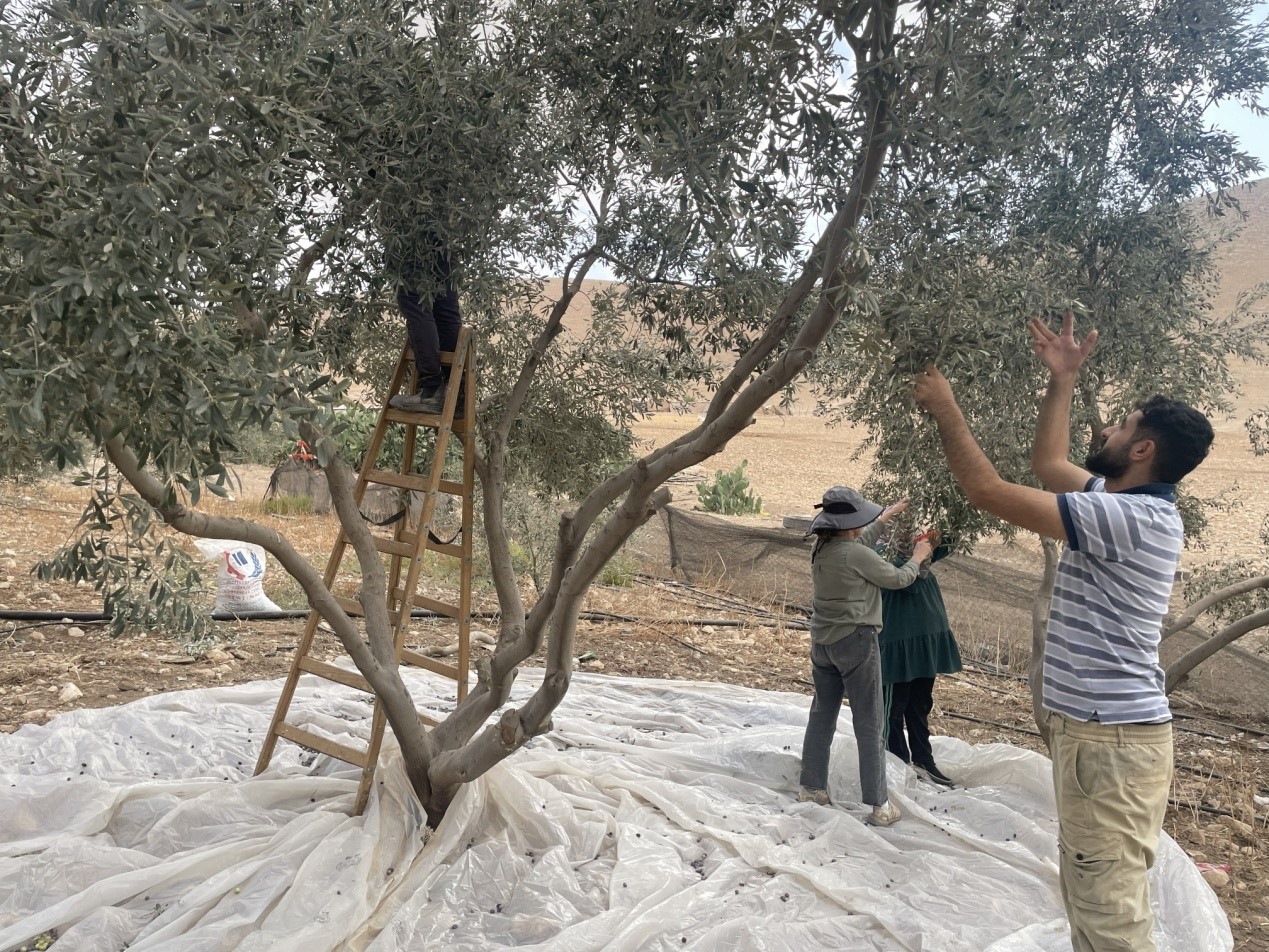 Rachel AfekOct-15-2026Olive Harvest in the Jordan Valley
-
