
Umm Al Fahm: under occupation skies, everything is possible


Agricultural Checkpoint Anin 6:30 a.m.
The military police soldiers opened the checkpoint on time. We and our ‘cousins’ from the village were there 15 minutes early because of false information about opening time. The passage proceeded speedily. 2 tractors passed through, their owners having registered them in their own permits, as well as a number of pedestrians. Spirits are stormy today because of the new requirement to register the tractors in their owners’ permits, declared only this Sunday. Some managed to do this right away at the Israeli DCO in Salem. Others who hurried in their footsteps were already sent on to the Palestinian DCO in Jenin. Unfortunately, in their own DCO it will take a whole week until the registration is received.
Umm Al Fahm 6:55
We climb up to the peak of the town on one of the main streets that leads to the southern exit. On the eastern side are a hill and a wood, and below the hill runs the Separation Fence and the security track. This area contains a long break in the fence, through which young men from the West Bank who loiter around here have come hoping to catch a day’s work. Apparently, all the action has died down, or not yet begun. Up the hill, in the wood filled with waste, crowd other youngsters who have already worked today and want to get back home now. What work? As porters in the smuggling activity. At 5:30 a.m., protected by the dark, they carried fruit and vegetables, sheep and cattle, and drugs and other things, from the West Bank into Israel/Umm Al Fahm. Now, the soldier does not let them through. About every 100 yards or so stands an armed soldier and either lets them through or not, in or out.
There is no work in the villages, no work in the West Bank, and they will do whatever it takes. They walk long distances through thorns and rocks, up and down hill, for the chance to bring a few shekels home. Not everyone gets to do that. Some return empty-handed. “Today’s a good day”, they say of the soldiers. “Sometimes soldiers throw teargas canisters at us and don’t let us through at all. Not today” They also spoke about soldiers who partake in the smuggling activity, and it was not comfortable to believe it, but under occupation skies, everything is possible…
Agricultural Checkpoint Tayibe-Roumana
(Opposite the eastern slopes of Umm Al Fahm) 7 a.m.
Just as we began the steep slope towards the checkpoint, we discovered that the narrow road leading to it is replete with obstacles – cut branches, plastic chairs, and two small sheds. In one is a messy kitchen and pastries (a kiosk for the smugglers?), and near the other stood the red Ferguson of our friend Ali from Tayibe. Around it stood several local young men. Ali (the older guy) was glad to see us and without delay proposed to me in marriage, happy as can be… Next to him, another guy was already taking his time with a water pipe. In recent months we heard rumors that these fellows take a payment from Palestinians who sneak through the holes in the fence and enter the city from here, on the road, which is better than traipsing around among the thorns. But the fine fellows denied that they charge money. So what are they doing here so early in the morning? Sitting. Just like that – relaxing. But they want to know who told us…
We never got to the checkpoint itself because passage was already over.
Eastern Barta’a Junction 8:15 a.m.
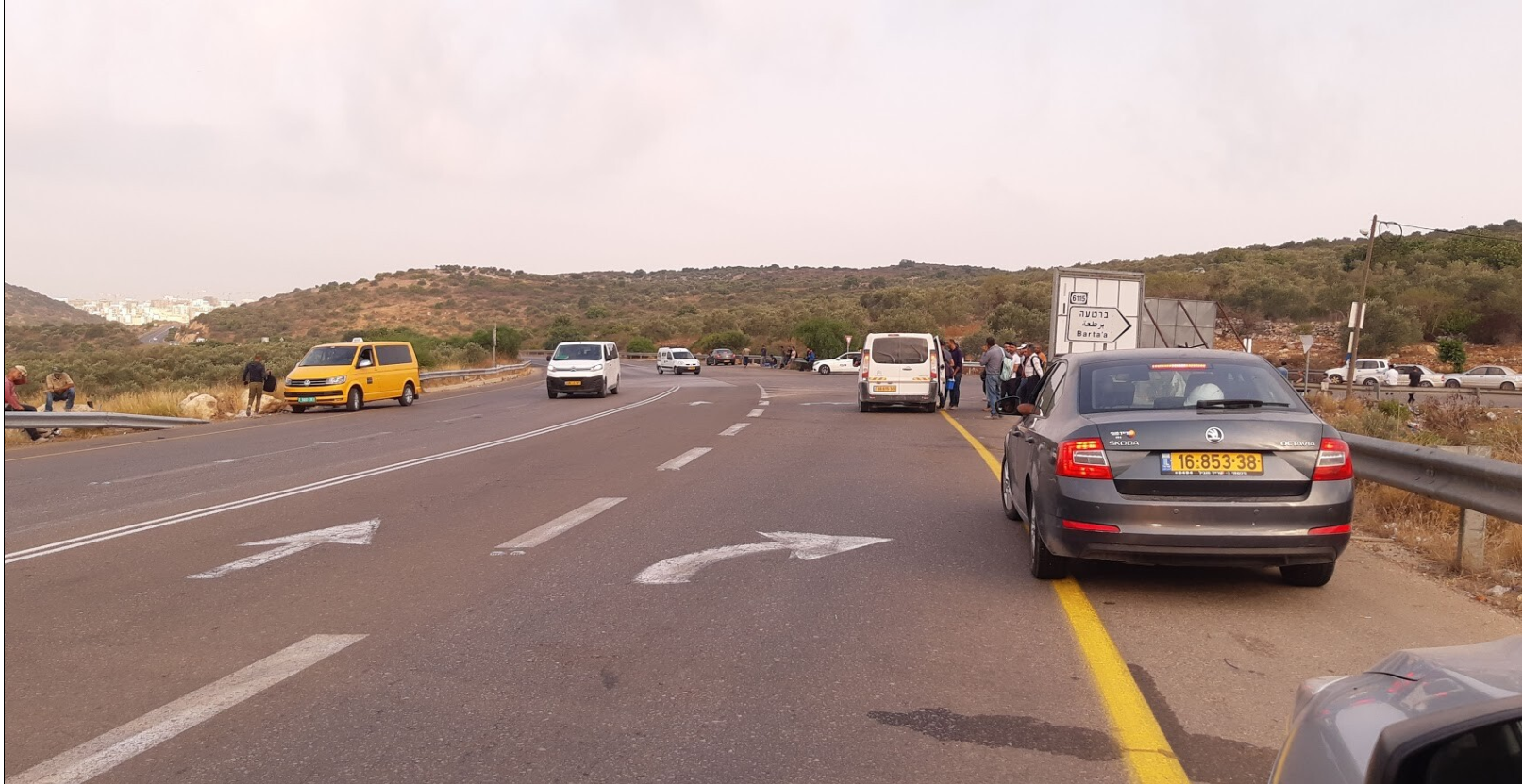
The entrance to Eastern Barta’a on road 611 has an active transport station for over half a year now. This is where hundreds of Palestinian workers congregate after having crossed the Separation Barrier at various places, and vans waiting for them there bring them here, to this junction from which they proceed in buses, vans and taxi cabs – on to work, especially in the new Israeli city of Harish that is under construction. Active passage takes place here in the light of day, in plain view of the Israeli soldiers who speed in their jeeps along the security road. Their job is to deter the smugglers. Sometimes these soldiers throw teargas grenades, yell at passers, usually try just not to tire themselves.
Along the road leading to Barta’a is a long line of parked Israeli cars. Apparently Israeli citizens also drive from here to Harish and other work places. Stalls have popped up here selling anything one could desire at the moment – black coffee out of large thermos bottles, wrapped cookies and candy, and even cabbages and cauliflowers in season.
Eastern Barta’a 8:40 a.m.
At this hour Eastern Barta’a – whose main street is a large colorful market – is waking up. On the other hand, neighboring Western Barta’a looks lifeless and except for a few nurseries and shops, there is nothing here to catch one’s eye.
'Anin checkpoint (214)
See all reports for this place-
'Anin checkpoint (214)
'Anin checkpoint is located on the Separation Fence east of the Israeli community Mei Ami and close to the village of Anin in the West Bank. It is opened twice a week, morning and afternoon, on days with shorter light time, for Anin farmers whose olive groves have been separated from the village by the fence it became difficult to cultivate their land. Transit permits are only issued to those who can produce ownership documents for their caged-in land, and sometimes only to the head of the family or his widow, eldest son, and children. Sometimes the inheritors lose their right to tend to the family’s land. The permits are eked out and are re-issued only with difficulty. 55-year-old persons may cross the checkpoint (into Israel) without special permits. During the olive harvest season (about one month around October) the checkpoint is open daily and more transit permits are issued. Names of persons eligible to cross are held in the soldiers’ computers. In July 2007, a sweeping instruction was issued, stating that whoever does not return to the village through this checkpoint in the afternoon will be stripped of his transit permit when he shows up there next time. Since 2019, the checkpoint has not been allways locked with the seam-line zone gate (1 of 3 gates), and the fence around it has been broken in several sites.
-
East Barta'a Junction
See all reports for this place-
East Barta'a Junction
The main station at the eastern Barta'a junction (Roads 611/6115).
A junction without special activities became about April 2020 a bustling center of transportation to workplaces in Israel, following the free passage through loopholes in the nearby separation fence.
Palestinian workers from all over the West Bank gather here every morning, without transit permits and often without masks. The army is turning a blind eye and the occupation is losing control.
There is also no shortage of coffee and pastry stalls.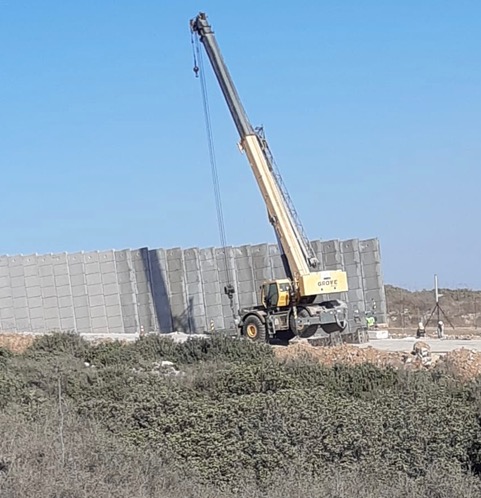 Hagar DrorSep-26-2023Barta'a: rapid construction of the separation fence
-
Tayba-Rummana
See all reports for this place-
Tayba-Rummana is an agricultural checkpoint. It is located in the separation fence in front of the eastern slopes of the Israeli city of Umm al-Fahm. The Palestinian villages next to the checkpoint are Khirbet Tayba and Rummana. Dozens of dunams of olive groves were removed from their owners, the residents of these villages on the western side of the separation fence. The Palestinian villages next to the checkpoint are Khirbet Tayba and Rumna. Dozens of olives dunams were removed from these villages' residents and swallowed up in a narrow strip of space, on the western side of the separation fence. The checkpoint allows the plantation owners who have permits to pass. Twice a week, the checkpoint opens for fifteen minutes in the morning and evening. During the harvest season, it opens every day for fifteen minutes in the morning (around 0630) and fifteen minutes in the afternoon (around 1530). (February 2020).
-
