
Visit at Khirbet Salman
Visit at Khirbet Salman (south of Azzun, between Thulth and Saniriya)
09:50 Eliyahu Checkpoint – few cars pass through without delay. At the junction leading to Tzofin settlement – an army vehicle.
Photos:
Nirit settlement, a touch away from Khirbet Salman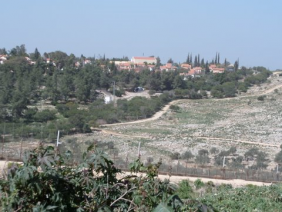
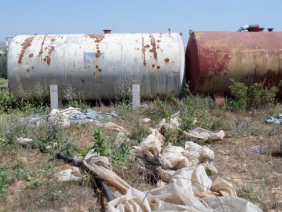
Water tankers for irrigation
Among the hothouses of Z.
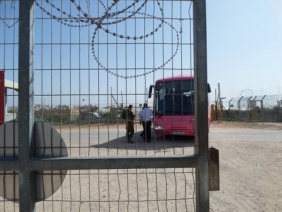
A bus being inspected at Habla Checkpoint
We met Z. in this small village, numbering about 1000 persons, of two families: Salman and Kuzmar. The most pressing problem they face is the robbing of their lands and water for irrigation. Most of the villagers’ land is located between the settlements of Oranit and Nirit.
We went out with Z. to tour his land, the hothouses he rents out to a Palestinian farmer.
We stood upon the hill overlooking Nirit, located on the hill right across, built on the village’s land. This is where Z. was born, where he grew up until his father, uneasy because of the tension between the Jordanian and the Israeli armies, left the hill and built his home inside the village itself. This was his big mistake. The separation barrier with its fences and road has ruined the family’s tilled lands, where they had invested a fortune in hothouses – and left nearly all of them (236 dunams) on the “wrong” side of the fence. A mere 7 dunams remained on their side. The village people have no “agricultural gate” in the fence near them to be bale to cross over and till their lands and citrus groves. They must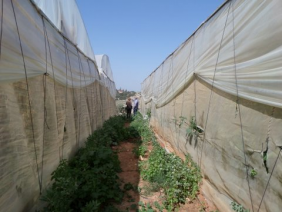 cross at Azzun Atme.
Only recently has Z. received a year’s permit to cross over to his lands, for the first time. In the past his permits were only valid for a month or two. In the past summer he received no permit so for two whole months he was unable to reach his lemon and orange grove in the wadi below the fence, and it gave no fruit this year. They have a well developed irrigation system from two wells which two families set up jointly in 1964. His brother also constructed a large, expensive concrete water cistern in order to irrigate the village’s lands, but the separation fence has made it irrelevant and farming has all but stopped there. At present, only a small part of the villagers make their living by farming.
Z’s brother and son responded in anger during the Intifada, and they were both sentenced to prison for long terms. Z. and his brothers have all had an academic education but he must make his living working as a tile-layer in construction projects. He has given his grownup children an academic schooling and two of them live with their families in the Gulf States. Life there is much easier. Palestinians there belong to the wealthier, more educated class and like all exiles (like the Jews…) wish to save money and return to the West Bank to build their homes in their own land.
Z. is “security prevented” by the GSS (Shabak) from entering Israel because he was arrested twice, in 1979 and in 1984. He has turned to a lawyer who demanded a sum of 6000 NIS for the attempt to arrange his paperwork, and an added 2000 NIS if his permit be issued.
As a child he attended school in Habla, 4 km from his village, every day. Now the village has an elementary and high school where boys and girls study together, at the dismay of the local religious.
We met H., head of the local council, who work the field after years of teaching school. He claims there is a lot of unrest. The army does everything it can to anger the villagers… and succeeds.
13:00 We took our leave after visiting Z’s home and meeting his wife and two of his younger daughters.
13:00 Azzun – we visited our friend’s shop.
13:50 Habla Checkoint – the girls’ bus stops, its driver disembarks and shows his documents to the policewoman. As she holds his ID, she calls somewhere (verifying data?). I ask her what the problem is, and she answers rudely: “None of your business”.
After two trucks leave the checkpoint, the gates close at 13:55, but the crew wait until 14:00.
A short visit with Omar at the plant nursery, who greets us as usual with his big smile. We bought potted herbs, and headed back home.
'Azzun
See all reports for this place-
Azoun (updated February 2019)
A Palestinian town situated in Area B (under civil Palestinian control and Israeli security control),
on road 5 between Nablus and Qalqiliya, east of Nabi Elias village. The inhabitants are allowed to construct and improve infrastructures. The Separation Fence has confiscated lands belonging to the town's people. In 2018 olive tree groves owned by one of its inhabitants were confiscated for the sake of paving a road to bypass Nabi Elias. Azoun population numbers 13,000, its economic state dire. Its infrastructures are poor, neglect and poverty rampant. In the meantime, the town council has completed paving an internal road for the inhabitants' welfare.
Because of its proximity to the Jewish settler-colony of Karnei Shomron and its outposts, the town suffers the intense presence of the Israeli army, especially at nighttime: soldiers enter homes, arrest suspects, trash the house and sometimes ruin it, as they do in numerous places in the West Bank. At times a checkpoint closes the entrance to the town, so no one can come in or get out.
-
Habla
See all reports for this place-
Habla CP (1393)
The Habla checkpoint (1393) was established on the lands of the residents of Qalqilya, on the short road that
connected it for centuries to the nearby town of Habla. The separation barrier intersects this road twice and cut off the residents of Qalqilya from their lands in the seam zone.(between the fence and the green line).
There is a passage under Road 55 that connects Qalqilya to the sabotage This agricultural barrier is used by the farmers and nursery owners established along Road 55 from the Green Line and on both sides of the kurkar road leading to the checkpoint.
This agricultural checkpoint serves the residents of Arab a-Ramadin al-Janoubi (detached from the West Bank), who pass through it to the West Bank and back to their homes. The opening hours (3 times a day) of this agricultural checkpoint are longer than usual, about an hour (recently shortened to 45 minutes), and are coordinated with the transportation hours of a-Ramadin children studying in the occupied in the West Bank.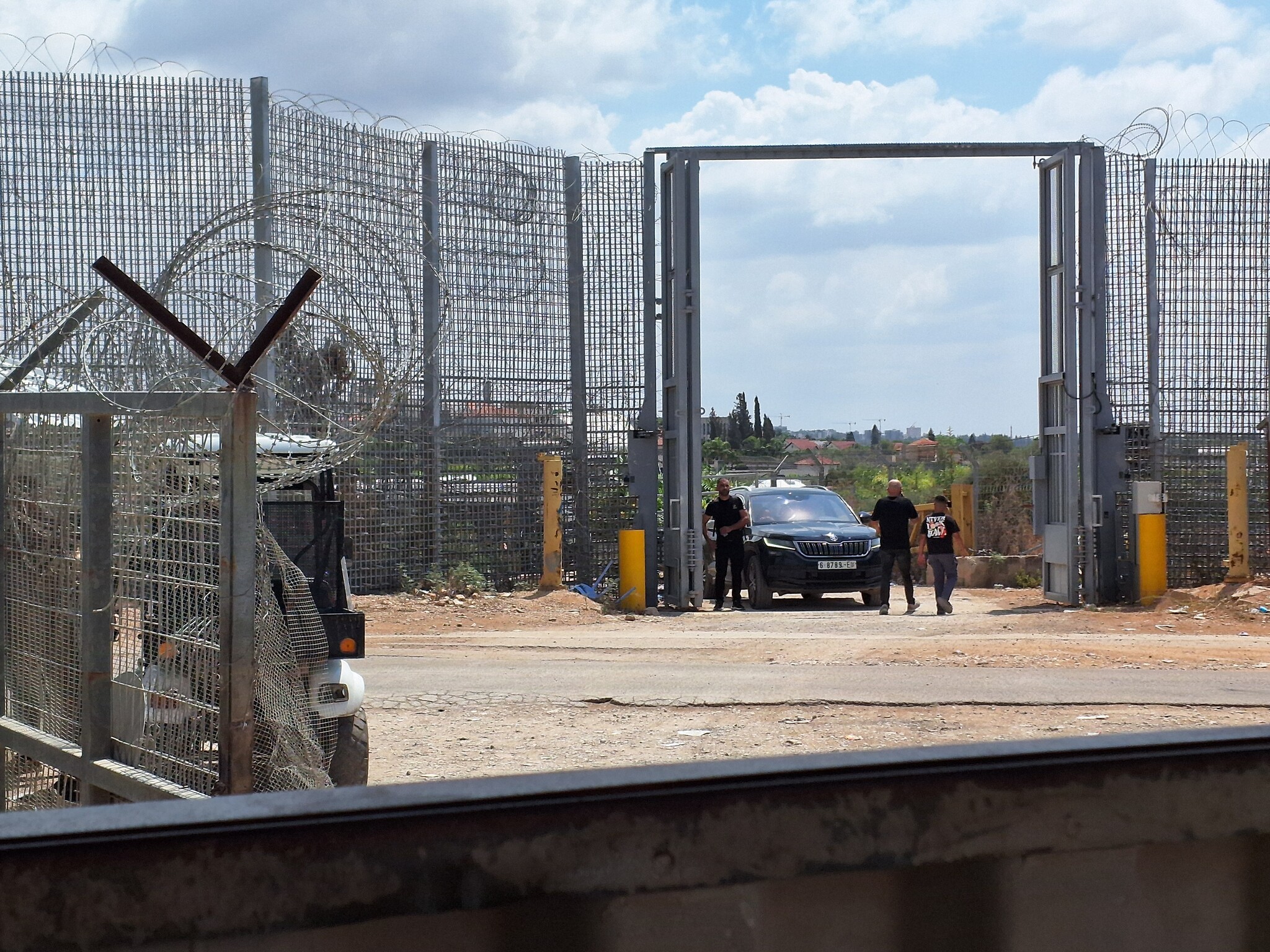 Ronit Dahan-RamatiAug-31-2026Habla. The gate is open
-
