
Wadi Radim – a heart breaking visit to Abu Safi

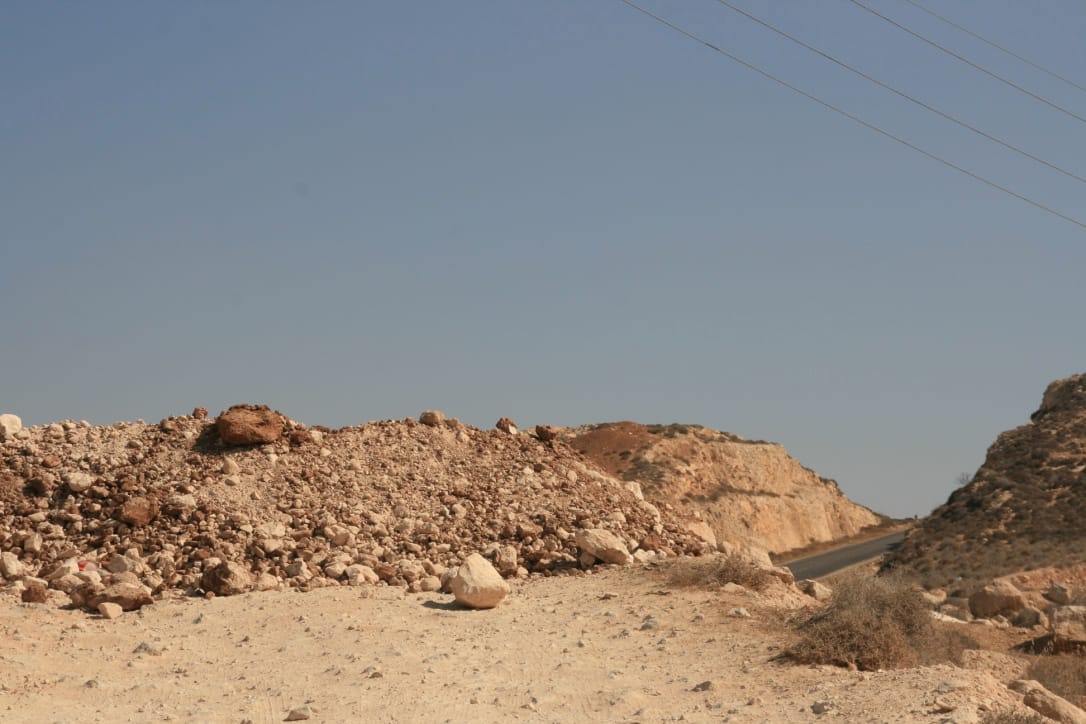
A heart-wrenching and infuriating report on the abuse of a poor civilian population, blocking access to homes, arbitrary searches by the sovereign. Water Deprivation – Right below an illegal settler farm which enjoys abundant water.
There are fewer vehicles in the parking lot at the Meitar checkpoint than usual – the holiday of Succot
The military tent that was placed at the beginning of Route 60 is gone. We did not see another tent.
At the Meiterim intersection facing Highway 317, flags of three types are hanging: the Israeli flag, the flag of the South Mount Hebron Regional Council, and a flag indicating 40 years of settlement in the council..
The entrance to Abu Safi (Wadi Radim) is still blocked by an earth embankment, leaving an entry and exit option narrower than usual.
The closure makes it difficult for the bus to pick up the little girls for kindergarten in Zenuta. Only the 5-year-old walked and they picked her up near the road. Farah, the younger one, finds it difficult to walk this distance, so she stayed at home.
Abu Safi describes a very difficult financial situation. Today he tried to sell yound goats and sheep to survive, but had to go back because of the roadblock.
He adds and says that each trip to Samu’ to fetch water takes 3 hours. Only the diesel costs him 100 NIS, while the water has been discounted.
He says that every drop of water is like a war. Even when washing the dishes, they are very careful
Abu Safi’s health is also not at its best. He has breathing problems and his injured leg is very painful.
This is a difficult visit.
We ask what about army visits, and it turns out that on the night of 11/10/22 two military vehicles arrived around 9:00 PM. They collected their cell phones, so that the Palestinians could not photograph, as well as their IDs (they took pictures of the IDs).
According to Abu Safi, at around 18:00 they entered the houses in the village of Rawan, which is on road 317, in front of Samu’. They searched there too, and also turned over the contents of the cupboards, moved objects and drove away. They also did a similar action in Zanuta around 19.00.
And what about Israel Kaplan, the owner of the farm next to the Asael holdings? Well, he is busy paving a road to the hill in front of the farm, where he takes his sheep and where he built a water pipe.
Meitar checkpoint / Sansana
See all reports for this place-
Meitar Checkpoint / Sansana The checkpoint is located on the Green Line and serves as a border crossing between Israel and the West Bank. It is managed by the Border Crossing Authority of the Defense Ministry. It is comprised of sections for the transfer of goods as well as a vehicle checkpoint (intended for holders of blue identity cards, foreign nationals or diplomats and international organizations). Passing of Palestinians is prohibited, except for those with entry permits to Israel. Palestinians are permitted to cross on foot only. The crossing has a DCO / DCL / DCL / DCL (District Coordination Office), a customs unit, supervision, and a police unit. In the last year, a breach has been opened in the fence, not far from the crossing. This breach is known to all, including the army. There does not appear to be any interest in blocking it, probably as it permits needed Palestinian workers without the bureaucratic permits to get to work in Israel. Food stalls and a parking area economy have been created, but incidents of violent abuse by border police have also been recorded. Updated April 2022
-
South Hebron Hills
See all reports for this place-
South Hebron Hills
South Hebron Hills is a large area in the West Bank's southern part.
Yatta is a major city in this area: right in the border zone between the fertile region of Hebron and its surroundings and the desert of the Hebron Hills. Yatta has about 64,000 inhabitants.
The surrounding villages are called Masafer Yatta (Yatta's daughter villages). Their inhabitants subsist on livestock and agriculture. Agriculture is possible only in small plots, especially near streams. Most of the area consists of rocky terraces.Since the beginning of the 1980s, many settlements have been established on the agricultural land cultivated by the Palestinians in the South Hebron Hills region: Carmel, Maon, Susia, Masadot Yehuda, Othniel, and more. Since the settlements were established and Palestinians cultivation areas have been reduced; the residents of the South Hebron Hills have been suffering from harassment by the settlers. Attempts to evict and demolish houses have continued, along with withholding water and electricity. The military and police usually refrain from intervening in violent incidents between settlers and Palestinians do not enforce the law when it comes to the investigation of extensive violent Jewish settlers. The harassment in the South Hebron Hills includes attacking and attempting to burn residential tents, harassing dogs, harming herds, and preventing access to pastures.
There are several checkpoints in the South Hebron Hills, on Routes 317 and 60. In most of them, no military presence is apparent, but rather an array of pillboxes monitor the villages. Roadblocks are frequently set up according to the settlers and the army's needs. These are located at the Zif Junction, the Dura-al Fawwar crossing, and the Sheep Junction at the southern entrance to Hebron.
Updated April 2022
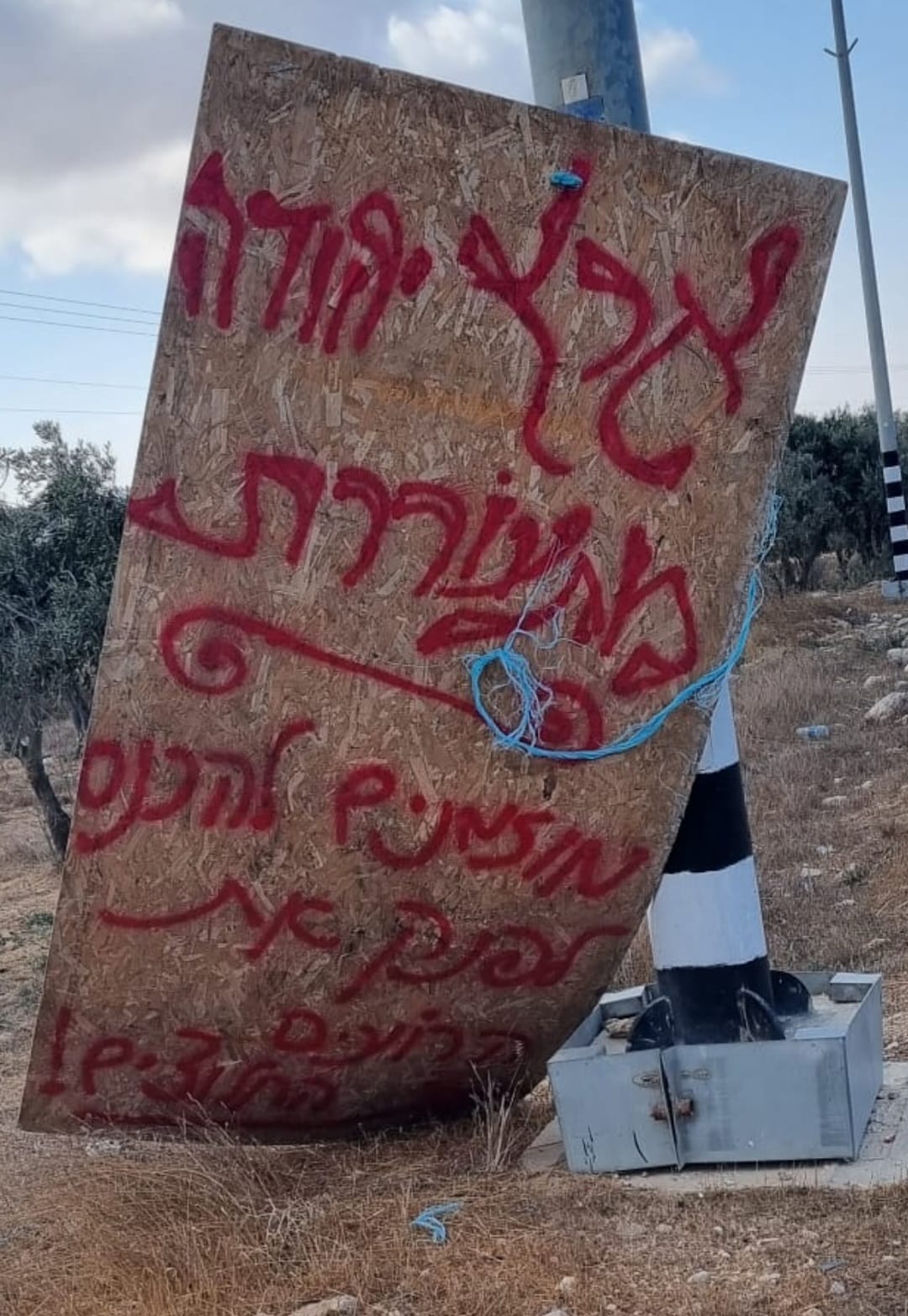 Smadar BeckerOct-17-2026A sign placed by those who call themselves the Pioneer Shepherds, at the outpost adjacent to Qawawis
-
