
Za’tara (Tapuah)
9.30 Departure from the Rosh Ha-Ayin train station. At the Za’atara-Tapuah intersection there is no special commotion. Three soldiers are at the bus station, one in the watch tower. The parking lot is empty.
10.15 A-Sawiya

Our connections with the village tightened after we went out in the preceding weeks, to help the villagers pick olives. A., a member of the village council and our liaison person, had a request: Could we donate a camera to the village’s kindergarten. After the request was made public on the net, our member Micky T.K. complied with the request and so we set out today to visit the village’s kindergarten with the camera and sweets to distribute to the children.
The kindergarten is protected from uncalled visitors. After we rang the bell and identified ourselves, the heavy iron gate was opened and we found ourselves in fron of a playground the floor of which was sea sand.
We enter the building. Our first impression was the quiet which pervaded the place. Were the children on leave? The directrice, an impressive young woman, tells us that at the moment 70 kindergarten children, aged 3-5, boys and girls together are gathered in 4 classes, busy with different activities. On the door of each class there is a sign on which there is a picture of an animal, drawn with talent. When the door of the “grasshopper” class is opened and the kindergarten teacher introduces us, the children welcome us in chorus, standing up, cheerfully.The class is very beautiful. The walls are decorated colourfully: a string of alphabet letters in Arabic and in English. The names of the children are presented in a very creative manner: they are written on paper snippets in the form of rain drops, which are tied by strings to white clouds (“As the autumn has just arrived”).

The directrice and the four nursery teachers are graduates of the education for the preschoolers faculty at the A-Nagah university. Judging by the atmosphere at the kindergarten and the knowledge level of the children, it seems they acquired there wonderful instruments for education. All along our visit at the kindergarten we saw no blows, we heard no shouts. We saw no child snatching a toy from another. We saw no child crying. The children are relaxed, smiling, polite and cooperate willingly and openly.
It is surprising to discover that at their young age the children are already exposed, and intensively, to the English language. On the blackboard the day of the week and the date are written – in English. The children are happy to demonstrate their command in the order of the English alphabet letters, they can count and enjoy replying in English to questions. The studies are interlaced with different activities: The children create in modeling clay the form of English letters, they build them from Lego stones or draw them on the sand.Their environmental frame is clean, esthetic and very orderly. Each toy is in its place. At the different work corners – dispensary, animal farm, puppet show, most items were formed by handcraft from material that is within reach.
The activity at the kindergarten is interlaced with the community life: together with the grown-ups the kindergarten children picked olives, preserved them and they are exhibited in jars in a special corner. The religious experience also has a place in the activity: the children learn about the command of the pilgrimage to Mecca while they turn around a black structure which should symbolize the Ka’aba and say prayers. For Id El Adha they created out of cotton wool a toy in the form of a sheep, in simulation of the feast’s sacrifice.
In the corridor photos of the children performing different activities are exhibited: at theater shows, disguised as soldiers in speckled army uniforms with batons in their hands, and even – a real surprise – dancing ballroom dances, with the boys dressed in suits and butterfly ties and hugging their small partners dressed up in muslin dresses.
The feeling is that these clever and gifted teachers believe that a better future is intended for the children, transgressing borders, transgressing occupation, and that it is their task to widen their horizons and to bestow on them tools which would allow them, when they grow up, to act successfully as world citizens of the 21st century. Naivety? Utopy? Or may it be that it is they who are endowed with long range vision and belief that what seems impossible today will be the reality in days to come. Let it be.But today we live in a present of a difficult and unchangeable reality. And when we think about the future of our children or grandchildren, there always emerges the request: Let them not know war. That until they grow up the longed for peace with prevail. Today, when we left the kindergarten, we expressed from the bottom of our hearts this request for the sake of the innocent sweet children of the Assariya kindergarten.
11:30 Zaatara/Tapuah junction – there are two additional soldiers at the hitch-hiking station leading to Huwwara.
On the road leading from the main road right to Hares a big military armored car is parked.
12:00 – back to the Rosh Ha’Ayin train station.
A-Sawiya
See all reports for this place-
A-Sawiya
Located about 18 km south of Nablus.
The population of the village was 2,904 in 2016. In 1983, about 400 dunams, on a hill about a kilometer south of the village, were declared "state lands" and the settlement of Ali was established on them. Over the years, the settlement has expanded to additional lands privately owned by the villagers, and nearby villages in an area of about 1,000 dunams. Only in 2013 was an outline plan prepared for Ali, in which hundreds of illegal structures were approved in its territory. In 2017, a synagogue was built in the Ali settlement, in violation of the law without permits, outside the legal territory of the settlement and on private Palestinian land of a-Sawiya residents.
Over the years, the settlement has expanded to additional lands privately owned by the villagers, and nearby villages in an area of about 1,000 dunams. Only in 2013 was an outline plan prepared for Ali, in which hundreds of illegal structures were approved in its territory. , Outside the legal territory of the settlement and on private Palestinian land of the residents of a-Sawiyah.
Checkpoint Watch companies have been in contact with the village since 2007. They document the checkpoints, the settlers' violence, the sewage problems flowing from the nearby settlements and outposts, and even held knitting and English lessons with women in the village. Even during the Corona we were in telephone contact to help the plight of the residents.
-
Za'tara (Tapuah)
See all reports for this place-
Za'tara (Tapuah) Za'tara is an internal checkpoint in the heart of the West Bank, at the intersection of Road 60 and Road 505 (Trans-Samaria), east of the Tapuah settlement. This checkpoint is the "border" marked by the IDF between the north and south of the West Bank, in accordance with the policy of separation between the two parts of the West Bank that has been in place since December 2005. At the Za'tara checkpoint, there are separate routes for Israelis and Palestinians. In the route for Israelis, there are no inspections and the route for Palestinians inspects. The queue lengthens and shortens suits. The checkpoint is open 24 hours a day. The checkpoint is partially staffed and the people who pass through it are checked at random.
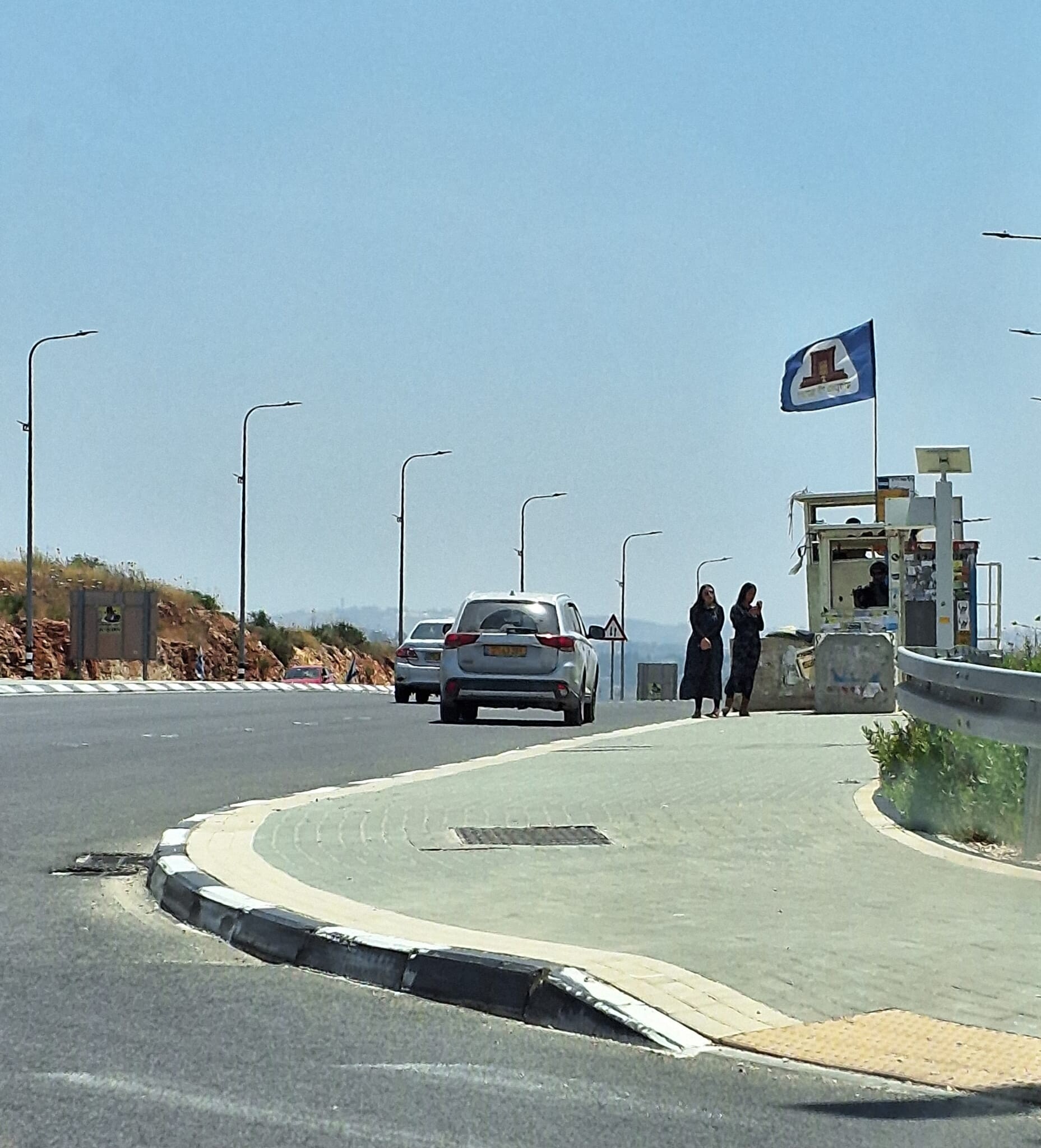 Ronit Dahan-RamatiJun-9-2026Za'atara (Tapuach Junction). The Temple Flag Above a Station
-
