Grandma, Why Are You Fighting for Palestine?
Grandma, Why Are You Fighting for Palestine?
German :
https://www.sueddeutsche.de/projekte/geschenk/einloesen?token=208ebefb-1f13-4e1f-84a2-57d1c82219e5
English Translation:
Roni Perlman regularly travels to the West Bank to document settler violence. Her grandson wants to vote for a right-wing party and can hardly wait to join the military. On Israel’s new generational conflict.
Roni Perlman is 82 years old and travels every week. Sundays, Tuesdays—as long as she can. On Monday, Thursday, and Friday mornings, she travels to Jerusalem to see her son’s children and watch over her other grandchildren. And on Thursday afternoons, she monitors—or documents—the violence in the West Bank.
She gets on the train in Tel Aviv, travels half an hour east, and gets off at the small Rosh HaAyin North railway station. There, a bus waits to take her into Palestinian territory. On this day, three elderly women from Israel are on the bus, wanting to see what remains of Palestinian villages and olive groves after they were attacked or destroyed. They have been doing this for years. Today they are travelling to Qusra, a small village where Palestinian farmers’ houses were burned down last autumn, and where massacres occurred. The world press reported on Qusra.
To get to Qusra, Roni Perlman wears inconspicuous blue-gray clothes, a Panama hat, sandals, and carries a small backpack. Over her blue eyes, she wears dark sunglasses.
The Palestinian West Bank is now more tense than ever, as she experiences it in mid-October. A few schoolboys stand on a hill near Nablus throwing stones. What is defined as “the area” is experiencing raids and settler violence. Roni Perlman has no fear when she travels there; she belongs to the public that stands in the middle of the struggle. He is a Palestinian soldier in disguise. Roni Perlman says: “I am not a cowardly citizen.”
Sixty percent define themselves as right-wing, and this is especially true for the young
When she retired at age 57, she joined an organization founded at the time, “Machsom Watch.” Palestinian women and Palestinian women. They travel to checkpoints and Palestinian enclaves within the West Bank to reduce violence. “Machsom” is the Hebrew word for a military checkpoint. At the checkpoints, the women watch the soldiers, inspecting and negotiating with them to open the checkpoints. For them, checkpoints are a symbol of oppression. And the situation has only gotten worse, says Perlman.
For years, Benjamin Netanyahu has led a government that wants to annex the West Bank. His finance minister actively promotes construction in the territories and enables the expansion of settlements. While in the past there was still talk of a two-state solution, today Netanyahu speaks only of annexation. Israel, no longer what it once was, has become a different country. Today, the majority of citizens belong to the right wing. Perlman belongs to a minority, a politically left-leaning citizen. According to polls, about sixteen percent of Israelis define themselves as part of liberal democracy. Young people, on the other hand, define themselves as right-wing, especially those serving in the army.
Perlman has a grandson who will turn 18 on October 27, and he wants to vote for a very radical right-wing party, Itamar Ben-Gvir’s party. When asked about these complexities, one can understand how the shift occurred. While Roni Perlman wants to liberate the Palestinian territories, her grandson, born now, wants to protect the Israeli state.
Her grandson Uri lives in Tel Aviv. Perlman and he sit opposite each other for two days in Roni Perlman’s apartment. The apartment is in a four-story apartment building. The apartment has green tiles, large windows, and a grand piano played by her grandson Uri. He lives with his parents in the Nahalat Yitzhak neighborhood, about a ten-minute drive away. He is waiting to enlist in the army in a few months, and in any case, he wants to serve in a combat unit. Perlman looks at her grandson and says: “My grandmother told me that in her time we had to fight.”
The grandson and grandmother disagree on almost everything. One reason for this is that they grew up in completely different times. Their arguments and experiences are rooted in the history of this country.
Roni Perlman grew up in a country where people feared its destruction. She remembers the war when Benjamin Netanyahu became prime minister. When the Hamas massacre took place on October 7, she felt a real existential fear. When she was a teenager, there was still a period of existential fear. Now everyone is afraid. Uri, on the other hand, as a teenager experienced a time when Israel was a strong and secure state, one not threatened by its neighbors. He experienced a politics of security, of war, and of climate change. In Israel, there are now many who grew up like this—without hope and without peace.
Roni Perlman was very young when she was in the Scouts. She says she had friends who lost their lives, and she was right-wing. When she was 18, she joined the army: “If I could have, I would have gone to combat,” she says.
“The Palestinians are still not political,” says Perlman. When she was eight years old, she saw the liberation of Tel Aviv. This happened in 1967, during the Six-Day War. Later, Perlman was a mother of two when Yitzhak Rabin was elected prime minister for his second term. When he signed the Oslo Accords with Arafat, she cried tears of joy. But Rabin was assassinated, and the Oslo Accords failed. Uri was born into opposition and the struggle against these peace agreements. The public changed. Today in Tel Aviv, demonstrations were mostly by the religious-nationalist right, and nothing else.
She felt secure in her country, he does now
For the grandmother, peace was once a great dream. Her generation brought their children relative freedom in the country, in an area where Palestinians lived within their state in security and peace. Eight years ago, she founded a women’s organization for peace: “Women Wage Peace.” For her grandson, however, war is something that belongs to daily life. In his eyes, questions of security and religion are of greater importance.
Roni Perlman looks out her window. Outside grow cypress, lemon, almond, and olive trees. As Uri plays another piece by Beethoven, the Pastoral, a symphony about the country’s nature, she says: “He doesn’t feel the danger.” She means Lebanon and Syria. She walks to her study. On the wall hangs a map from Prime Minister Ariel Sharon, on which the territories are marked. “Here they build more and more,” she says. Behind a Machsom Watch sign hangs a picture of Perlman with photos of men who fell. “The leaders are liars,” says Perlman. Uri does not talk about Rabin. He talks about Hamas terror.
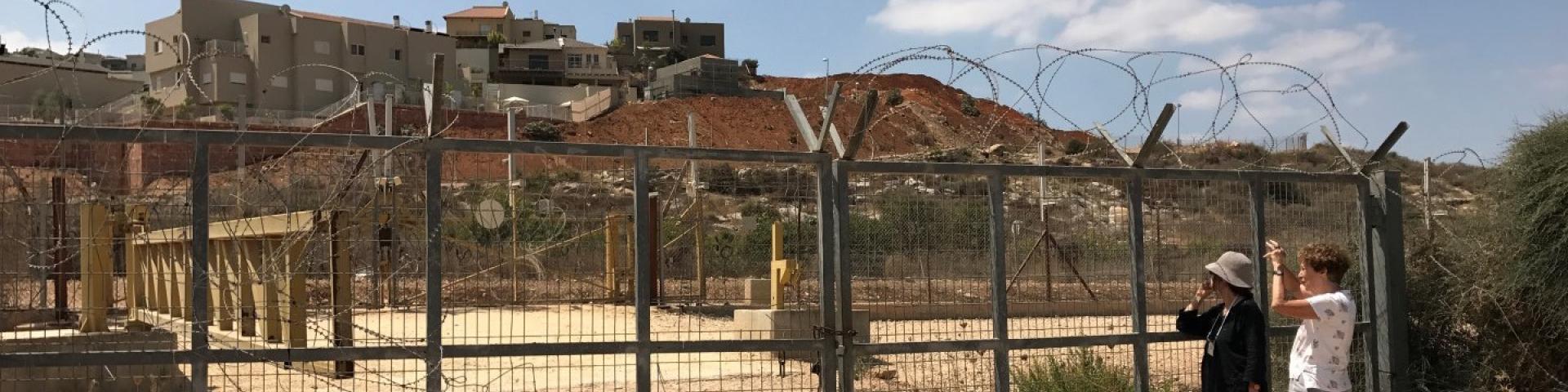
Now the two stand on the mountain, looking at the roads leading to the village, watching the military posts. From above, on top of the hills, new settler outposts are being established. “It is dangerous to go up there,” says the mayor, pointing to one of the roads. “These houses were built recently.”
Perlman takes photos. Her friend writes a report. In the end, they will write a report for Machsom Watch, even if they have read these reports thousands of times: religious settlers taking over Palestinian land, women laying stones, soldiers not intervening, but protecting the settlers. Like here in Qusra, where settlers attacked Palestinian families and burned houses, and the army was there, but did not prevent it.
The settlement movement has grown over the past four years under the current right-wing government, in a place of severe violence. As reported by human rights organizations and the UN, this year there have already been more than 1,200 settler attacks on Palestinians, and more than 3,000 people living in this area were forced to leave their homes. Netanyahu, however, speaks of a few, a small group of violent youths who do not represent the vast majority of settlers. But the West Bank is protected by the army from Palestinian terror, as claimed.
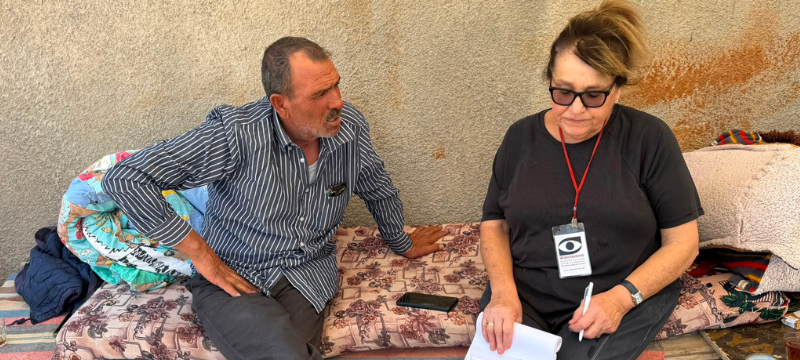
The mayor of Qusra, an impressive man with a dark mustache, wears glasses and uses a cell phone. His name is Hani. He says: “The street used to be green, now everything is destroyed. The Palestinians here want to live, they want peace.”
Her grandson Uri sees this completely differently. At his parents’ home in Tel Aviv, he talks about October 7. While on that day Palestinian militias in Gaza massacred people, stones were thrown here at the checkpoint. “When October 7 happened, people saw what took place,” he says. “It showed that we must protect ourselves. October 7 changed people’s thinking. In the end, it showed that you cannot live next to a war zone and that there is no other option.”
So she pulls out her phone and takes a photo of the settler
What the Palestinians feel, that he understands, he says. On the one hand, they want to live somewhere else. On the other hand, Hamas killed people on October 7. “Someone once said that we must maintain control,” he says. In the West Bank, he says, there is a need for more army, more police. A group of Palestinian terrorists tries to infiltrate, but settlers also harm people. “What’s happening there is simply not right.”
In the West Bank, now a few days later, Perlman and her friends stand at the entrance of a Palestinian heritage house. The sky is gray, the sun cannot be seen, only the checkpoint and the soldiers. There are surveillance cameras here documenting everything. The house they are in belongs to Hassan, a Palestinian. He serves tea. He says the settlers set up a small outpost nearby.
Perlman gets up. Without saying a word, she leaves the house and walks toward the checkpoint. There stands a settler with a Kalashnikov rifle, showing no fear. “He feels at home,” says Perlman. She pulls out her phone and takes a photo of the settler, who is again wearing an officer’s hat. “It’s a free photo,” the others say, it’s dangerous.
Perlman talks about the Palestinians, about the distance they travel to reach a hospital. Now, after October 7, the Israeli army blocked the roads. Now they have to take detour routes. The army closed the roads with nets, preventing access. The day after October 7, soldiers blocked the roads with stones, preventing passage. In addition, armed settlers came down from the mountains. People who went up to their lands were shot at. Now they see broken people, farmers who cannot reach their lands. “It is cruel,” she says.
“The culture is very difficult,” says Perlman. “The younger generation wants to fight. ‘We do what is necessary because we want to save the country,’ they say. But it’s not completely dictatorial. There are others too. The only way is a different way. There are many people who want peace.” She hopes that the new generation in Israel, the young people, the voters, especially Israelis in the West Bank, will understand this. She believes Israel needs a generation of people who are not afraid. People like her grandson.
When children think differently, the grandson finds it okay
Uri Perlman sits on the sofa. He is ready for his military service. He wants to serve in a combat unit, an infantry unit. Most of his friends want this. “There are good reasons for it, I want to be there,” he says. “I want to be active.” Some of his friends were in Gaza or Lebanon. “My girlfriend’s brother didn’t return for a month, and we only got messages from him.” These are stories that frighten him, but he finds something positive in them.
He also talks about the situation in Lebanon. In 2006 there was a war in Lebanon. He asked his father about his experiences, but the father didn’t want to talk about it.
“My parents don’t show it when we talk about politics at dinner,” says Uri Perlman. Neither do his grandmother and grandfather talk about it when they visit on weekends. They avoid such topics, the war, the settlements. He knows they disagree. “I understand why my grandmother does it, but I don’t really talk about it, what my grandmother does, what she does for her family. She travels there because she wants to change something.” He himself is trying to find his position. “I’m young, some of my friends are right-wing, and others are left-wing.”
A week later. Roni Perlman and the others are on their way again. The driver drives past a large supermarket, near the Hadassah-Ein Kerem junction. “Excellent,” says Roni Perlman. She looks at her grandson. Uri sits next to his father. Her brother-in-law said last week at dinner with Uri: “Look how the flowers bloom. These are the Palestinians.” She shares that she spoke with her other grandson, who is currently in Zurich. Both talk about Europe when he returns.
Uri Perlman wants to serve in the army, to protect the country. A child you taught to read is now standing at the front. “We must continue,” says Uri. “I understand my grandmother, but now, with the jubilee celebrations, with all the protests, we have changed.” He looks at his grandmother. She reads today’s entries in her diary. “It will all end soon,” it says there. “It won’t end in the near future.” But she hopes that eventually there will be another way. “For individuals living here, for people with a dream, for the land and the state, peace is deserved.”
The question also arises for the grandson: “If the people living in the land understand that responsibility rests on both? I see what is happening, but can I change my mind? No,” he says. “The terror attacks of recent years showed us that the soldiers and the people are just a distance away from us. Therefore, I don’t want to let it happen. I want to contribute so that what happened won’t repeat itself. 99 percent of the people here want the good of the country. That’s no reason not to fight.”
In the West Bank, evening falls. The hills are wrapped in a gray mist. The settlement area is a symbol of Israel. If you ask Palestinians, they will tell you they fear the settlers will take over the West Bank. They put up another sign: “We are in the Ariel settlement area.” Ariel is one of the largest settlements, with cultural centers, industrial zones, a sports field, and shops. They stand at the checkpoint. A female soldier opens the gate and looks at the women. Roni Perlman looks back. “Top priority,” says the female soldier, “is to protect the country.” They get on the bus and drive away.