
A quiet and calm morning in Qalandiya, apparently under the influence of Ramadan
05.15. On arrival we found the shed empty, with only a few people at the checking stations themselves. As people arrived they passed right away through the open turnstiles. Later the turnstiles were closed occasionally but no lines developed.
Apparently Ramadan influenced the number of people. People told us that the whole week had been quiet. Because of the fast, there is no smoking or coffee-drinking. Women and older folk fit in without problem into the regular lane. We thought that because of the small numbers and, hence, lack of pressure, older people without permits would be allowed to pass – but they were sent back and had to wait until 8 o’clock.
Outside we found the tea kiosk had totally disappeared. (Recently it had been a van, replacing the original kiosk which was removed because of “incipient extension” of the checkpoint.) At first we thought this was because of Ramadan, but then we saw that in the neighbouring wall 4 openings had been made. On the other side of the wall, which is on the Israeli side, is a big parking lot where buses, taxis and ambulances are stationed. We photographed the openings from both sides of the wall. On the Israeli side are piles of building materials. Apparently here will be more checking stations.
The parking lot was totally empty. It seems they have now blocked the side entrance, too. From afar we saw the shades that had been erected in the areas where people have to pass on Fridays. We were approached by a man who asked us if we know Sylvia “who works in the D.C.O. and helps those refused permits.” Of course we enlightened him …
We re-entered the shed. The lines were short and all was quiet. A little after 6, a guard and a D.C.O. soldier arrived, although there was no need to open the Humanitarian gate. We talked with them and asked why they weren’t allowing older people to enter before 8 o’clock, seeing there were no lines and no pressure. Usually we are given the excuse that this is to reduce the pressure when workers are in a hurry. Suddenly the reason has changed and now we are told “what do they have to do in Jerusalem before 8 o’clock? After all, prayers begin only at 11.” When we said that some of them go to work, the answer came from the guard “then let them take out work permits.” The D.C.O. officer’s answer was “It’s the rule.”
At 6.15 we joined a line and passed through in a couple of minutes. We noticed that the D.C.O. officer had already left, and indeed there was no need of him today.
Qalandiya Checkpoint / Atarot Pass (Jerusalem)
See all reports for this place-
Click here to watch a video from Qalandiya checkpoint up to mid 2019 Three kilometers south of Ramallah, in the heart of Palestinian population. Integrates into "Jerusalem Envelope" as part of Wall that separates between northern suburbs that were annexed to Jerusalem in 1967: Kafr Aqab, Semiramis and Qalandiya, and the villages of Ar-Ram and Bir Nabala, also north of Jerusalem, and the city itself. Some residents of Kafr Aqab, Semiramis and Qalandiya have Jerusalem ID cards. A terminal operated by Israel Police has functioned since early 2006. As of August 2006, northbound pedestrians are not checked. Southbound Palestinians must carry Jerusalem IDs; holders of Palestinian Authority IDs cannot pass without special permits. Vehicular traffic from Ramallah to other West Bank areas runs to the north of Qalandiya. In February 2019, the new facility of the checkpoint was inaugurated aiming to make it like a "border crossing". The bars and barbed wire fences were replaced with walls of perforated metal panels. The check is now performed at multiple stations for face recognition and the transfer of an e-card. The rate of passage has improved and its density has generally decreased, but lack of manpower and malfunctions cause periods of stress. The development and paving of the roads has not yet been completed, the traffic of cars and pedestrians is dangerous, and t the entire vicinity of the checkpoint is filthy. In 2020 a huge pedestrian bridge was built over the vehicle crossing with severe mobility restrictions (steep stairs, long and winding route). The pedestrian access from public transport to the checkpoint from the north (Ramallah direction) is unclear, and there have been cases of people, especially people with disabilities, who accidentally reached the vehicle crossing and were shot by the soldiers at the checkpoint. In the summer of 2021, work began on a new, sunken entrance road from Qalandiya that will lead directly to Road 443 towards Jerusalem and Tel Aviv. At the same time, the runways of the old Atarot airport were demolished and infrastructure was prepared for a large bus terminal. (updated October 2021)
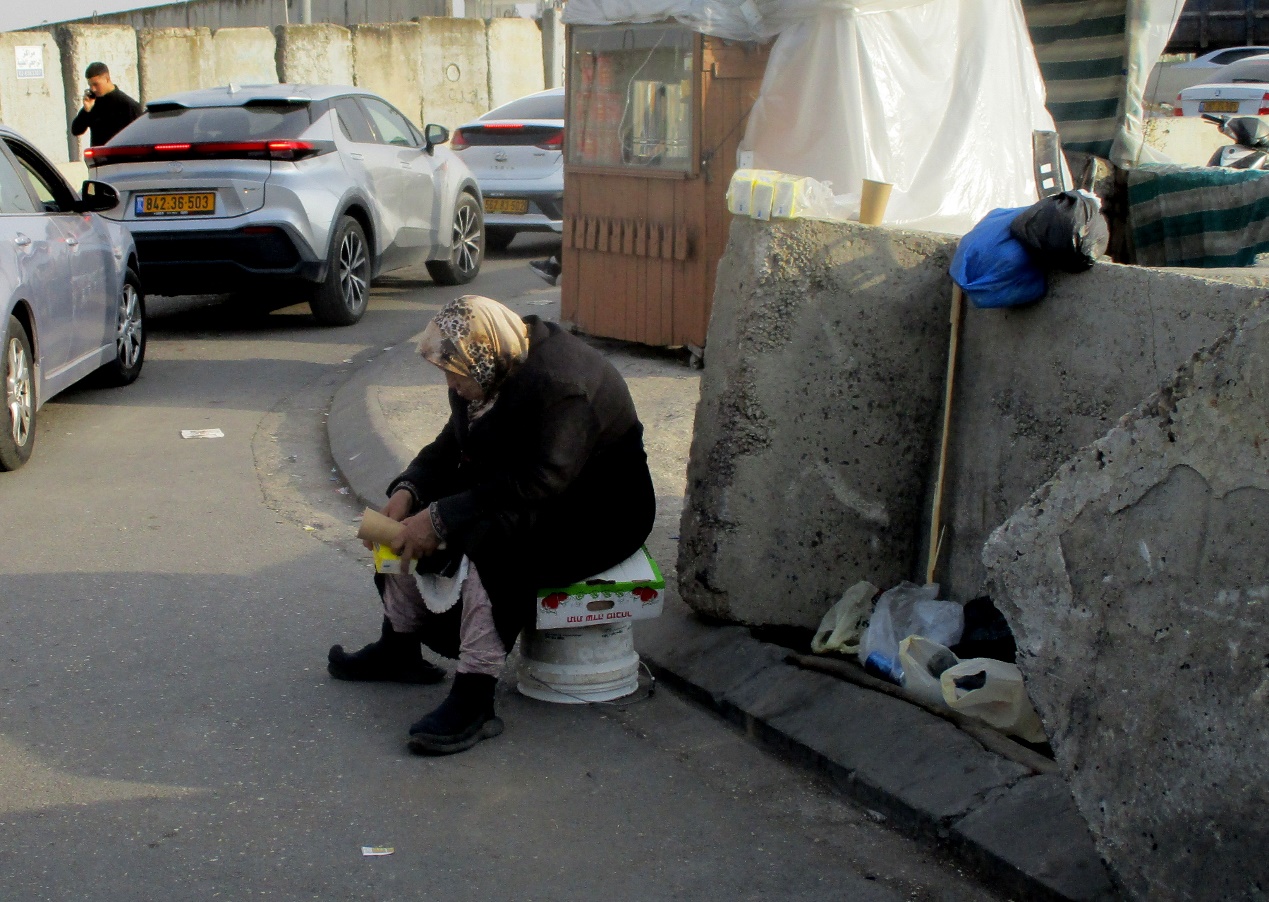 Tamar FleishmanOct-11-2026Qalandiya. Female Beggar
-
