
Dura-Al Fawwar Junction, South Hebron Hills
On our way to visit Farhan in Simiya, at Samu’a Junction the police stops a line of cars and “distributes” traffic tickets.
Farhan, his wife and younger son and grandson welcome us warmly in the shade of the fig tree near the house, with coffee, tea and fresh cucumbers. They say this year the women and children of the village will participate in a beach day (organized by Israeli volunteers, also members of MW) – 67 are already signed up. Assuming that by the planned date (August 7) some will drop out and they will fill a bus. Note that this is the village that made several attempts to establish a school for its children, so they wouldn’t have to cross a dangerous road on their way to the schoolhouse on the other side. All their efforts have been in vain. Now Farhan wants to donate his own land inside the village to build the school. At this point the children are on summer holidays, it’s a very hot day and they are all indoors.
On our way from there, the entrance to Abde with the pillbox army post is open.
At the spring near Dura-Al Fawwar Junction, a flock of sheep is seen drinking. The junction is open in both directions. We drove to Hursa. On our way we left bags with clothes and objects for a second hand shop owner who makes a meager living.
At Hursa, approach to the diwan is difficult since a pillbox post was put up adjacent to it, and the track was declared “closed military zone” and blocked by two large gates. But life goes on: today preparations for a wedding are taking place. The place is already filled with chairs, and now the wedding tent is being put up. People we met here wished to tell us of the hardships – not only has passage been blocked as described above, but an additional, parallel track has also been blocked by the pillbox soldiers with a barrier 203 times a day, especially mornings and evenings, when activity is at its highest.
Before leaving we are asked whether Sylvia (of MW) could help lift two of the locals out of the blacklist – they worked in Israel and were blacklisted and prevented from entry for no reason whatsoever! Suddenly they are on the ‘security’ blacklist. (We will pass on their details to Sylvia, hoping…)
On our way back, again at Samu’a Junction, the police escorted by soldiers, is still here, stopping a line of cars…
Dura Al-Fawwar Junction
See all reports for this place-
Junction on Route 60: west - the town of El Dura, east - the Al Fawwar refugee camp. There is a manned pillbox at the junction. From time to time the army sets up flying checkpoints at the entrance to El Fawwar and Al Dura. Al-Fawwar is a large refugee camp (7,000 inhabitants in 2007) established in 1949 to accommodate Palestinian refugees from Be'er Sheva and Beit Jubrin and environs. There are many incidents of stone-throwing. In the vicinity of the pillbox there are excellent agricultural areas, Farmers set up stalls adjacent to the plots close to the road. In recent months the civil administration has set up dirt embankments thereby blocking access to the stalls, and making it impossible for the farmers to sell their vegetables. Updated April 2021, Michal T.
-
South Hebron Hills
See all reports for this place-
South Hebron Hills
South Hebron Hills is a large area in the West Bank's southern part.
Yatta is a major city in this area: right in the border zone between the fertile region of Hebron and its surroundings and the desert of the Hebron Hills. Yatta has about 64,000 inhabitants.
The surrounding villages are called Masafer Yatta (Yatta's daughter villages). Their inhabitants subsist on livestock and agriculture. Agriculture is possible only in small plots, especially near streams. Most of the area consists of rocky terraces.Since the beginning of the 1980s, many settlements have been established on the agricultural land cultivated by the Palestinians in the South Hebron Hills region: Carmel, Maon, Susia, Masadot Yehuda, Othniel, and more. Since the settlements were established and Palestinians cultivation areas have been reduced; the residents of the South Hebron Hills have been suffering from harassment by the settlers. Attempts to evict and demolish houses have continued, along with withholding water and electricity. The military and police usually refrain from intervening in violent incidents between settlers and Palestinians do not enforce the law when it comes to the investigation of extensive violent Jewish settlers. The harassment in the South Hebron Hills includes attacking and attempting to burn residential tents, harassing dogs, harming herds, and preventing access to pastures.
There are several checkpoints in the South Hebron Hills, on Routes 317 and 60. In most of them, no military presence is apparent, but rather an array of pillboxes monitor the villages. Roadblocks are frequently set up according to the settlers and the army's needs. These are located at the Zif Junction, the Dura-al Fawwar crossing, and the Sheep Junction at the southern entrance to Hebron.
Updated April 2022
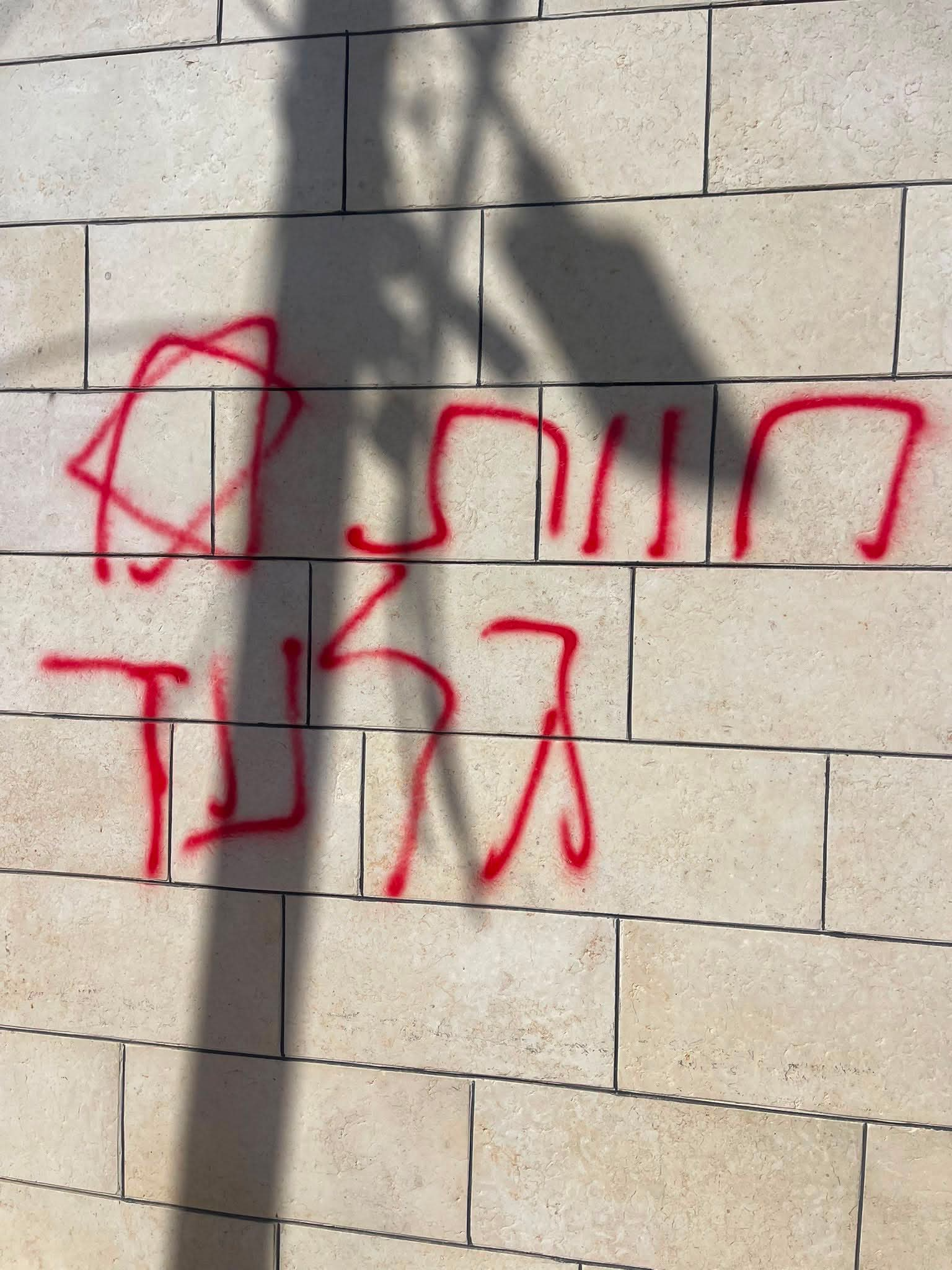 A Palestinian residentJul-19-2026Graffiti sprayed in A-Tuwani
-