
Eliyahu Crossing, Eyal Crossing, Habla, Irtah (Sha’ar Efrayim), Mon 21.1.13, Morning
03:45-04:50 Irtach
The Palestinians’ entry courtyard to the inspection building has been reorganized. The inner gates have also been electrified. The spirals of razor wire along the fence dividing the general checkpoint area from the part considered Palestinian have been removed. There’s now no way to bring women up to the revolving gate without their first joining the main line. The concrete cubes along the exit from the inspection building have been replaced by higher walls that look like stone tiles; the lower portion is made of broad, flat straight surfaces resembling benches.
Congestion is terrible in the fenced lane before the entrance. There is a large group of women bunched around two small bonfires to warm up on this very cold morning.
The electric revolving gate at the entry plaza begins operating at 04:07. A few women manage to enter in the second wave going through the revolving gate. The rest enter only 7-8 minutes later and the congestion is great.
The first few people exit on the other side about seven minutes later From then on, the revolving gate at the exit (constructed, as we recall, according to the venerable checkpoint principle of one-at-a-time) doesn’t stop turning quickly and at a fairly consistent rate. Those coming out can be seen putting more than one layer of clothing back on as they leave the document inspection booths – not only coats, but often the layer beneath as well. Men and women complain to us about the terrible congestion in the lines. Women stress the crowding; they can’t deal with the men or with the undesirable physical contact and touching while on line. Most of the women are adults. They began exiting the other side, in groups, only about 20 minutes after the checkpoint opened. Many of them work picking strawberries during this season.
Many of them arrive an hour or even an hour and a half before the gates open to ensure they’ll get to work on time, because it’s impossible to estimate how long it will take to go through the checkpoint. Some say that yesterday one of the laborers had to be hospitalized because of the crowding.
They say that inspection takes longer than necessary; there aren’t enough inspectors to handle the hundreds and thousands trying do go through in a relatively short period of time and the clerks at the final stage of document inspection work slowly.
At 04:35, the revolving gate at the entrance stopped for about three minutes. We think it was because so many people were crowded into the inspection building.
At 04:50 we drove to the Eyal checkpoint.
People were crowded all through the checkpoint area when we arrived. People came out fairly quickly.
We met Na’im, from Jayyus, who thought it would be good to enable Machsom Watch women to see things from the other side – the congestion, the long wait, etc.
05:30 We drove to the Eliyahu gate
We arrived and parked in the lot. We walked down toward the checkpoint. First one of the security guards stopped us. We waited on a sort of large traffic island adjoining the sidewalk running the length of the parking lot. A particularly extreme example of ornate checkpoint architecture with stone flower pots, ramps resembling mosaic and swaths of artificial grass, though there aren’t multicolored lights illuminating the grass like at the Eyal checkpoint. Then the person in charge appeared and didn’t allow us to walk to the checkpoint, claiming that we “are interfering with people doing their job.” He allowed us only to stand on the sidewalk on the other side of the road, dozens of meters from the checkpoint itself. He was very assertive in his demands which are, in our view, illegal, and we wrote down his particulars in order to file a complaint.
06:15 Habla agricultural gate
The inner area of the checkpoint was illuminated by two giant projectors. In a plastic bag on the gate, so it wouldn’t get wet, was a printed page in Arabic listing the new opening hours of the checkpoint and the telephone number of the humanitarian office in Jerusalem. The projectors were turned off when the gate opened. The soldiers told us that they turn on and off automatically; the gate isn’t illuminated all night long. The area here has also been reorganized; the barbed wire fences that used to be on the inner side of the ditch surrounding the checkpoint area have been removed, the ground leveled and new razor wire spirals have been placed on the external fence on the other side of the ditch. (The garbage surrounding the checkpoint hasn’t been removed).
The gate opened at six-thirty. At 06:35 people in groups of five began coming through the inspection building. Inspection was quick, also for a man and young son in a horse cart.
Tightly packed rows of pruned olive trees were planted temporarily in mounds of earth along the path leading to the checkpoint gate and behind the bus stop. They were about 12-15 years old. At the exit from the village and on the other side of the main road running past it we saw rows of much older olive trees. No one could tell us at this hour of the morning where they’d come from; people only pointed to the plant nursery to which they belonged. Because the crossing operated in a reasonable manner and the soldiers didn’t seem stressed and weren’t unduly pedantic . We left at about 07:30
Eliyahu CP (109) / Crossing
See all reports for this place-
Eliyahu CP (109) / Crossing This checkpoint, also known as the Fruit Crossing, is one of the main checkpoints between Israel and the West Bank. It is located on Route 55 between Alfei Menashe and the turn to Qalqilya and Zufin, more than 4 km east of the Green Line, in the separation fence, which separates Qalqilya from its lands to the south, thus leaving Alfei Menashe West of the fence - the Seam Zone. This checkpoint, a few kilometers across the Green Line, is intended for "Israeli settlement in the West Bank and the population of the Seam Zone." It is managed by a civil company. Palestinians with a special permit for their lands in the seam area are also allowed to pass through it, on foot, and sometimes by car.
-
Eyal Checkpoint / Crossing
See all reports for this place-
Eyal Checkpoint is intended for pedestrians and Palestinians only. This is the main barrier for workers to cross from the center of the West Bank. Workers with a work permit to enter Israel can pass through it for trade, medicine, and visiting prisoners. The checkpoint was built on the Green Line north of Qalqilya in the separation barrier that surrounds the city. The checkpoint began operating in 2004 by the military. Opening hours on weekdays from 04:00 to 19:00. We started holding shifts there in 2007. We arrived at the checkpoint before it opened at 4 in the morning. We reported on the difficult conditions and the long and cramped queues of workers who must continue their journey by commuting to work throughout Israel. At the end of June 2009, the checkpoint was operated by a civil security company, The transit time has been gradually shortened, today it is faster, but the Palestinians still have to arrive very early to make it to the transportation. Usually, about 15,000 people pass through.
-
Habla
See all reports for this place-
Habla CP (1393)
The Habla checkpoint (1393) was established on the lands of the residents of Qalqilya, on the short road that
connected it for centuries to the nearby town of Habla. The separation barrier intersects this road twice and cut off the residents of Qalqilya from their lands in the seam zone.(between the fence and the green line).
There is a passage under Road 55 that connects Qalqilya to the sabotage This agricultural barrier is used by the farmers and nursery owners established along Road 55 from the Green Line and on both sides of the kurkar road leading to the checkpoint.
This agricultural checkpoint serves the residents of Arab a-Ramadin al-Janoubi (detached from the West Bank), who pass through it to the West Bank and back to their homes. The opening hours (3 times a day) of this agricultural checkpoint are longer than usual, about an hour (recently shortened to 45 minutes), and are coordinated with the transportation hours of a-Ramadin children studying in the occupied in the West Bank.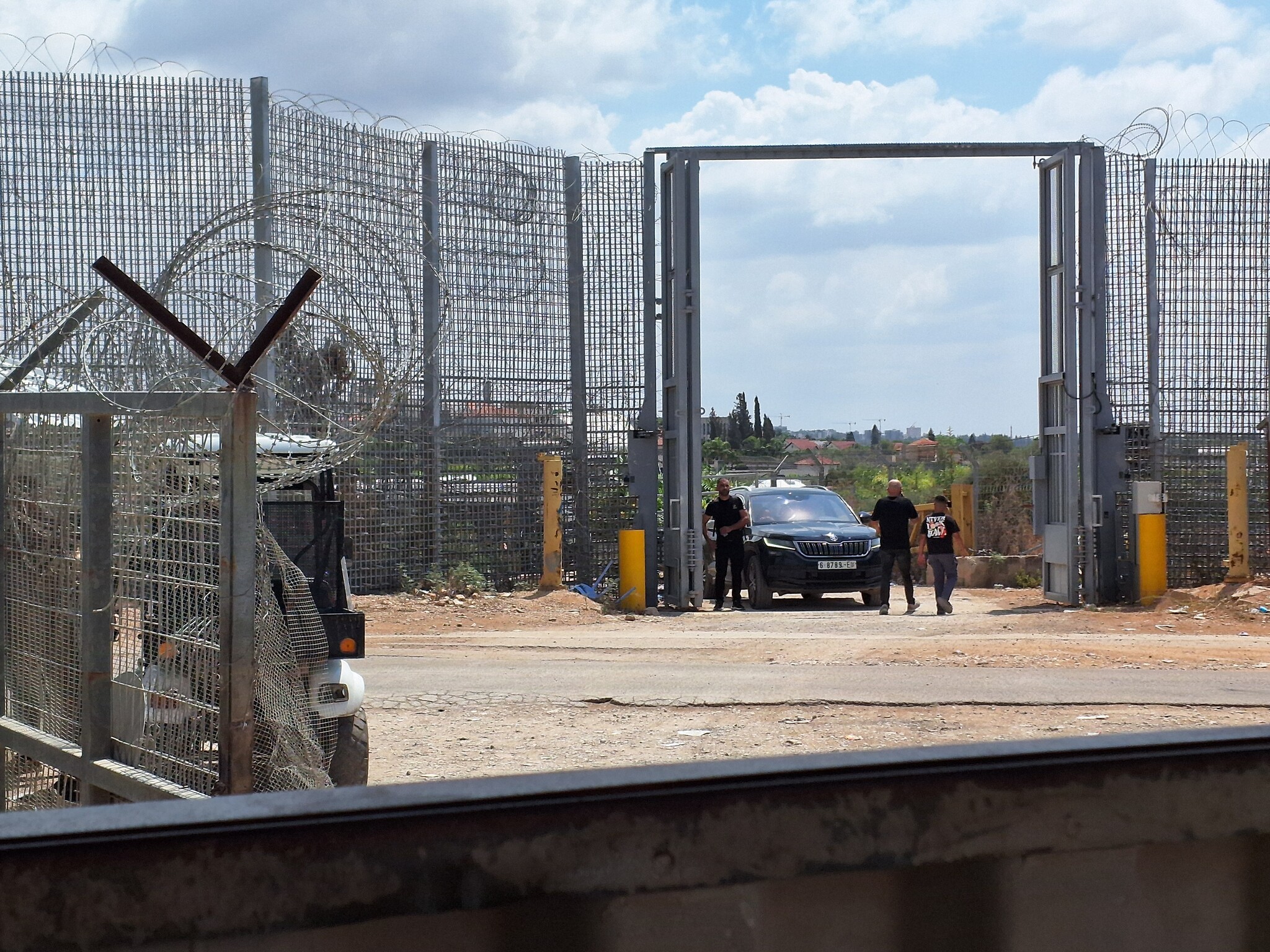 Ronit Dahan-RamatiAug-31-2026Habla. The gate is open
-
Irtah (Sha'ar Efrayim)
See all reports for this place-
The checkpoint is for Palestinians only. It is the main barrier to the passage of workers from the northern West Bank to Israel. Workers with a permit to work in Israel and also for trade (with appropriate permissions), medicine, and visiting prisoners. One can cross the checkpoint only on foot. The checkpoint is located north of Road 557 and south of Tulkarm. Operated by a civil security company, opening hours: between 4:00 and 19:00 on weekdays. As members of Machsom Watch, we began our shifts to this location in 2007. We arrived before it opened at 4 in the morning and report since, on the harsh conditions and the long and crowded queues of workers. The workers who pass by continue their journey by transportation to work throughout Israel. In the first period of its activity, about 3,000 and then 5,000 people passed through this checkpoint every day. Due to the small number of checking points and arbitrary delays for long periods of time in the "rooms", workers feared losing their transportation. Hence workers leave their homes at 2:30 at night to be among the first. Today, 15,000 pass and the transition is faster. Workers are still leaving their homes very early to get past the checkpoint at 7 p.m. In an adjacent compound, there is a terminal for the transfer of goods on a commercial scale, using the back-to-back method.
-
