
Hizma, Qalandiya
To see a demolished home is to see the destruction of a life.
In a big joint operation large contingents of the IDF, the Civil Administration and the Border Police demolished the family home of Hasin Muhammad Hasin Abu-Gosh in the Qalandiya refugee camp.
Hasin Muhammad Hasin Abu-Ghosh, 17 years old, who carried out the stabbing attack in the settlement of Beit Horon in January in which Shlomit Krigman was murdered, didn’t survive. He joined a long list of martyrs from the refugee camp.
On the night of April 20, the home on the third floor of the apartment building deep inside the refugee camp was demolished.
The destruction of the home by the soldiers took more than three hours.
During that time the neighbors below, and their children, and the neighbors above, and their children, as well as those in the adjoining buildings, and their children, heard the hammers pounding, the collapse of the interior walls, the noise of the breaking sanitary facilities and the cries and footsteps of the destroyers, the breakers and the shatterers.
When the sun rose the apartment building still stood, while many mouths gaped in a silent scream from the orphaned apartment on the third floor.

Nine people lived there, parents, four daughters and three sons.
According to the colors of the interior walls, you can guess where the girls slept.

And the boys.

The rooms of the apartment that were emptied of life are also empty of their contents and the walls are empty of pictures.
The pictures were replaced by sprayed black texts and arrows that looked like codes of the operation’s planners.

Among the rubble and the nothingness and lifelessness, through the broken walls, the gaze that passes unimpeded through the rooms and bathroom fixes on an oven standing where the kitchen was.
A whole, undamaged oven, like an actor in a theater of the absurd.

And the neighbors’ lives continue, because life continues so long as you’re alive, and new laundry hangs on the clotheslines of the apartment below, and people walk on the other side of the street and on the adjoining street, looking up and shaking their heads.
The open door, an invitation to enter and see and experience, hangs on its hinges. A young family member closed it as they left, locked it with a key and put the key in his pocket, because a key is important. Even though it’s clear thieves won’t come to the home that has been emptied of its property, a key is important, a key represents the myth.
And pictures of two martyrs are pasted on the inner side of the door. Of Hasin Muhammad Hasin Abu-Ghosh,above an older picture of Ahman Abu-A’aleysh who met his death when shot by soldiers six months earlier during a demonstration against the demolition of another home in the same refugee camp.

The demolition of the home was carried out (as is written) “according to the politicians’ orders .”
http://news.walla.co.il/item/2954649
But why?
It’s not punishment. Because the one because of whom the decision was made to demolish the home is no longer living, and the dead can’t be brought to trial or punished. Could the sons’ sins fall upon the fathers? Of course they could.
Nor does the demolition of homes deter. That’s said both clearly and implicitly by senior security figures, and also in conversations with acquaintances and is implicit in the looks of people in the refugee camp alleys.
The only possible answer to the question of why, is to make a show, to prove how strong is the IDF, how vindictive and cruel. A proof not aimed at the Palestinians, who know the IDF is strong, vindictive and cruel, but at Israeli society.
—————–
What the army does every day and every night in the village of Hizma is drive the residents crazy.
“Since the Jews’ holiday started they’re here constantly,” they said.
The two entrances to the village, the one to Highway 60, in the front of the village,

And the one in the rear, at the road to Jericho,

are both blocked by soldiers who stop every vehicle, inspect documents and rummage through the trunk, and create a line of dozens of vehicles along the road that crosses the village.
“Today the soldiers are good,” said the guys at the gas station, “we even gave them ice cream and juice.” Did they accept them? “Sure they did.”
So today they’re good, but yesterday, Saturday, they weren’t good, there were Border Police soldiers who, as well inspecting cars, also patted down the men. “They do all that to mess up our lives,” one man said, correctly.
But even the term “good” is relative, because while the (Palestinian) guys are talking and telling us, one of “good guys” who has to urinate went over to the wall of a shop, turned around and pissed against the wall.
Hizma
See all reports for this place-
Hizma
A checkpoint at the north-eastern entrance to the Jerusalem area which was annexed in 1967, at Pisgat Zeev. The passage is allowed to bearers of blue IDs only. Open 24 hours a day.
-
Qalandiya Checkpoint / Atarot Pass (Jerusalem)
See all reports for this place-
Click here to watch a video from Qalandiya checkpoint up to mid 2019 Three kilometers south of Ramallah, in the heart of Palestinian population. Integrates into "Jerusalem Envelope" as part of Wall that separates between northern suburbs that were annexed to Jerusalem in 1967: Kafr Aqab, Semiramis and Qalandiya, and the villages of Ar-Ram and Bir Nabala, also north of Jerusalem, and the city itself. Some residents of Kafr Aqab, Semiramis and Qalandiya have Jerusalem ID cards. A terminal operated by Israel Police has functioned since early 2006. As of August 2006, northbound pedestrians are not checked. Southbound Palestinians must carry Jerusalem IDs; holders of Palestinian Authority IDs cannot pass without special permits. Vehicular traffic from Ramallah to other West Bank areas runs to the north of Qalandiya. In February 2019, the new facility of the checkpoint was inaugurated aiming to make it like a "border crossing". The bars and barbed wire fences were replaced with walls of perforated metal panels. The check is now performed at multiple stations for face recognition and the transfer of an e-card. The rate of passage has improved and its density has generally decreased, but lack of manpower and malfunctions cause periods of stress. The development and paving of the roads has not yet been completed, the traffic of cars and pedestrians is dangerous, and t the entire vicinity of the checkpoint is filthy. In 2020 a huge pedestrian bridge was built over the vehicle crossing with severe mobility restrictions (steep stairs, long and winding route). The pedestrian access from public transport to the checkpoint from the north (Ramallah direction) is unclear, and there have been cases of people, especially people with disabilities, who accidentally reached the vehicle crossing and were shot by the soldiers at the checkpoint. In the summer of 2021, work began on a new, sunken entrance road from Qalandiya that will lead directly to Road 443 towards Jerusalem and Tel Aviv. At the same time, the runways of the old Atarot airport were demolished and infrastructure was prepared for a large bus terminal. (updated October 2021)
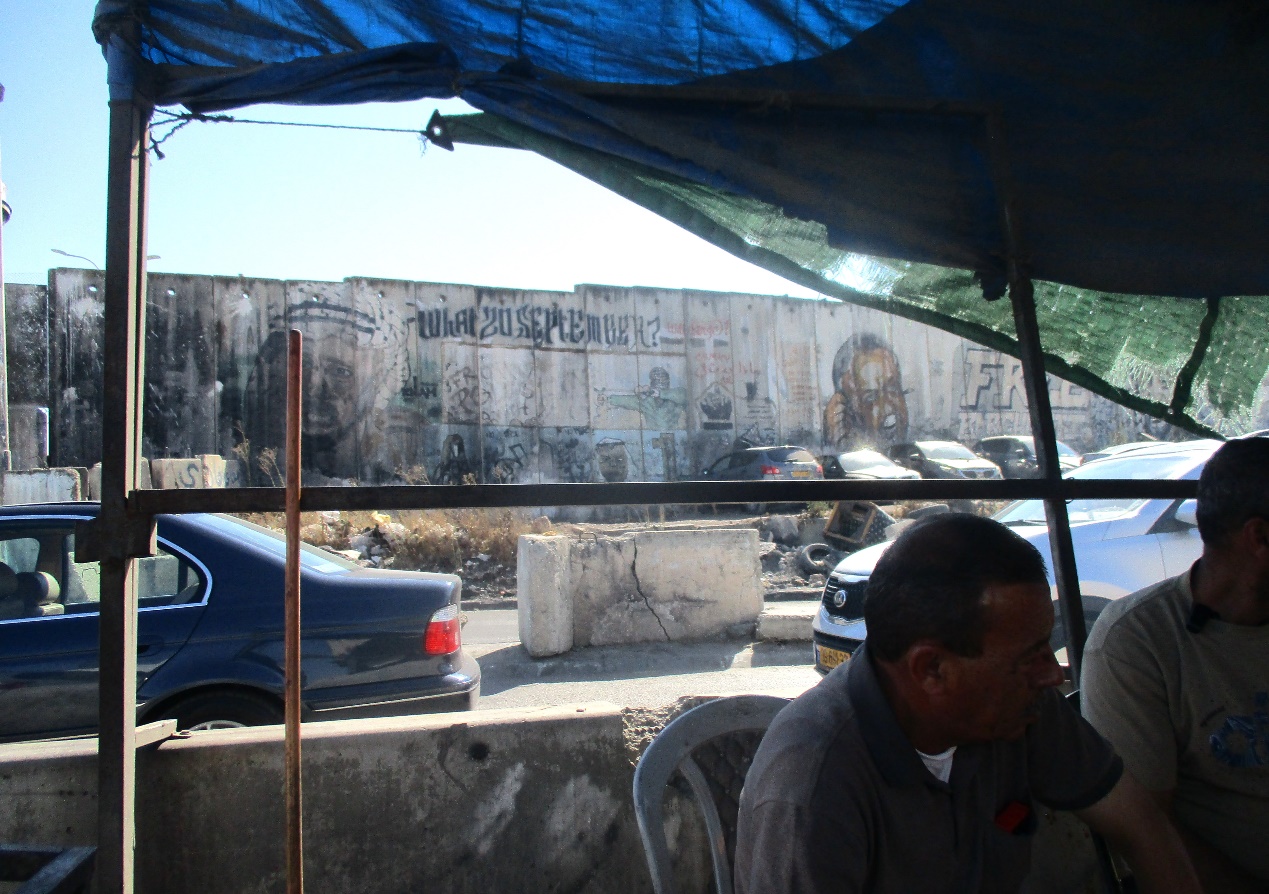 Tamar FleishmanJul-21-2026Qalandiya. Conversation in the shadow of the wall
-
