
Humsa: Distributing Fans and Providing Protective Presence
Life under occupation is not the only hardship Palestinians face. The intense summer heat and the prolonged absence of rain have made daily life almost unbearable. While these are natural conditions that local communities have always had to cope with, enduring temperatures of 40°C (104°F) places an enormous strain on families already living under extremely difficult circumstances.
After receiving several requests for electric fans, we appealed to MachsomWatch members for donations. Their response was immediate and generous, enabling us to purchase a carload of fans. Nava also brought five large bags of food donated by a supporter from Jaffa.
One of the most urgent requests came from a family displaced from Ras al-Ayn (Auja), who told us they had literally run out of food.
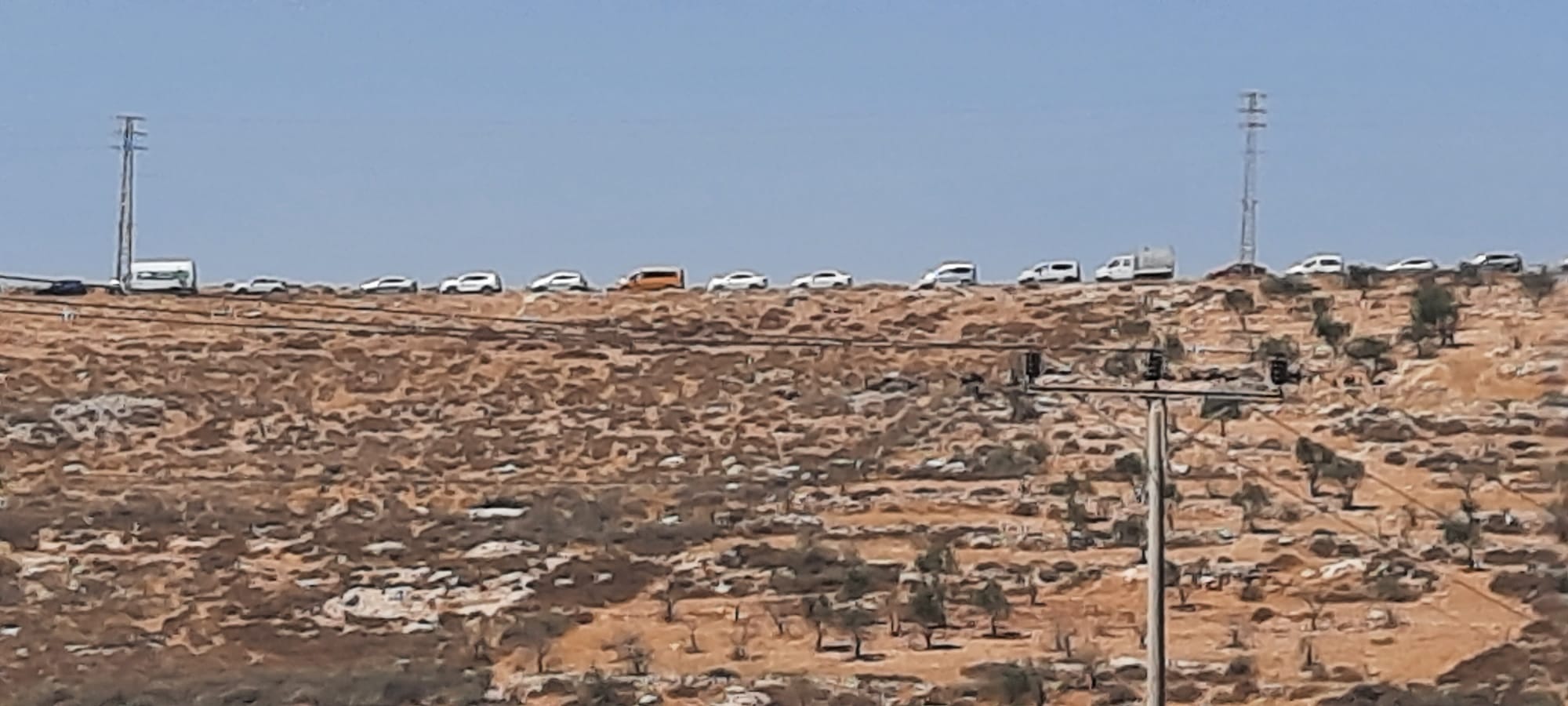
We chose the longer route to Auja via the Allon Road, passing near Taybeh, after reading reports by Looking the Occupation in the Eye describing violent settler attacks on the community near the Taybeh junction, as well as a temporary military checkpoint at the entrance to the town.
Long before we reached the junction, we saw a line of cars and trucks stretching across the hillside. At the roundabout, four armed soldiers were stopping every vehicle attempting to leave Taybeh. During the entire time we observed the checkpoint, no traffic was allowed to exit the town.
We initially watched from a nearby vantage point, but a police vehicle suddenly appeared behind us and began approaching. To avoid the possibility of arbitrary detention, we quietly turned around and retraced our route until we were able to lose the police vehicle.
Driving south through the winding road past the now-deserted communities of Mu’arrajat and others that had been forcibly displaced from their land, we eventually reached Al-Auja. There, in the community hospitality tent, we met Israeli and international volunteers preparing to provide protective presence in the Sateh area near Jericho and south of Al-Auja.
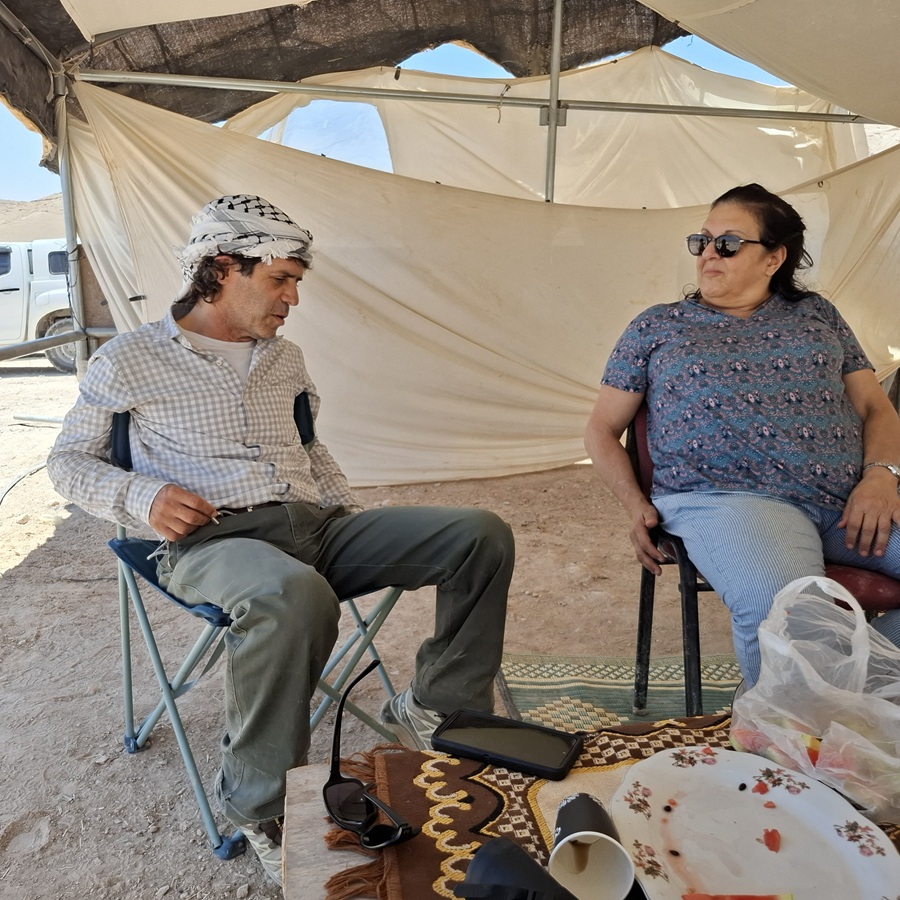
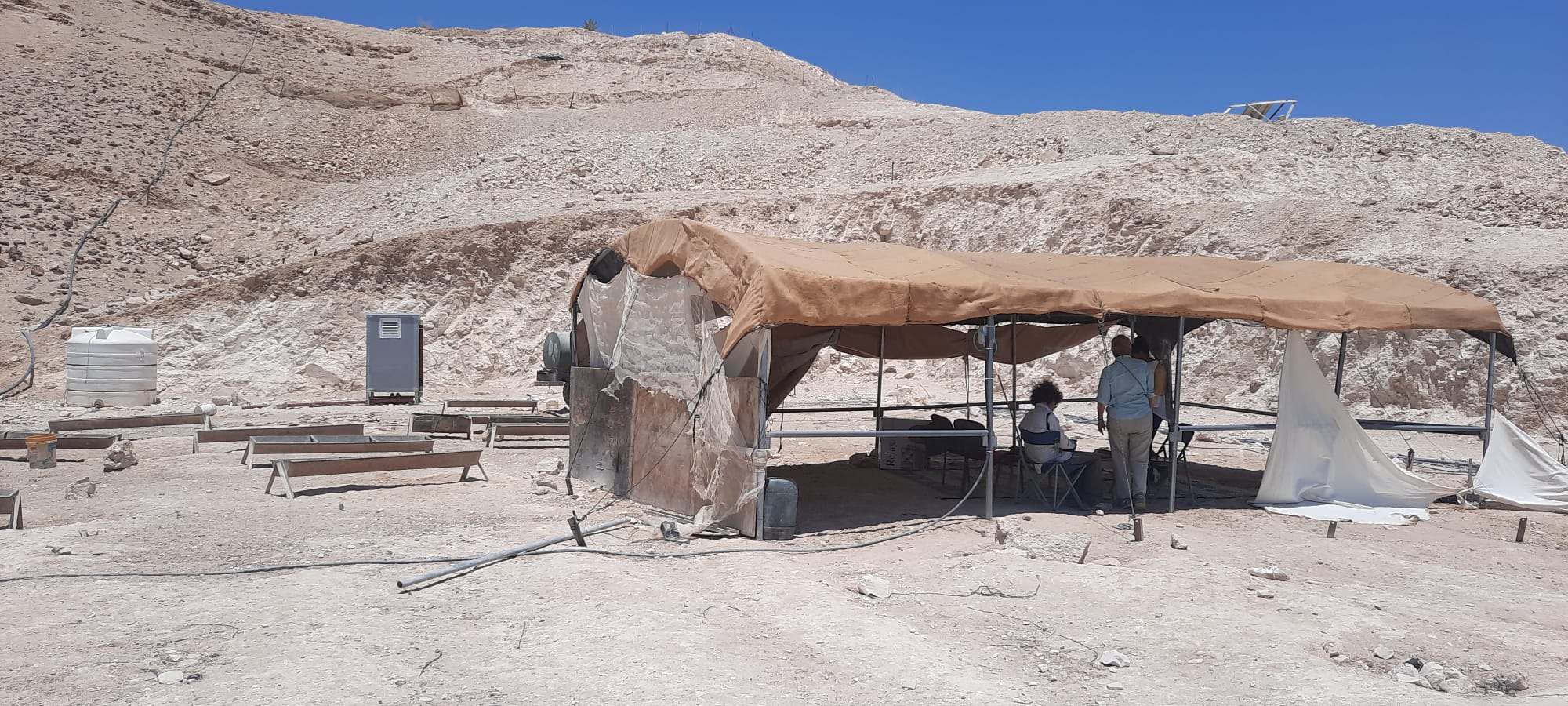
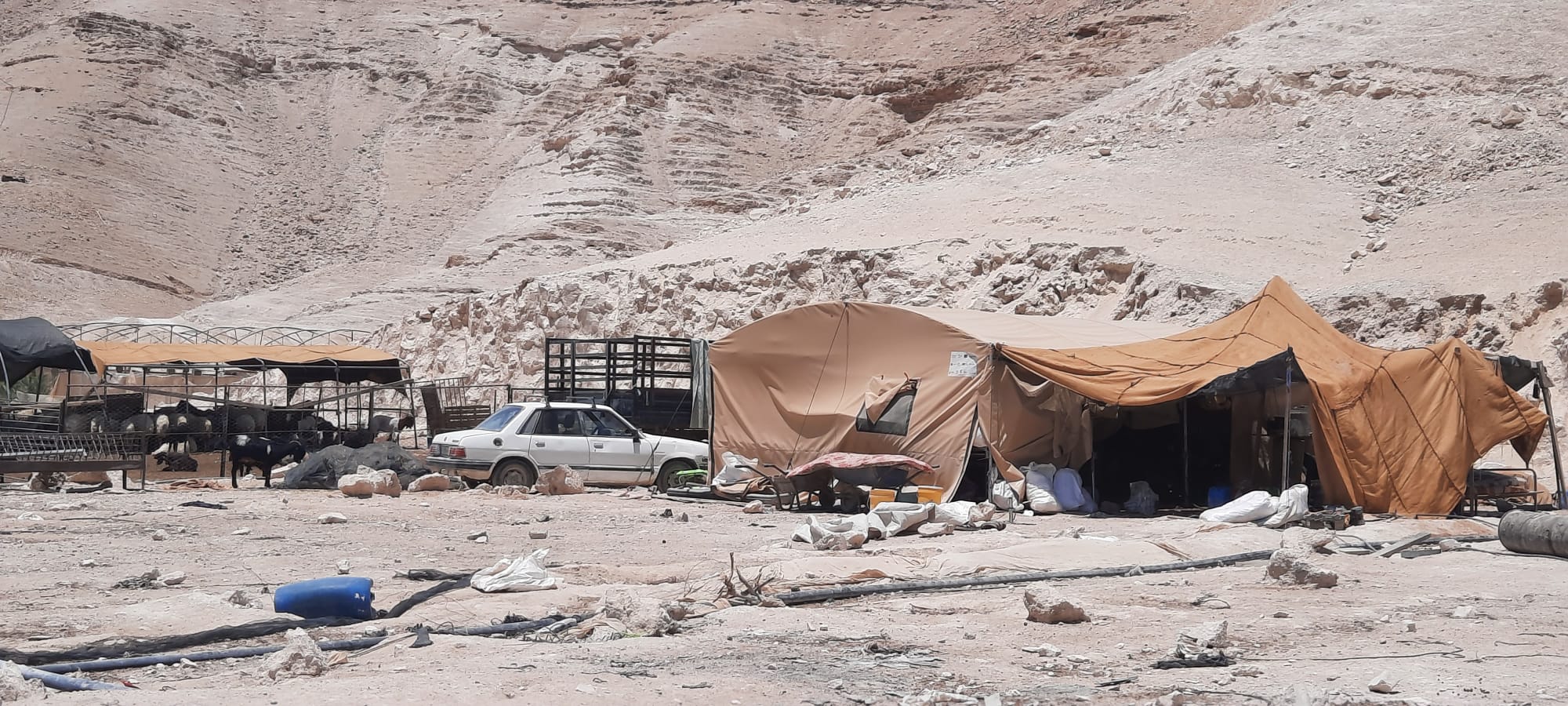
Together with Oded Paporish and Anat Pollak, we visited a family that had been displaced from Ras al-Ayn about a year ago and now lives in isolation near Highway 90.
Even there, another settler outpost has recently been established along the edge of Area A. According to the family, settlers have already begun entering their tents and harassing them. Although the surrounding area contains date plantations owned by residents of Jericho, members of the Jahalin Bedouin community are prohibited from grazing their goats there and have effectively lost their livelihood.
We arrived in response to their desperate appeal for food, bringing both food supplies and a fan. Sitting together in the family’s tent with the father, M., and his two delightful daughters, we shared a warm conversation. Yet it was impossible not to wonder how long this gentle family could continue to endure life in such isolation, without the mother, and under constant intimidation from their new neighbors.
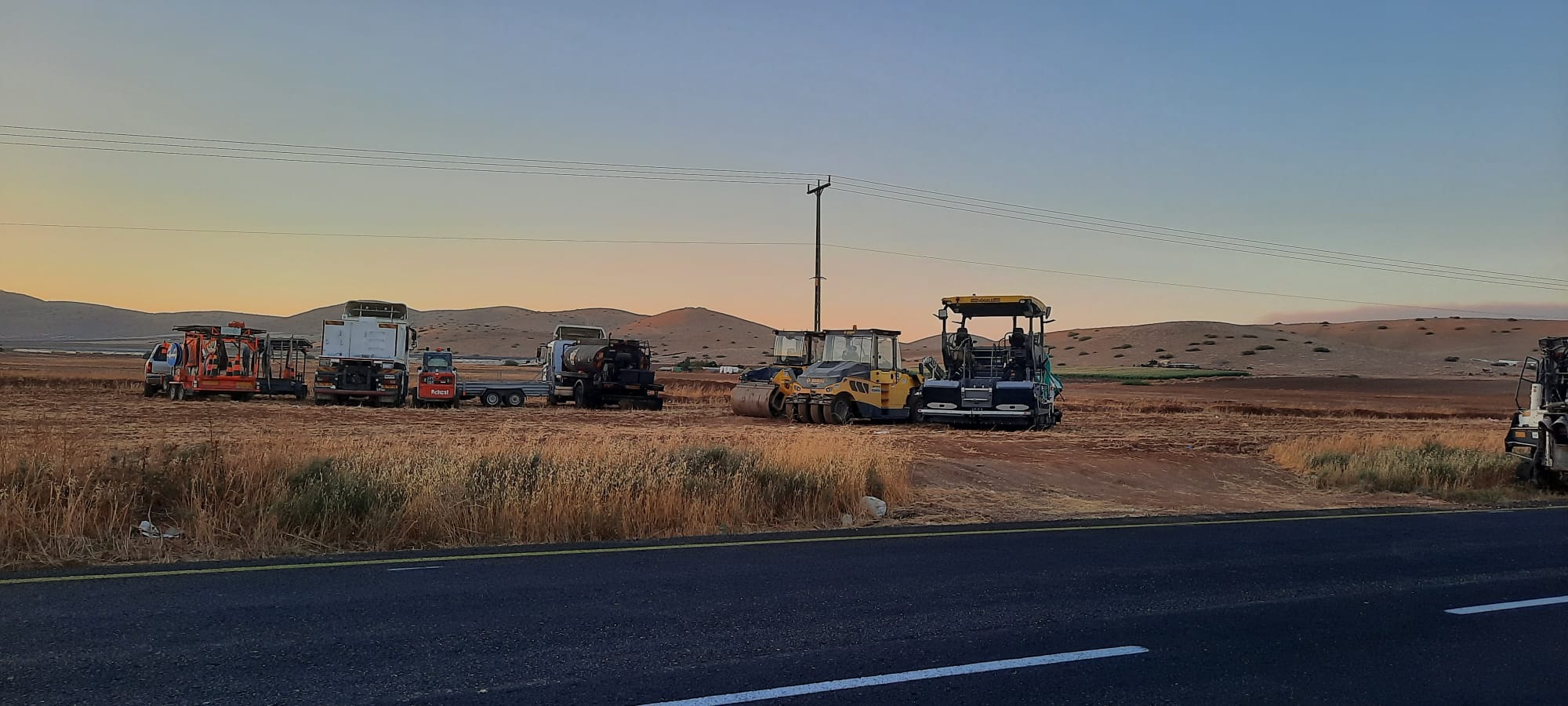
We continued north through the Jordan Valley. Near Ro’i and Beka’ot, where water tankers once transported water from Atuf, Israeli bulldozers were carrying out extensive earthworks. Residents explained that the apparent purpose is to extend the separation between the Jordan Valley and the central West Bank by approximately one and a half kilometers, deep into Area B.
They described widespread destruction of agricultural infrastructure. Once a fertile farming region supplied by pipelines and wells located in Area A, the area has seen its water infrastructure destroyed: pipelines cut and wells sealed. It was heartbreaking to witness how quickly a once-thriving agricultural landscape has become dry and barren.
In Makhoul, we distributed fans to every family. One family we are especially fond of is that of A. and R. (A. S.’s daughter). Their home is always filled with warmth and calm. The children eagerly join the conversation, and the family’s quiet dignity—including the fact that they never ask for anything—makes every visit especially meaningful.
Our visit to Y. and N. was particularly painful. Their 18-year-old son, Hussein, has now spent four months in administrative detention. His imprisonment has devastated N. physically and emotionally. She has become so thin and frail that she is barely recognizable.
Hussein is scheduled to be released on August 8, but experience has taught us that his detention could be extended for another six months without trial or formal charges. Since the appointment of Itamar Ben-Gvir as Minister of National Security, reports about the treatment of Palestinian prisoners have become increasingly alarming, leaving families deeply fearful about the condition in which their loved ones may eventually return.
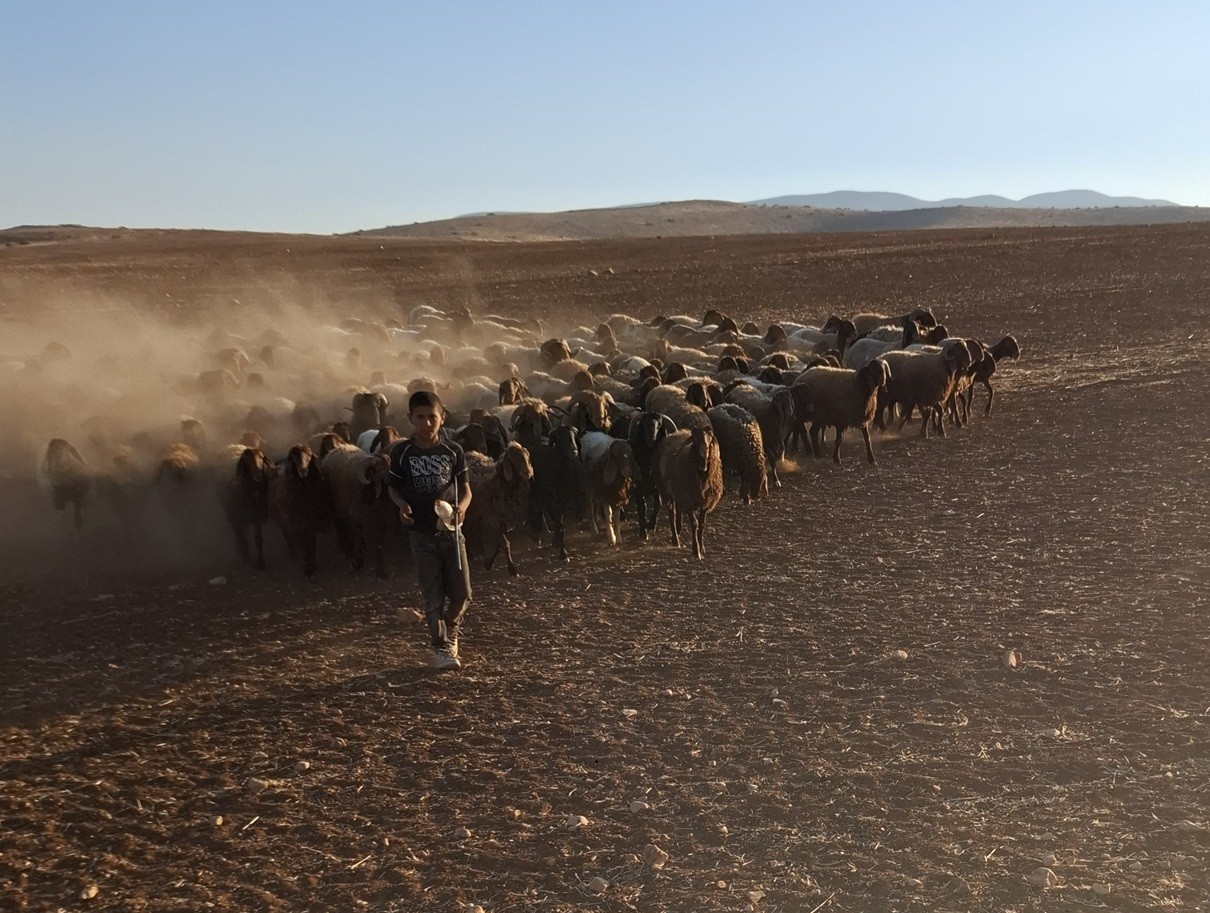
In Humsa we distributed more fans, much to the joy of the residents. They told us that only a few days earlier settlers had entered the village, walked into people’s homes, sat inside them, and behaved as though they owned them.
At 6:00 p.m., we began our drive home. Before leaving, however, residents asked us to travel east to where a grandfather and his grandson were grazing their flock. They had seen a military vehicle heading toward them and feared trouble.
Although we were unable to reach the shepherds directly because they were about a kilometer from the track, we remained in contact by phone while observing from a distance. They reported that soldiers had approached them on foot and were forcing them to leave the grazing area. After an argument, the shepherds, as so often happens, were compelled to withdraw and make their way back toward their encampment. We drove behind them until they reached safety, hoping our presence would discourage further harassment.
Before leaving the area, we collected several international volunteers from the first Humsa encampment and drove them to the most remote community, where they would spend the night providing protective presence to residents whose community had suffered a serious settler attack only three months earlier.
It was nearly 8:00 p.m. before we finally began our journey home.
Location Description
Humsah
See all reports for this place-
Humsah
A shepherd community in the Jordan Valley. It is located in a remote place in Area C. There are no convenient ways to reach it. Its inhabitants make a living from their flocks. Like other shepherd communities, they live without basic infrastructure. This shepherd community is exposed to settler harassment and demolition of property by the military through civil administration orders.
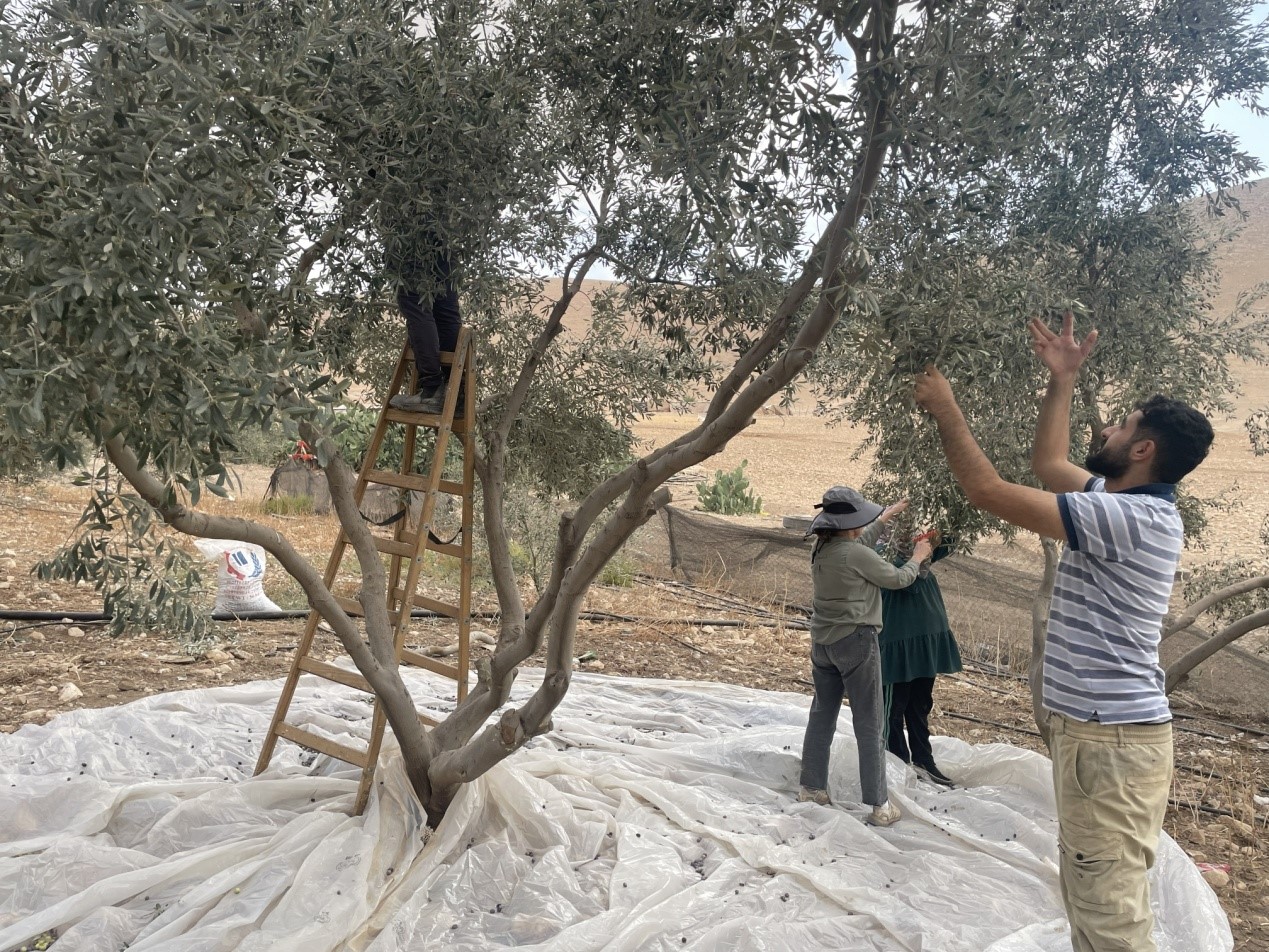 Rachel AfekOct-15-2026Olive Harvest in the Jordan Valley
-
Jordan Valley
See all reports for this place-
Jordan Valley The Jordan Valley is the eastern strip of the West Bank. Its area consists of almost a third of the West Bank area. About 10,000 settlers live there, about 65,000 Palestinian residents in the villages and towns. In addition, about 15,000 are scattered in small shepherd communities. These communities are living in severe distress because of two types of harassment: the military declaring some of their living areas, as fire zones, evicting them for long hours from their residence to the scorching heat of the summer and the bitter cold of the winter. The other type is abuse by rioters who cling to the grazing areas of the shepherd communities, and the declared fire areas (without being deported). The many groundwaters in the Jordan Valley belong to Mekorot and are not available to Palestinians living in the Jordan Valley. The Palestinians bring water to their needs in high-cost followers.Rachel AfekOct-15-2026Olive Harvest in the Jordan Valley
-
Khalet Makhul
See all reports for this place-
Khalet Makhul
A small settlement of a shepherd community located on the way to the settlement of Hemdat. Two nearby outposts make life miserable for the Palestinians, who make a living from grazing, and the army backs the settlers. As a result, the possible grazing areas are getting smaller.
The local children attend school in the settlement of Ein Al-Beida. Long lines of 3 hours sometimes stretch out at the Hamra and Tayasir checkpoints leading to the town of Tubas, making it difficult to get water, supplies, and sell the cheese, milk, and meat that the residents produce for their living.
Following a deadly attack at the Tayasir checkpoint in February 2025, the checkpoint was closed completely for the time being.
(Updated March 2025)
-
