Back to reports search page

Huwwara

Place: Huwwara
Observers: Carol Cook and Susie Ahyed (reporting)
Apr-07-2016
| Afternoon
Uneventful ride along the highway. Previous varied concrete posts have been replaced with brightly colored yellow posts with letters and numbers (probably for the army).
The road to Akraba had some large boulders blocking the entrance (put there by the army?), but they have been moved (by the villagers?) to allow cars to pass. The village is quiet, most of the stores are open and the atmosphere is peaceful. On the hill opposite the village we see a large blue tent and what looks to be a small caravan, but we cannot identify them.
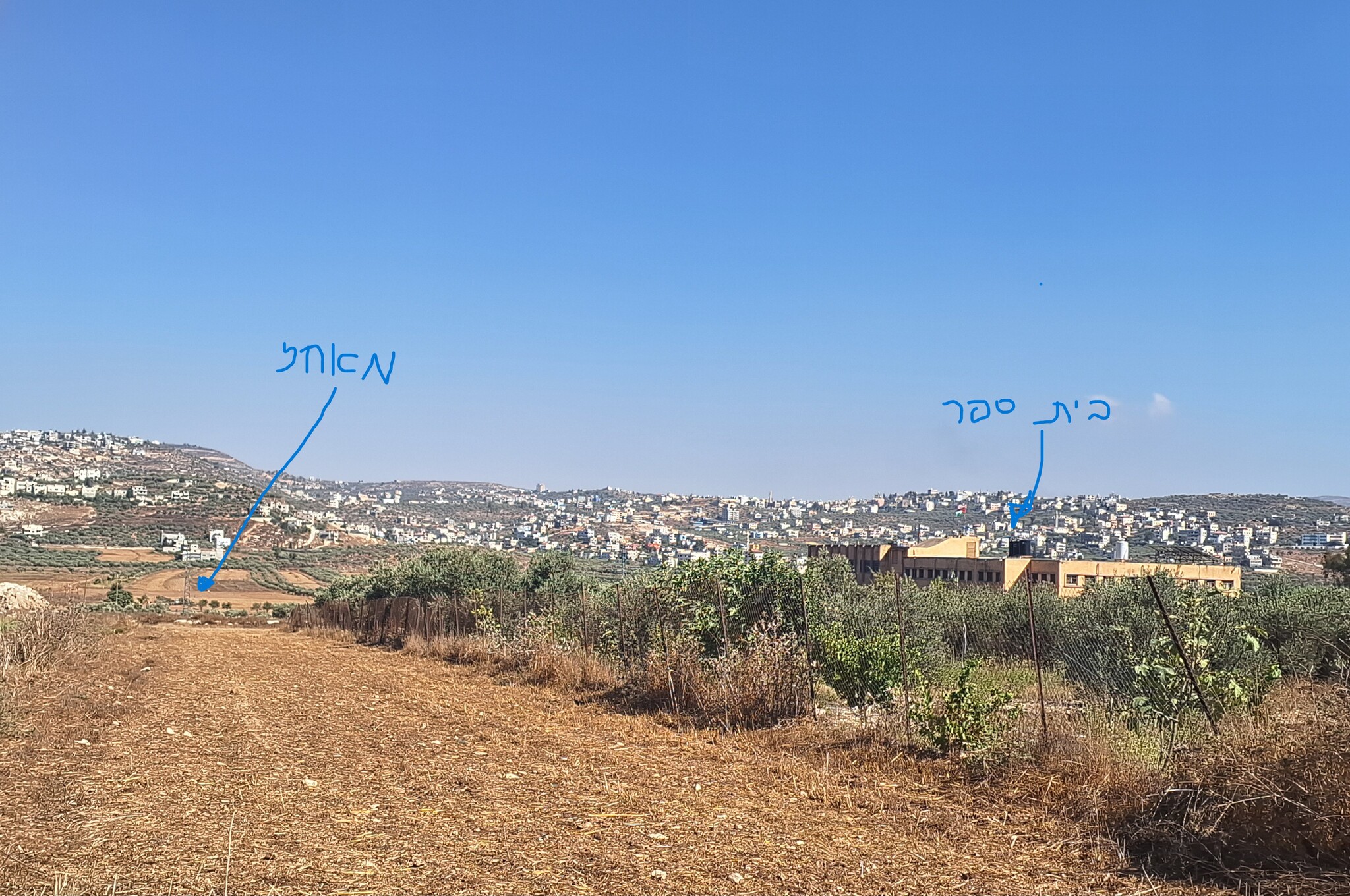
Between Akraba and Yanun the road has been paved with asphalt and at the end it leads to the open fields besides the village. As we approach Yanun we can see that the settlement of Itamar has encroached upon the land surrounding the village and is nearing the village on both the right and left sides – the left side by a warehouse and the right side a water tower.
As we reach the village we meet Inge and Anders Dejke from Sweden who are volunteers with EAPPI (Eucumenical Accompaniment Programme in Palestine and Israel) and are presently staying in the village in the rented EAPPI house. They are wearing vests that identify them and invite us into their home. The EAPPI program is run by the World Council of Churches and sends volunteers from all over the world to their houses in Jayus, Jerusalem, Bethlehem, Hebron, and Yanun among others. The volunteers stay for an initial period of three months and many come back every year or two for a month or several weeks.
We found the couple to be very interesting and informative. They have been married for 50 years and are both retired school teachers. Anders was first in Tulkarm in 2006 and has been back to the area five times since then. They said that since 2006 the settlement of Itamar has been moving its fences closer and closer to the village and often armed settlers would walk through the village in the evening. Since then many people have left the village, perhaps more than half, who have moved down to Akraba. When we were in the village some months ago there were 16 children in the elementary school, today there are 8. The high school is in Akraba and the youngsters who go to college go to Nablus. Since the village is partly in area C they cannot build and when the young people get married they have no place to live so they leave the village. There are many empty apartments in upper Yanun which we were told had recently been looked over by the settlers. Could they be moving in?
Some months ago the Mayor was awoken in the middle of the night by the army who said that one of the settlers reported a goat had been stolen. He was told to round up all the men from the village to the village square. When he refused he was told that if he did not get them, the army would make trouble. All the men were rounded up into the village square and then all the houses in the village were searched. No goats were found. Now, at night there are very strong spotlights shining down from Itamar onto the village.
On the way back near Beita and Huwwara we saw many jeeps and soldiers, one jeep was flying a huge Israeli flag through the town. At Zaatra road work was being done and the entrance to Huwwara was blocked by an army jeep.
 
P.S. Anders the Swedish volunteer said that he had met many Machsom Watch membesr during the years he volunteered here and he believed we were doing very important work. He said that when he gave talks in Sweden about his work here he always mentioned the good things that Machsom Watch was doing.
 

  • Huwwara

    See all reports for this place
    • The Huwwara checkpoint is an internal checkpoint south of the city of Nablus, at the intersection of Roads 60 and 5077 (between the settlements of Bracha and Itamar). This checkpoint was one of the four permanent checkpoints that closed on Nablus (Beit Furik and Awarta checkpoints to the east and the Beit Iba checkpoint to the west). It was a pedestrian-only barrier. As MachsomWatch volunteers, we watched therre  since 2001  two shifts a day -  morning and noon, the thousands of Palestinians leaving Nablus and waiting for hours in queues to reach anywhere else in the West Bank, from the other side of the checkpoint the destination could only be reached by public transport. In early June 2009, as part of the easing of Palestinian traffic in the West Bank, the checkpoint was opened to vehicular traffic. The passage was free, with occasional military presence in the guard tower.  Also, there were vehicle inspections from time to time. Since the massacre on 7.10.2023, the checkpoint has been closed to Palestinians.

      On February 26, 2023, about 400 settlers attacked the town's residents for 5 hours and set fire to property, such as houses and cars. Disturbances occurred in response to a shooting of two Jewish residents of Har Bracha by a Palestinian Terrorist. The soldiers stationed in the town did not prevent the arson and rescued Palestinian families from their homes only after they were set on fire. No one was punished and Finance Minister Smotrich stated that "the State of Israel should wipe out Hawara." Left and center organizations organized solidarity demonstrations and support actions for the residents of Hawara.

      Hawara continued to be in the headlines in all the months that followed: more pogroms by the settlers, attacks by Palestinians and  a massive presence of the army in the town. It amounted to a de facto curfew of commerce and life in the center of the city. On October 5, 2023, MK Zvi established a Sukkah in the center of Hawara and hundreds of settlers backed the army blocked the main road and held prayers in the heart of the town all night and the next day. On Saturday, October 7, 23 The  "Swords of Iron" war began with an attack by Hamas on settlements surrounding Gaza in the face of a poor presence of the IDF. Much criticism has been made of the withdrawal of military forces from the area surrounding Gaza and their placement in the West Bank, and in the Hawara and Samaria region in particular, as a shield for the settlers who were taking over and rioting.

      On November 12, 2023, the first section of the Hawara bypass road intended for Israeli traffic only was opened. In this way, the settlers can bypass the road that goes through the center of Hawara, which is the main artery for traffic from the Nablus area to Ramallah and the south of the West Bank. For the construction of the road, the Civil Administration expropriated 406 dunams of private land belonging to Palestinians from the nearby villages. The settlers are not satisfied with this at the moment, and demand to also travel through Hawara itself in order to demonstrate presence and control.

      (updated November 2023)

      .
      חווארה: הבתים הישנים בשטח סי
      Shoshi Anbar
      May-18-2025
      Huwara: The old houses in Area C
Donate

DIGITAL EXHIBITION

25 Years in the Field.

Images that show why we’re still here. 

Enter the exhibition