
Jaba (Lil), Qalandiya, Sun 14.3.10, Afternoon
"In two weeks there going to be a closure, that's fine. But why now? "
The police at Jerusalem is preparing to reinforce its units"-said the broadcaster on the radio.
Some of the reinforced units were to be seen at Qalandyia checkpoint: three police vehicles were parked at the interior lot of the checkpoint. The inventory among "our best fighters" that were sitting or standing nearby, ready to hold back any enemy, was made up of: two Yasam soldiers, a police woman and eight BP soldiers- all of them were bearing arms and bats.
The peddlers surrounding the checkpoint told us about the demonstration that was held by Palestinian women at the checkpoint last Saturday. During the demonstration the women headed towards the separation fence, they giggled it in attempt to take it down. BP soldier hurried to hold them back ,using stun grenades and tear gas. On of the women who fell while tried to escape was beaten and arrested.
According to Kol Israel, five women were arrested.
"In two weeks there's going to be a closure, that's fine. But why now? "- asked a cab driver. This made it clear to me that Passover was about to begin. The Palestinians have to be experts (more than me) in the Jewish calendar and holidays which coincide with the closures.
We weren't able to give Sami, the cab driver, or our American guests, a satisfying answer as to why the Minister of Defense decided to bestow such privilege on the residents of the West Bank.
Sami told us about six people for Gaza who had arrived at the checkpoint that day, they wanted to head back to their city after having received medical care at the West Bank. But although they had received (that very day) their permit from the DCO they weren't allowed to pass, the soldier at the inspection post told them that only once the closure was over, on Wednesday morning (once the opening of the "Ha'Hurba" synagogue is over), will they be able to return home.
Sami, who had thought there had been a misunderstanding or that the people from Gaza didn't understand what the solider was saying, escorted one of them to the DCO offices- this person had difficulty walking since he had just been discharged from hospital after heart surgery. It appeared that while the right hand (of the administrators of occupation) distributes permits, the left hand annuls them. When Sami told the person from the offices that this man was in a bad state and that he must rest at home, he was told: "We allowed him to sit in the air-conditioned room and have a glass of water…"(one of the signs of extreme humanitarianism).
In spite the closure, in spite the fact that only few people could pass and in spite the fact that there were three open lanes, the lines grew longer and the turnstiles outside the checkpoint were locked so to regulate the number of people inside the checkpoint.
On the southern side of the square they were still conducting constructions which caused more limitations on the mobility of the drivers: a yellow metal bare stretched across the road and a line of spikes was sticking from the the other side of the square. As a result of these "improvements" the left turning was prohibited, the direction to Ramalla, and drivers heading there were forced to go east, bypass a square which is several meters away and return to the parallel road heading west. The improvements won't cause any relief they will just more the traffic jam elsewhere.
Jaba checkpoint
We were amazed to find a white police jeep when we arrived. It is notorious among the teenagers of Qalandyia for stimulating riots. The police men were busy checking the cargo of a Palestinian vehicle, the driver was told to step away from it. The camera which emerged in front of them bothered the inspectors.
"Each time they check to see if the vehicles are in order and hand out tickets to those with defects"– said the soldier from the unit manning the checkpoint. When asked whether inspecting under the car's mats or checking every crack in the car had anything to do with the state of the vehicle, he replied: "maybe they are looking for knives…".
Unsurprisingly, the search was over once the camera was directed at the soldier who was trying to hide from it the policeman who was looking in the car. The three of them left not before threatening us that they would give us a ticket for parking on the side of a main road.
The Palestinian driver, who had managed this time to get away with no punishment, told us that the inspection had been going on for about fifteen minutes until we had arrived.
— — —- —- —
Before parting from our guests we wanted to hear about their impressions from the hours they had spent with us. Debby couldn't stop talking and describing the shivers she had when standing inside the human pens, the touch of the metal turnstile, the loud and annoying noises that came from the loudspeakers and then kept repeating over and over again that this is how she imagined the places in which Jews were kept in over sixty year ago were like (unlike me, she didn't hesitate to utter the "sacred name").
James on the other hand talk of the obvious arbitrariness in the reaction toward the people, the loss of time and the uncertainty a person has to face before leaving his home.
They told us that they had met with representatives from the Elad association, from there heard that:
–The Arab houses at Sheikh Jarrah are actually a Jewish property.
– That the authorities offered the Palestinian residents of Silwan to transfer from their village at no cost, but they insisted on staying.
- – That after the Annapolis summon Israel wanted to give the Palestinian residents from East Jerusalem an Israeli citizenship which they had declined.
- – And: You mustn't call the residents of Jehuda and Samaria "settlers", you should call them "residents of the Jewish communities"
Jaba' (Lil)
See all reports for this place-
Jaba' (Lil) In fact, the Jaba checkpoint is east of the Qalandiya checkpoint. Its declared purpose is the prevention of Israeli citizens from entering Area A. A road checkpoint for vehicles, located on Road 65, borders the southern fence of Kfar Jaba, about three kilometers east of the Qalandiya checkpoint, on the road leading to the settlement of Adam on Road 60. Archaeological excavations within the village found the remains of a cloth house from the First Temple period. The events that led to the construction of the checkpoint are precisely here: on the day of the abduction of Gilad Shalit and before the outbreak of the Second Lebanon War, a 17-year-old man from one of the settlements was abducted by a Palestinian cell. His body was found several days later at the entrances to Ramallah. A military investigation revealed that his abductors had taken him along this route. The checkpoint was set up to prevent future kidnappings and to warn settlers from traveling to Ramallah and entering Area A (which is forbidden for Israelis). The checkpoint that operates around the clock. Usually only vehicles traveling in the direction of Ramallah are inspected. (November 2016): Every morning, when the settlers en masse travel to Jerusalem on Route 60 and every afternoon they return from Jerusalem on Route 60, the army initiates a traffic jam at the entrance to the Jaba checkpoint and stops the movement of Palestinians traveling toward Route 60. (February 2020): In the last two years the checkpoint has not always been manned. Sometimes the soldiers come and just stand, sometimes they come and stop and check those who enter the village, sometimes they patrol the alleys of the village, sometimes they fire stun grenades and gas and sometimes they invade houses and stop young people, say those passing through the Hazma checkpoint. (Updated February 2020)
-
Qalandiya Checkpoint / Atarot Pass (Jerusalem)
See all reports for this place-
Click here to watch a video from Qalandiya checkpoint up to mid 2019 Three kilometers south of Ramallah, in the heart of Palestinian population. Integrates into "Jerusalem Envelope" as part of Wall that separates between northern suburbs that were annexed to Jerusalem in 1967: Kafr Aqab, Semiramis and Qalandiya, and the villages of Ar-Ram and Bir Nabala, also north of Jerusalem, and the city itself. Some residents of Kafr Aqab, Semiramis and Qalandiya have Jerusalem ID cards. A terminal operated by Israel Police has functioned since early 2006. As of August 2006, northbound pedestrians are not checked. Southbound Palestinians must carry Jerusalem IDs; holders of Palestinian Authority IDs cannot pass without special permits. Vehicular traffic from Ramallah to other West Bank areas runs to the north of Qalandiya. In February 2019, the new facility of the checkpoint was inaugurated aiming to make it like a "border crossing". The bars and barbed wire fences were replaced with walls of perforated metal panels. The check is now performed at multiple stations for face recognition and the transfer of an e-card. The rate of passage has improved and its density has generally decreased, but lack of manpower and malfunctions cause periods of stress. The development and paving of the roads has not yet been completed, the traffic of cars and pedestrians is dangerous, and t the entire vicinity of the checkpoint is filthy. In 2020 a huge pedestrian bridge was built over the vehicle crossing with severe mobility restrictions (steep stairs, long and winding route). The pedestrian access from public transport to the checkpoint from the north (Ramallah direction) is unclear, and there have been cases of people, especially people with disabilities, who accidentally reached the vehicle crossing and were shot by the soldiers at the checkpoint. In the summer of 2021, work began on a new, sunken entrance road from Qalandiya that will lead directly to Road 443 towards Jerusalem and Tel Aviv. At the same time, the runways of the old Atarot airport were demolished and infrastructure was prepared for a large bus terminal. (updated October 2021)
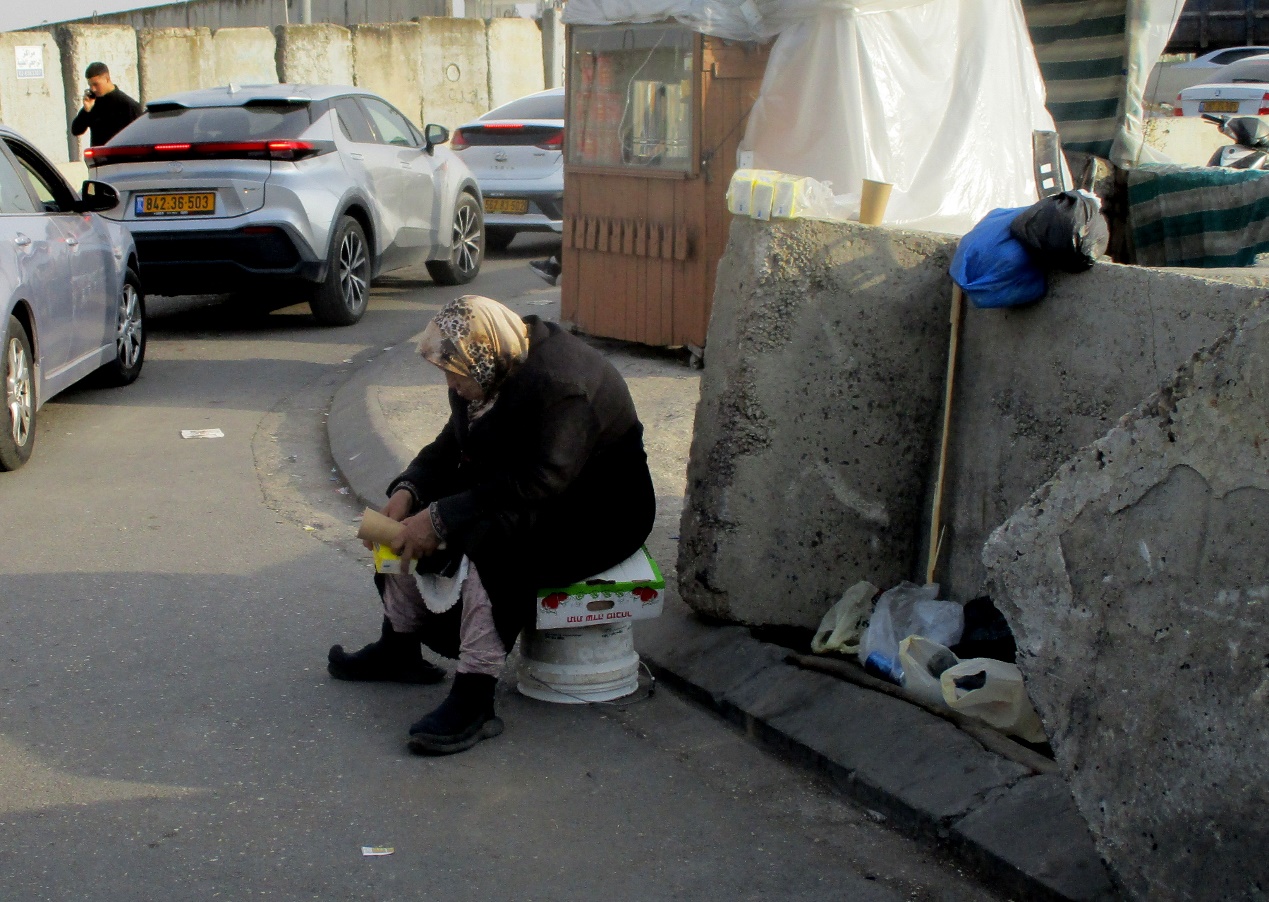 Tamar FleishmanOct-11-2026Qalandiya. Female Beggar
-
