
Jordan Valley: Tattered Flags and Concrete Blocks
I choose to begin with Ofer Shorr’s text, one of the accompaniers:
Ofer Shorr @oshorr67 writes:
Along the Allon Road, beginning with Mekhola Junction, proud Israel flags wave one after the other, stuck at equal intervals from each other. Some are still waving proudly, most of them however already loose and victims of the sun, wind and dust of the Valley. Large signs beg one to put on safety belts, drive slowly, and populate the last houses left on a rocky hill (part of the Mekhola settlement) above the road. Another sign publicizes “The connection plan – getting back to the Northern West Bank [Samaria]” in orange lettering, calling for “pioneering families that love challenges” to join the new settlement groups there. All the road signs are scarred with ugly black spray that carefully covers the Arabic language site names, and every post is covered with the mandatory stickers of the dead Iron Sword Israeli soldiers beside those that declare the coming soon of the Messiah.
The deeper one drives into the dry landscape, the larger the concrete slabs at the roadside. They have been recently colored with bright red, and the words “Danger! Firing zone! Entry forbidden!” are inscribed in thick white letters, with the skull and cross bones drawing added. Underneath this in blue is the entire map of the Greater Israel drawn fully, all the way to Syria and the Euphrates and Tigris Rivers, and the Star of David beside them. For the Palestinians, these rough concrete slabs are the limits of their grazing grounds, limits of their livelihood. No such limits are applied to the settlers, lords of the land. They are immune to firing zones.
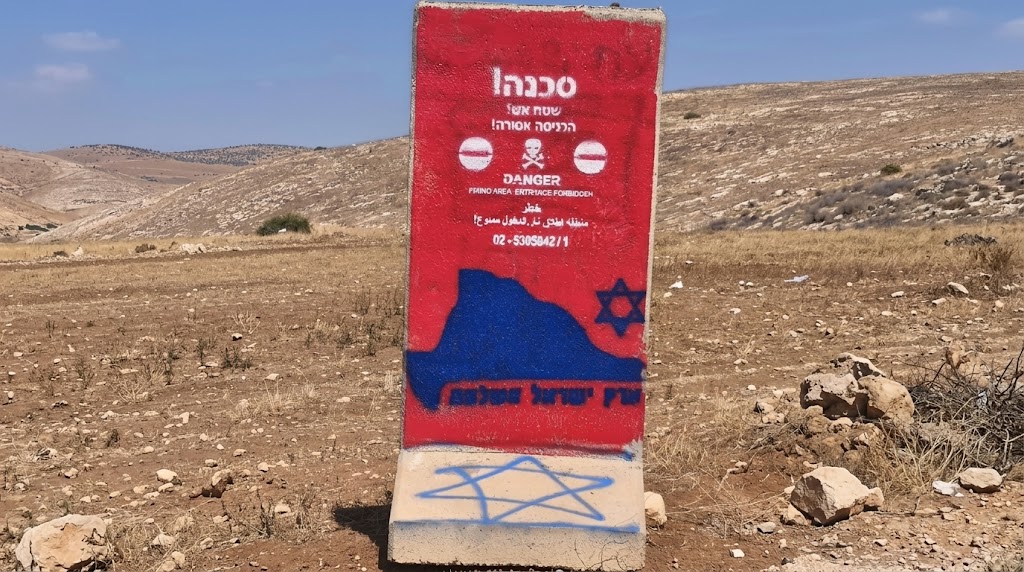
Inside the zone itself, one sees fences: the settler youth is constantly busy stretching barbed wire fences that choke the Palestinians and prevent their flocks from grazing. On the rare occasions they try to break the siege into their old grazing grounds, “Smotrich’s ATVs” emerge on which the settlers harass them, block and sometimes beat them up. Often the Israeli army intervenes: huge jeeps appear from which male and female soldiers emerge masked and armed from head to foot. They harass the shepherds and detain them without reason, take them to a nearby base and then, after a “mysterious treatment”, throw them by the side of road.
All these excessive, oppressive measures – the signs, concrete slabs, fences, plenty of army supplies and arms – are supposed to express mastery and governance. But they only cover up emptiness and weakness: where no essence exists but oppression and subjugation, there is the constant need to aggrandize outward symptoms. But this representation of excess is witness to weakness, not to strength. On Fear and Insecurity.
Thanks to Ofer. Every time we come to this area, this is the basis. This is what we see. All that remains is to add the daily ATV occurrence. And the weekly addition of exposure, road buildup, outposts, more of the same. The feeling is that one day we shall get up in the morning and realize that annexation has already taken place. In other words, it took place, we just didn’t know about it. I see the field in which the housewarming of this new “state” will take place. It is being set up in front of our very eyes. Let us just mention that the flag project put in place several months ago has already withered and died. Let it be a sign of what is to come.
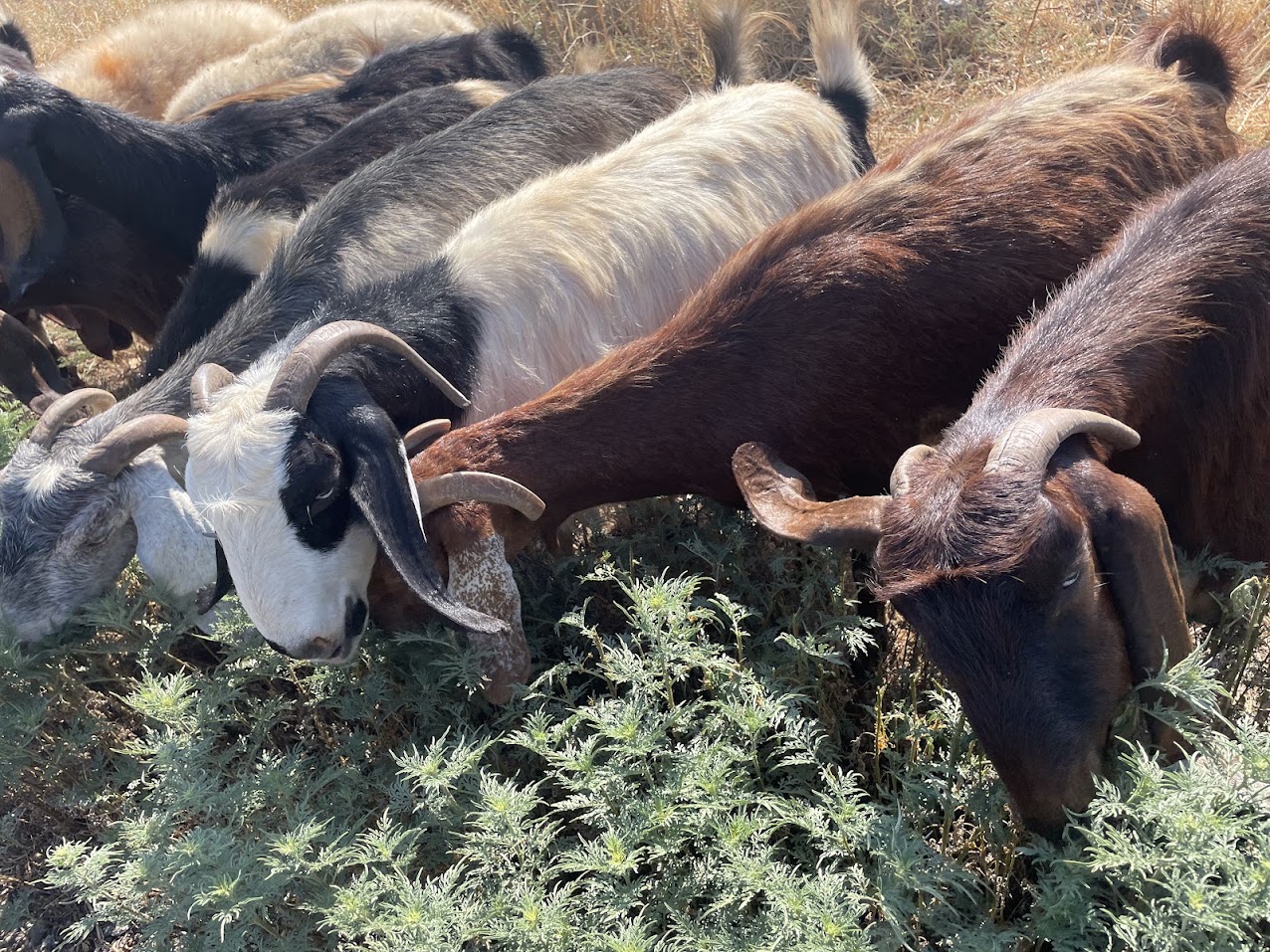
I arrived at Samra. From there I was a teammate with Ofer to be everywhere where needed. There were a few of us that day. We accompanied I. to grazing near the Allon Road where some dry grass still grew. This passed peacefully. From there we drove to F. to water the cattle. We were late. He had already done it. We went back to Samra. I had something I needed to discuss. I couldn’t take the paternalist-religious stiffness. Who decides for whom what is right, what is wrong. No compromise. I was sorry. Next week, I shall add the content.

Location Description
Jordan Valley
See all reports for this place-
Jordan Valley The Jordan Valley is the eastern strip of the West Bank. Its area consists of almost a third of the West Bank area. About 10,000 settlers live there, about 65,000 Palestinian residents in the villages and towns. In addition, about 15,000 are scattered in small shepherd communities. These communities are living in severe distress because of two types of harassment: the military declaring some of their living areas, as fire zones, evicting them for long hours from their residence to the scorching heat of the summer and the bitter cold of the winter. The other type is abuse by rioters who cling to the grazing areas of the shepherd communities, and the declared fire areas (without being deported). The many groundwaters in the Jordan Valley belong to Mekorot and are not available to Palestinians living in the Jordan Valley. The Palestinians bring water to their needs in high-cost followers.
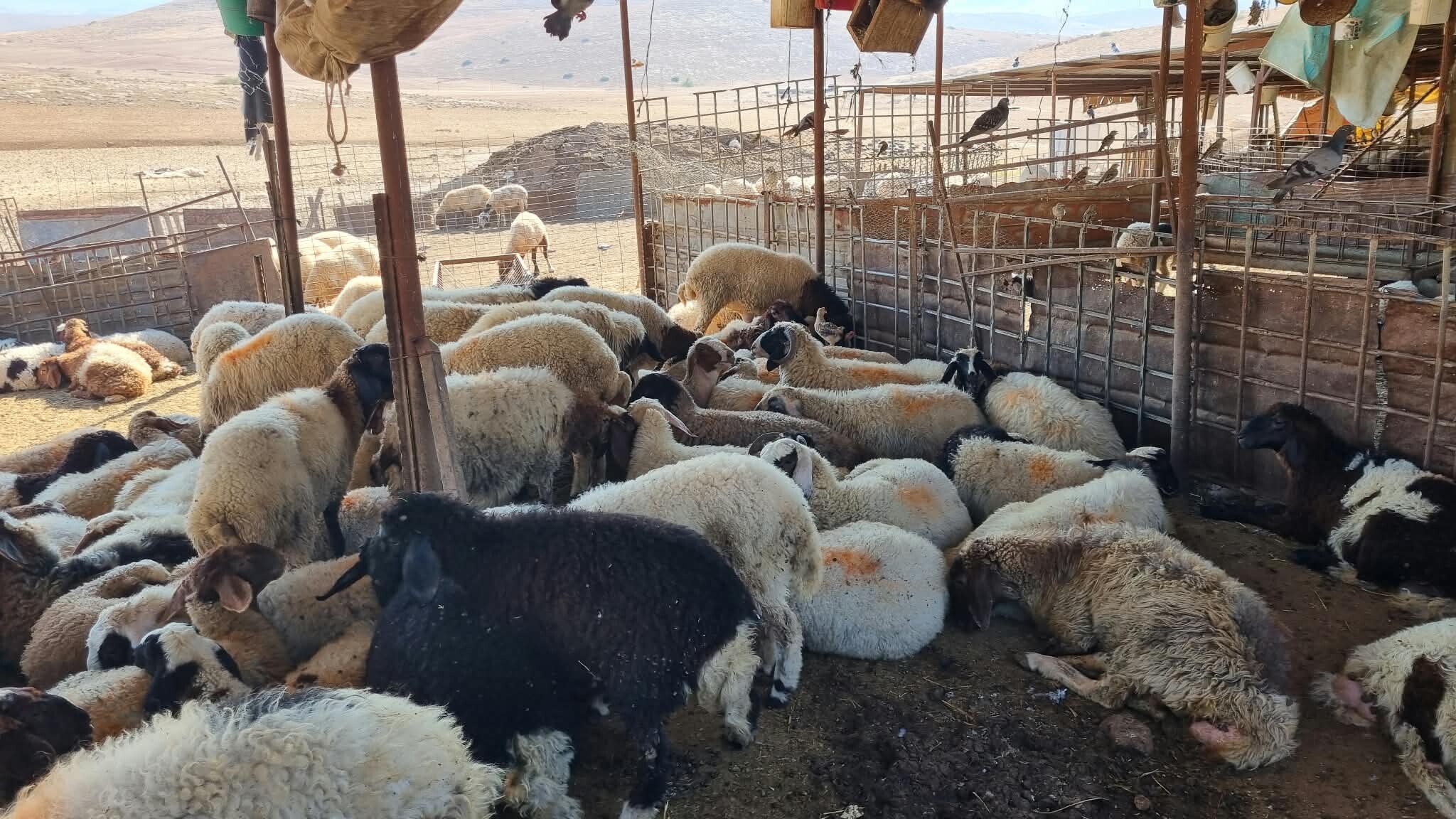 Bosmat HetzroniSep-10-2026Samra. Sheep resting at noon
-
Khalet Makhul
See all reports for this place-
Khalet Makhul
A small settlement of a shepherd community located on the way to the settlement of Hemdat. Two nearby outposts make life miserable for the Palestinians, who make a living from grazing, and the army backs the settlers. As a result, the possible grazing areas are getting smaller.
The local children attend school in the settlement of Ein Al-Beida. Long lines of 3 hours sometimes stretch out at the Hamra and Tayasir checkpoints leading to the town of Tubas, making it difficult to get water, supplies, and sell the cheese, milk, and meat that the residents produce for their living.
Following a deadly attack at the Tayasir checkpoint in February 2025, the checkpoint was closed completely for the time being.
(Updated March 2025)
-
Khirbet Samrah
See all reports for this place
