
Jordan Valley, Tayasir: Past Present Future


“And all will be as nought, back to being not”
(H.N. Byalik, Hebrew poet)
We ventured out to a “natural phenomenon” about which we had reported for years. We recalled the trampling of Palestinians’ humanity at the checkpoints, people whose voices we tried to amplify. Our memories returned to the oppression and humiliation of hundreds and thousands of women, men and children, exerted in order to assure Israeli criminal dominance of the occupied people. We saw the actions of “the most moral army in the world” and documented the everyday of military occupation, containing not necessarily dramatic events but endless sadness, despair and hopelessness.
And what remains…?
Qalandiya: a young man arrived carrying a small back pack, his 2-year old daughter on one arm, and in his other hand a cell phone that would not leave his ear for the next two hours. He seemed extraordinarily stressed. His wife had been hospitalized at Al Muqassad Hospital in East Jerusalem, is weak for lack of blood and about to give birth to their son by Caesarian section, in two hours. The man has a magnetic card and a valid entry permit into Israel, he has been working for years at a permanent employment in Modi’in, but for sheer stress and confusion he forgot his permit yesterday inside his wife’s bag, along with her medical documents. He must get to the hospital in a hurry, to donate blood and be alongside his wife.
The soldier checks the computer and gets a negative answer. The computer states the man has no entry permit into Israel. The man insists that he does, until November 22. “You have no permit”, says the commander. “The computer says”. We called. The answer: “The man has no permit”. The 2-year old girl had a cold, her ears were aching… She didn’t cry nor nag, but kept running around the whole time. His Israeli employers wished to fax his permit to the DCO, but the DCO fax number is confidential… At the same time, the hospital tried to fax it too… A friend who owns a taxi and holds a blue (Israeli resident) ID hurried to drive to the hospital and get the forgotten permit. The time was already 11 a.m. For two hours the man has been begging the commanders, making endless phone calls… At 12:30 we were told that the taxi had reached the checkpoint with the permit. The security guard noticed it, stopped it and would not let it approach… us. So we stood on the one side of the fence and the driver holding the permit on the other side, 10 meters separating us. A DCO officer was summoned who checked the permit and said, “It is not valid…” An officer of the crossings unit took a look and said it was, but they need to find out why the computer did not get it. We ran back to the turnstiles, but the lamps overhead all flickered red. “No passage”. The woman soldier sitting there does not see us, she’s on the phone. Desperate we stood in front of the armored glass window, waving our arms so she would notice us. No, she would not open the gate. We let her know by intercom that the officer is waiting for the man, urgently. After a few seconds she opened. The man got through, the turnstile locked, and we were left outside… (Qalandiya November 5, 2007)
We were greeted warmly by our friend who is responsible for the car-park. He told us how the “improved” parking conditions have damaged people’s livelihood and how this is all so frustrating. On the way to “Qalandiya crossing” is a vendor stand with masks for sale, without them – no entry into the checkpoint. Next to the stand are a police officer and policeman threatening the mask vendor that if he does not leave immediately, “response will be harsh”. The two proceed to the checkpoint and the vendor continues to offer his wares to passers-by. The checkpoint itself has undergone massive “cosmetic uplifting”, everything is clean and neat. Passage is swift, passersby tell us that this is also the case during rush hours. Complaints are about the difficult crossing of the new bridge. They complain about the angle of the ascent. They request that the elderly and women be allowed to cross through the direct track opened for blue ID holders. We turned to the DCO and were told that “the bridge was planned especially to make crossing the road and accessibility easier. Palestinians are always complaining and you women are always voicing their complaints instead of being satisfied with what has been done for them”. We were being educted!
Jericho DCO: We drove through Anata to the Jerusalem-Jericho road (437) and turned towards the city of Jericho. We parked in the car park close to the DCO entrance, with very few Palestinian cars. We were glad to realize that our past complaints bore fruit and that the entrance to the checkpoint is now sheltered. The turnstile was turning and we entered the waiting room unhampered. An amazed soldier sitting behind armored glass asked us to wait until he summoned his superior. Beside us there were two more people sitting in the waiting room. A young nice man arrived and wonder how we got there, explaining to us with growing excitement that we are now inside Area A which is out of bounds for Israelis. We asked him if he is allowed there, and heard that only “military forces” are allowed there. We could not carry out a conversation since “Area A” beat all rationale. In the car park we met a man who explained to us that everything’s “cool”. Long live occupation and the permit regime.
We drove along the Palestinian Jordan Valley on road 90 that was nearly devoid of traffic. The date palm groves add color to the region. At the Jiftlik junction we turned to the Hamra Checkpoint.
Waiting lines on both sides of the checkpoint in both direction – from Nablus and from Jiftlik – are always long. Approaching the checkpoint we have been “greeted” all these years by soldiers shooing us away. “It’s not allowed”, “move over there”, “We’ll summon the police” (and they did)… Palestinian were always at the mercy of soldiers, seated in their un-air-conditioned cars in the heat of the Jordan Valley. Our calls to the DCO never carried results. One clear day – this checkpoint simply vanished.
The checkpoint is neglected, everything is dilapidated. Cars cross fast – no one can tell this was once true hell.
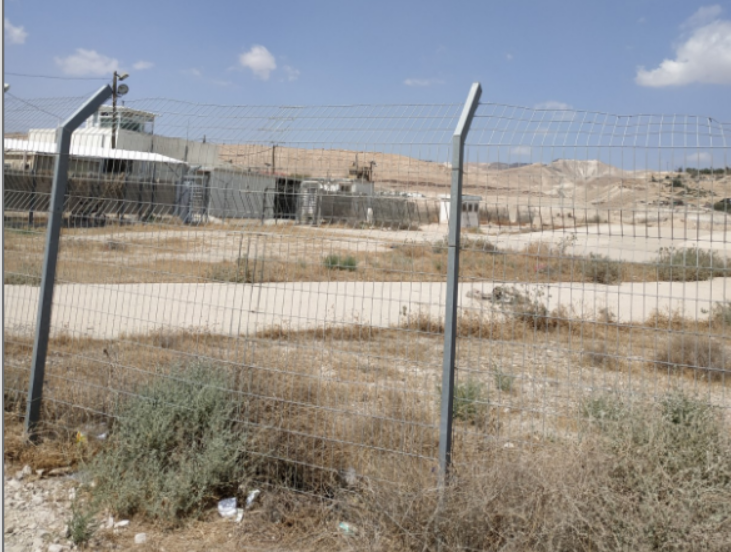
We continued to Tyassir. The road leading from Hamam Al Malahy to the checkpoint is potholed. The entire area now is declared a firing zone. Bedouins live in the heart of this hellhole. We saw flocks still nibbling the little greenery left after the rainy season. Out in the field a large group of soldiers looks as though they had spent the night there and seem to be waiting for transport to their base. We did not stop. We continued to the checkpoint, that stands empty and open with only a sign warning Israelis from entering Area A. We went up to the old army base – it’s all neglected. So much money was poured into it, and such brainwashing of soldiers of the Netzach Yehudah (religious) and Kfir Brigades – this injustice, these crimes will have their day in court…
We stopped on our way and sat in the shade of an acacia tree to picnic. Cars drove by – including a military vehi8cle, and mostly did not stop to find out if we needed help. In the past this would not have happened!
We drove through Maale Efrayim checkpoint to Zaatara-Tapuach Junction. The checkpoint is active. Corona tests applied to Palestinian cars. The posts all around the checkpoint compound are manned. Soldiers with pointed weapons give one the feeling that any moment “war might break out”. Apparently Shabaq (Israeli secret service) checks are still held behind closed partitions. The waiting line of cars towards Nablus is long.
DCO Huwwara (Nablus): we get on the Madison road – the apartheid road leading to settler-colony Alon More, pass by the entrance to Shomron army base, and turn right next to the water pump and shooting gallery. We continue towards Awarta (Palestinian village). After a while we turn on a track partly dirt and partly paved, towards a large car park. It is filled with many cars – all with Palestinian license plates. A large group of young men stand in a shaded corner at the entrance to the DCO. The turnstile is open. We began talking. They do not complain – “Everything’s cool”! One explained that he is Shabaq-blacklisted for another one-hundred years. Everyone laughs. He is a 24-year old single fellow. We tried to “explain” and he suggested we raise money so he can find a wife. We didn’t find this so funny. They asked who we were and we showed our tag they wanted to know if we know Munir. He is the regional “star”! We should visit from time to time.
Huwwara Checkpoint: a man arriving with a bandaged leg was demanded aggressively by the commander to “take it off, are you trying to bluff me?!” The man took off his bandage and exposed a swollen leg. “Who told you to take off the bandage?!” the commander yelled. “Scram, go home!” (October 5, 2004)
A Palestinian man in his twenties stands at the checkpoint and documents the goings on. But the soldiers are told he is a Machsomwatch member. The DCO representative is “stressed” by his presence. The soldiers confiscate his notebook and the DCO man calls his superiors, telling them the notebook is pre-war information. We tried to show him how idiotic this is, after all this is no military secret – a Palestinian knows how the checkpoints work. To no avail. The man is taken to the hold and passed on to the brigade’s handling. His notebook is translated by one of the soldiers and the DCO representative claims it contains “political statements” – that there should be no checkpoints and the area should be under control of the PA. All this shocks the DCO man deeply, and is proof that he was right and that this fellow is a security threat. (July 5, 2007)
Among the detained is a father of a 4-year old boy, a heart patient who opens big sad eyes at the soldiers. They are on their way on foot from hospital in Nablus. To save money that an ambulance would cost. They have no permit, only a chest X-ray. They wait for 3-4 hours. The army’s ongoing answer is that “we are looking into it”. (October 4, 2007)
At the junction near the roundabout stand two army jeeps. Waiting… Later we find out that settler-colonists entered Nablus on a pilgrimage to Joseph’s Tomb without coordination with the Palestinian police. Provocation. A line of cars proceeds slowly. In the positions around the roundabout are heavily armed soldiers. We heard that this is a troublespot and checks often hold up traffic. The large checkpoint is naturally closed and neglected, but its sight from the road is definitely present.
We crossed Tapuach junction checkpoint again – much traffic, a lot of army, and many Corona tests. The waiting line drags on.
We have been going out to the checkpoints for 19 years now. The system has changed. Computerization have turned the checkpoints into “crossings”. Physical conditions have improved, the internal checkpoints are no longer active. But the system, the regime, and the intention have not. Absolute control over the freedom of movement – one of the Israeli military occupation’s terrible crimes.
Our journey from Jerusalem and back lasted from 8 a.m. until 5 p.m.
סיור אל מחסומי הרפאים
מסיירות: רוני פרלמן וחנה בר”ג (מדווחת)
Huwwara
See all reports for this place-
The Huwwara checkpoint is an internal checkpoint south of the city of Nablus, at the intersection of Roads 60 and 5077 (between the settlements of Bracha and Itamar). This checkpoint was one of the four permanent checkpoints that closed on Nablus (Beit Furik and Awarta checkpoints to the east and the Beit Iba checkpoint to the west). It was a pedestrian-only barrier. As MachsomWatch volunteers, we watched therre since 2001 two shifts a day - morning and noon, the thousands of Palestinians leaving Nablus and waiting for hours in queues to reach anywhere else in the West Bank, from the other side of the checkpoint the destination could only be reached by public transport. In early June 2009, as part of the easing of Palestinian traffic in the West Bank, the checkpoint was opened to vehicular traffic. The passage was free, with occasional military presence in the guard tower. Also, there were vehicle inspections from time to time. Since the massacre on 7.10.2023, the checkpoint has been closed to Palestinians.
On February 26, 2023, about 400 settlers attacked the town's residents for 5 hours and set fire to property, such as houses and cars. Disturbances occurred in response to a shooting of two Jewish residents of Har Bracha by a Palestinian Terrorist. The soldiers stationed in the town did not prevent the arson and rescued Palestinian families from their homes only after they were set on fire. No one was punished and Finance Minister Smotrich stated that "the State of Israel should wipe out Hawara." Left and center organizations organized solidarity demonstrations and support actions for the residents of Hawara.Hawara continued to be in the headlines in all the months that followed: more pogroms by the settlers, attacks by Palestinians and a massive presence of the army in the town. It amounted to a de facto curfew of commerce and life in the center of the city. On October 5, 2023, MK Zvi established a Sukkah in the center of Hawara and hundreds of settlers backed the army blocked the main road and held prayers in the heart of the town all night and the next day. On Saturday, October 7, 23 The "Swords of Iron" war began with an attack by Hamas on settlements surrounding Gaza in the face of a poor presence of the IDF. Much criticism has been made of the withdrawal of military forces from the area surrounding Gaza and their placement in the West Bank, and in the Hawara and Samaria region in particular, as a shield for the settlers who were taking over and rioting.
On November 12, 2023, the first section of the Hawara bypass road intended for Israeli traffic only was opened. In this way, the settlers can bypass the road that goes through the center of Hawara, which is the main artery for traffic from the Nablus area to Ramallah and the south of the West Bank. For the construction of the road, the Civil Administration expropriated 406 dunams of private land belonging to Palestinians from the nearby villages. The settlers are not satisfied with this at the moment, and demand to also travel through Hawara itself in order to demonstrate presence and control.(updated November 2023)
.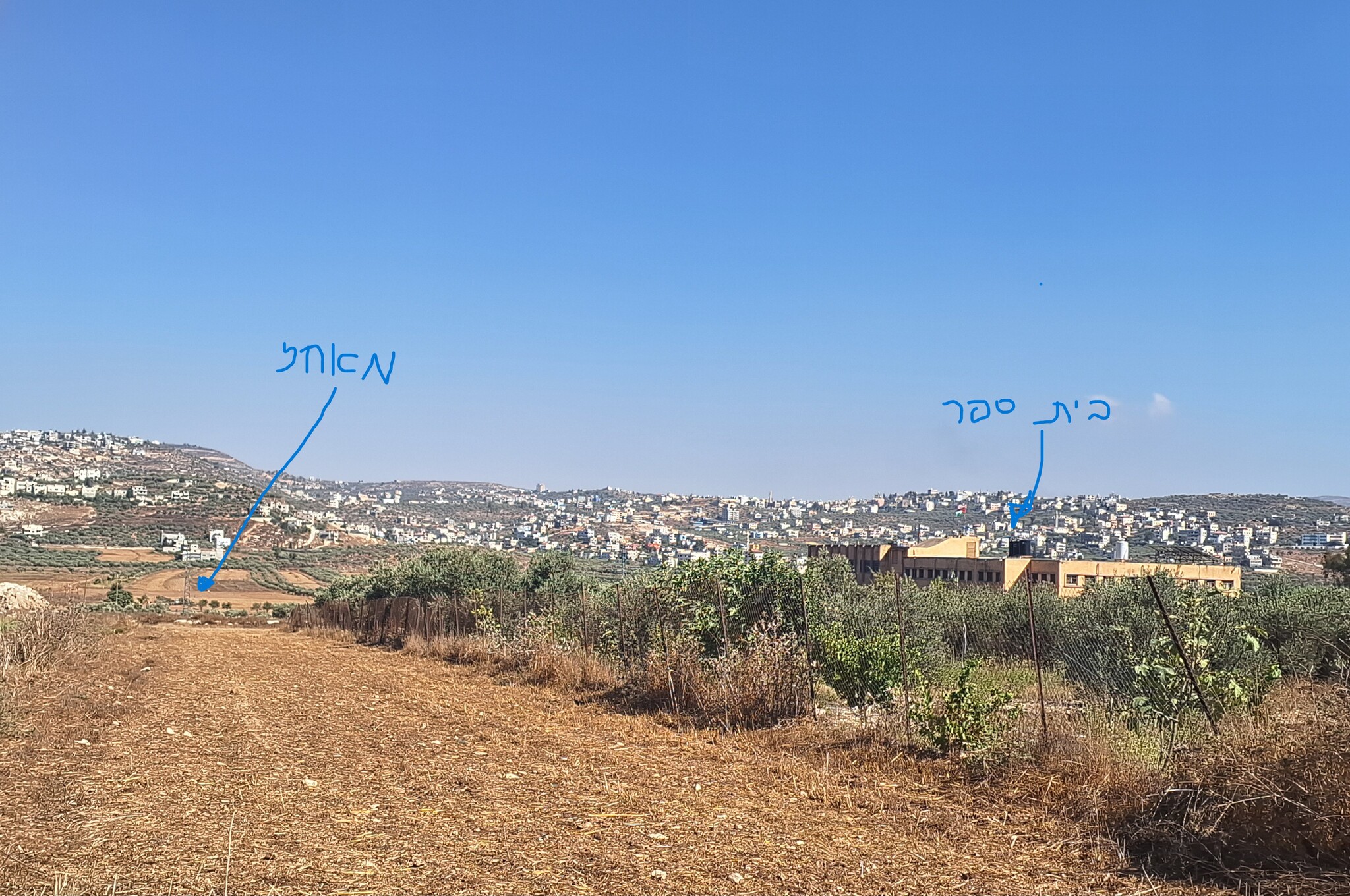 Ronit Dahan-RamatiAug-24-2026Huwara: The school on the outskirts of town and an outpost hidden among the trees
-
Jordan Valley
See all reports for this place-
Jordan Valley The Jordan Valley is the eastern strip of the West Bank. Its area consists of almost a third of the West Bank area. About 10,000 settlers live there, about 65,000 Palestinian residents in the villages and towns. In addition, about 15,000 are scattered in small shepherd communities. These communities are living in severe distress because of two types of harassment: the military declaring some of their living areas, as fire zones, evicting them for long hours from their residence to the scorching heat of the summer and the bitter cold of the winter. The other type is abuse by rioters who cling to the grazing areas of the shepherd communities, and the declared fire areas (without being deported). The many groundwaters in the Jordan Valley belong to Mekorot and are not available to Palestinians living in the Jordan Valley. The Palestinians bring water to their needs in high-cost followers.
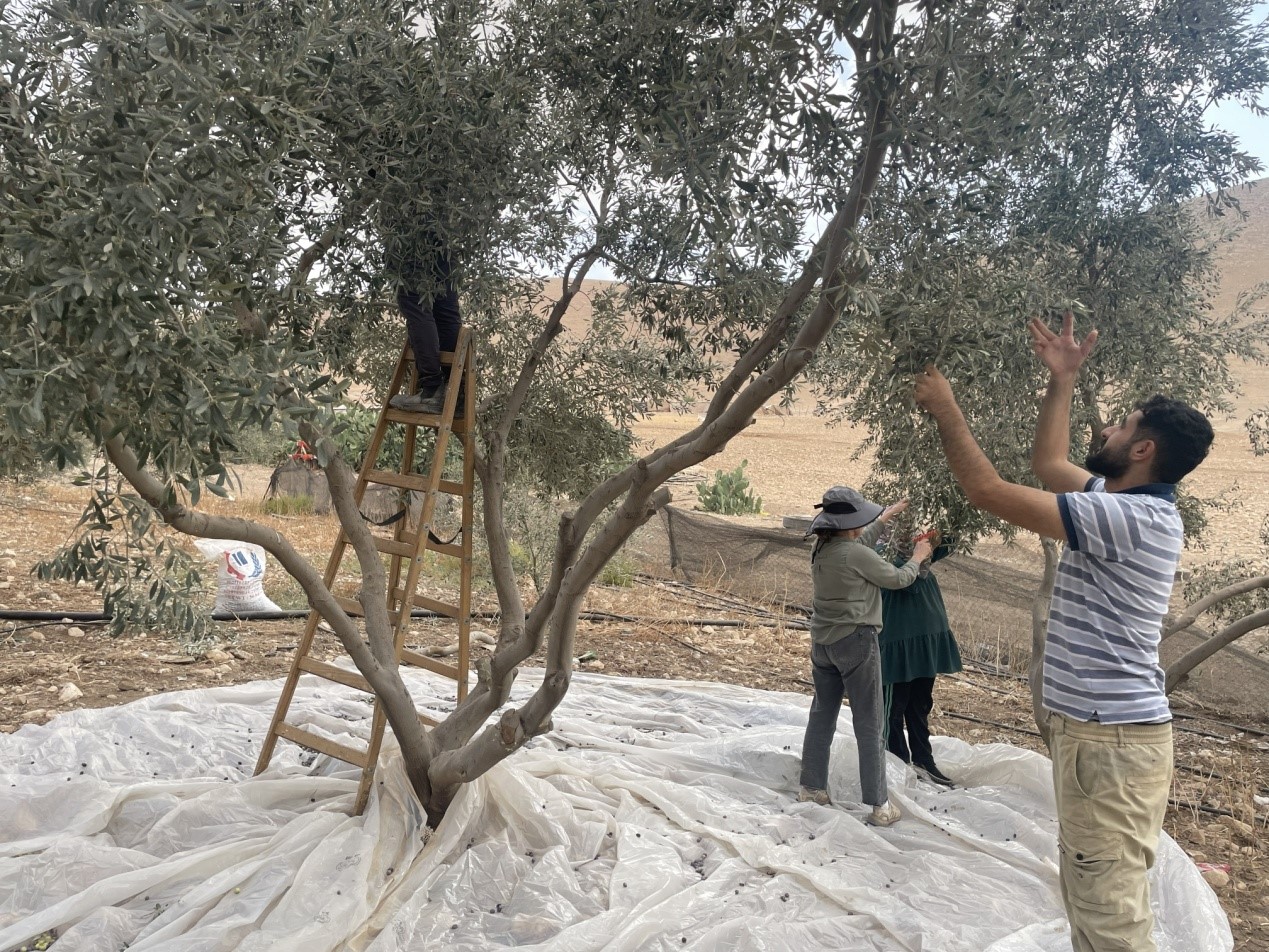 Rachel AfekOct-15-2026Olive Harvest in the Jordan Valley
-
Tayasir CP
See all reports for this place-
Located on road 5799, It is one of the checkpoints control the passage between the northern West Bank and the Jordan Valley. For a long time, it stood empty and open, with only a sign next to it warning against entering Area A. It was adjacent to an old military camp - now everything is neglected. How much money was invested here, and how much brainwashing was done to the soldiers of Netzah Yehuda and Kfir.
Today, it is very difficult to pass there. Many delays. Often, teachers from Tubas are not allowed to pass into the Valley to villages like Ein al-Bida where the local schools are located, and there are no classes. There are additional days when the checkpoint is closed. In general, there is a wait there of about two to four hours to go towards the Valley and also to return. Many times the Palestinians are forced to use the Hamra checkpoint, which also leads into Tubas and the West Bank, but there is also a huge queue there and a long wait.
Following a deadly attack on soldiers at the nearby base in February 2025, the checkpoint was completely closed for the time being. (Updated March 2025)
-
