
Qalandiya
As we have been doing lately, we parked on the Israeli side. While we were walking across we noticed that the sidewalks had been cleaned! It really made a difference, especially where, since the storm, the sidewalk had almost been blocked by branches and garbage. But it wasn't really clean. There was a lot of garbage on the other side of the low stone fence: paper cups, bags and all sorts of wrappings. We wondered if they had not simply collected the garbage from the sidewalk and thrown it over the fence…
We passed by a large group of praying people at the entrance before we crossed. At 5:15 all the 5 check posts were open on the Palestinian side. The bagel and cake vendors were already there, and Eyman had also opened his coffee stall. There were lines, but they weren't long. People entered only two fenced-off areas, even though the thirds area wasn't blocked. We thought they didn't enter because they knew the turnstile was still stuck, but then they did enter and everything was in order. The soldier in the aquarium let a small number of people pass each time, although the lines at the check posts were not long.
5:25 – The blonde policewoman and an additional policeman arrived. The turnstiles opened at once and many people passed through. The lines got shorter and all in all it was a quiet morning. The birds were singing and things were working quite smoothly even when the lines got longer. Yesterday at last, we managed to visit H. where he works at the market. He told us that Monday and Tuesday had been difficult days at the checkpoint.
Monique and Ada May, two Dutch Journalists, arrived together with a photographer. We explained how the checkpoint works adding that today things were relatively good. It appeared that Monique even though she has been here three years this was her first time at the checkpoint early in the morning when the workers are crossing.
Towards 6 o'clock the lines were getting longer. People were already waiting at the humanitarian gate. A security guard arrived but not the officer from the DCO. The female soldier who had arrived to her shift in the aquarium came outside for a moment and we asked her to open the humanitarian gate. Her reaction was to go inside and close the door behind her. Most of the waiting people gave up and went to the regular line. The people who were waiting there let them join the line at the entrance to the fenced-off areas. The light in the aquarium was turned on and we saw the policewoman explaining to the female soldier how to open the turnstiles. When she finished her explanation the lights went out again. P., the officer from the DCO arrived at about 6:10and opened the gate. Women and people with permits saw him, left the regular line and hurried to the gate. P. let everybody in and went to the aquarium to ask them to open the turnstiles. We heard the policewoman ask if he had checked to make sure that everybody had a permit. "You know everybody", he answered, but she insisted on checking and, surely, one man was sent back to the regular line.
6:15 – The lines got shorter. P. let one more group of waiting people pass through the humanitarian gate. While P. was away a policeman opened the gate. Then P. returned.
At 6:30 after they had opened the turnstiles and let many people through the lines remained only within the fenced-off areas. Our work force including P. from the DCO, the female soldier in the aquarium, three police officers and two security guards were left without much to do.
Meanwhile, the Dutch journalists and the photographer took pictures and interviewed the Palestinians. Among other things, we called their attention to a man who returned. Ada May speaks Arabic so she helped Monique with the translation. They turned to him and it appeared that he had not been permitted to pass since he had to renew his magnetic card. They didn't understand. We explained that in addition to the ID card the Palestinians have a magnetic card. They have their finger prints taken so that the soldier at the check post can verify the details about every Palestinian on the computer. If somebody isn't permitted to pass it appears in red.
6:45 Everything calmed down and there were no lines any longer. The turnstiles remained open. Before we crossed Monique and her team asked to interview us as well. We explained about Machsomwatch and our activities. They asked if it helps, we answered that not necessarily… but we mentioned that a few weeks ago the head of the civilian administration had been visiting, and since then –at least on Wednesdays – when we arrive at 5:15 all the 5 check posts are open. Among other things, we explained about our activities concerning Palestinians who are prohibited from crossing. They asked if we are afraid of walking around among the Palestinians. We answered that absolutely not. Some Palestinian thank us for what we are doing, others ask us – especially on bad days – why we come if we cannot help, and still others choose to ignore us. However, we made it clear that during all the years we have been active not even one Machsomwatch member has been attacked by the Palestinians.
Qalandiya Checkpoint / Atarot Pass (Jerusalem)
See all reports for this place-
Click here to watch a video from Qalandiya checkpoint up to mid 2019 Three kilometers south of Ramallah, in the heart of Palestinian population. Integrates into "Jerusalem Envelope" as part of Wall that separates between northern suburbs that were annexed to Jerusalem in 1967: Kafr Aqab, Semiramis and Qalandiya, and the villages of Ar-Ram and Bir Nabala, also north of Jerusalem, and the city itself. Some residents of Kafr Aqab, Semiramis and Qalandiya have Jerusalem ID cards. A terminal operated by Israel Police has functioned since early 2006. As of August 2006, northbound pedestrians are not checked. Southbound Palestinians must carry Jerusalem IDs; holders of Palestinian Authority IDs cannot pass without special permits. Vehicular traffic from Ramallah to other West Bank areas runs to the north of Qalandiya. In February 2019, the new facility of the checkpoint was inaugurated aiming to make it like a "border crossing". The bars and barbed wire fences were replaced with walls of perforated metal panels. The check is now performed at multiple stations for face recognition and the transfer of an e-card. The rate of passage has improved and its density has generally decreased, but lack of manpower and malfunctions cause periods of stress. The development and paving of the roads has not yet been completed, the traffic of cars and pedestrians is dangerous, and t the entire vicinity of the checkpoint is filthy. In 2020 a huge pedestrian bridge was built over the vehicle crossing with severe mobility restrictions (steep stairs, long and winding route). The pedestrian access from public transport to the checkpoint from the north (Ramallah direction) is unclear, and there have been cases of people, especially people with disabilities, who accidentally reached the vehicle crossing and were shot by the soldiers at the checkpoint. In the summer of 2021, work began on a new, sunken entrance road from Qalandiya that will lead directly to Road 443 towards Jerusalem and Tel Aviv. At the same time, the runways of the old Atarot airport were demolished and infrastructure was prepared for a large bus terminal. (updated October 2021)
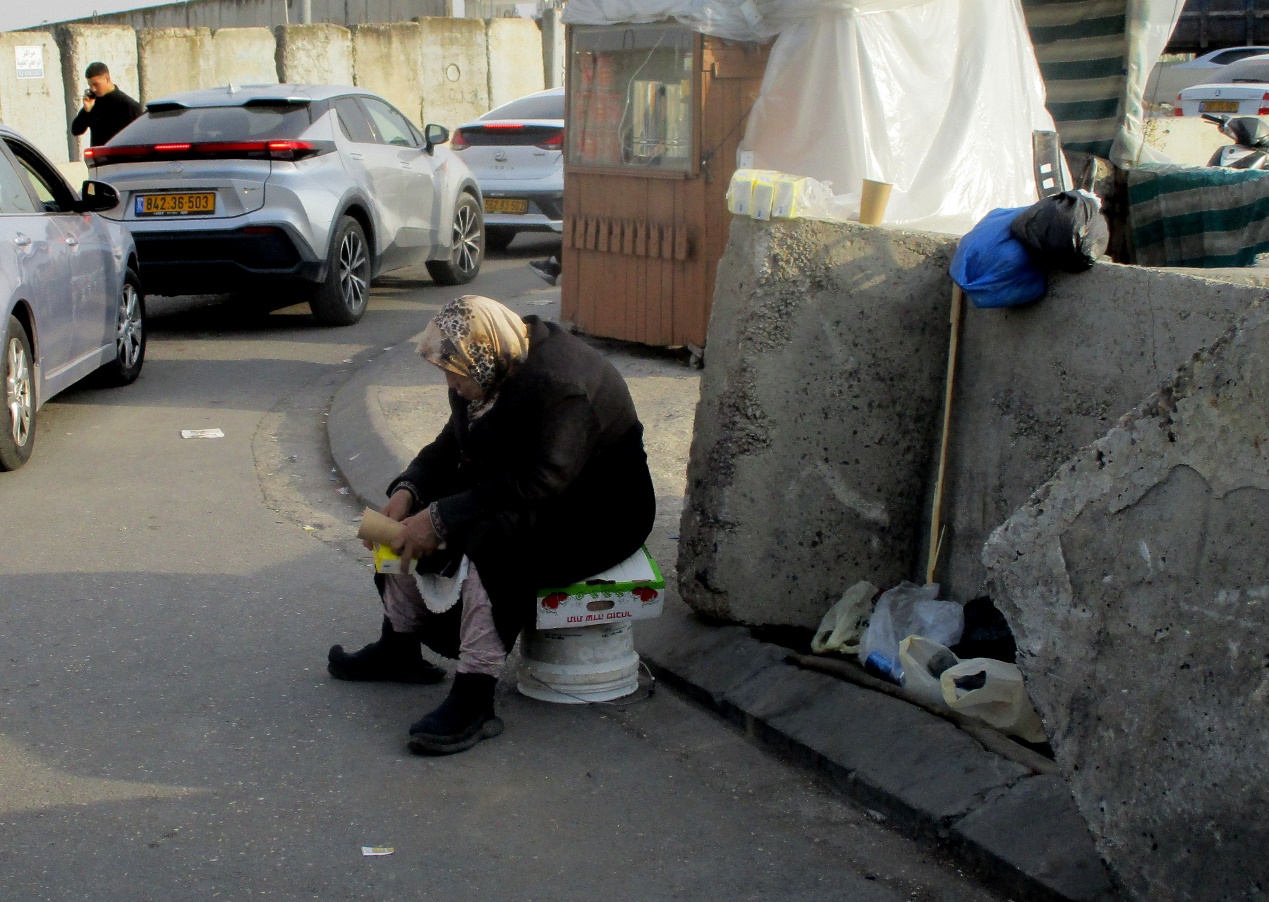 Tamar FleishmanOct-11-2026Qalandiya. Female Beggar
-
