
Qalandiya
05.15. The first thing that struck us was the – even more than usual – piles of dirt. Remains of the fruitseller’s counter, cartons, discarded fruit … Inside the shed the queues were not particularly long, reaching slightly beyond the shed itself. The beigel seller was pesent, and the cake stall outside was open.
The humanitarian gate has been moved forward slightly, apparently in connection with the planned building works. Previously there had been a kind of corridor leading to it bounded by metal. We understand from our colleagues’ previous report that on Monday and Tuesday it was still unclear how the arrangement would work. By now there is a gate and a ‘woven’ fence with a little space cut in it for the soldiers to put their hands through to work the lock to open and close the gate.
The soldier operating the turnstiles came outside of the aquarium now and again. He asked who we were and had never heard of Machsomwatch. Although he has worked here for a year, says he has never seen our members. A Brazilian team – photographer and reporter – are present. They preparing a report for a well-known Brazilian paper (also for a web-site) on places with walls or fences between populations/states. They have been in the country already for two weeks, visiting also Bethlehem. We rcommended that they meet also our members who visit farmers whose fields are across the separation fence.
Soon after we arrived a policeman came, and at 5.50 the blonde D.C.O. officer came, with a guard. Soon afterwards a policewoman arrived with an additional guard. At this point there was no need to open the humanitarian gate as the lines were not long and there were hardly any women. Soon afterwards, as women and the ‘worthy’ arrived, they were let in. At one point the policewoman even called some women and children over from the regular line to the humanitarian gate.
At sunrise we went outside to check the situation. The parking lot is still blocked, and has piles of building material. A white metal wall has surrounded the checkpoint building now for some time. We entered through a gate but there is no evidence of building going on there.
The tea kiosk is working again. There is a refrigerator, a water heater and cooking plate. A cup of hot tea was welcome on this cold morning…
At about 6.45, although there were still some (not very long) queues, the D.C.O. officer left. Anyone arriving later was told to join the regular lines. At one point an apparently senior police officer arrived. The police welcomed him and chatted with him. He left soon after together with the policeman who had accompanied him.
Just before 7 o’clock we joined a line and were through in 20 minutes. As we passed we noticed that they have blocked the passage through the ‘slalom’ on the way to the checking stations. Now people go straight from the turnstiles to the checking stations, as they used to do previously.
Qalandiya Checkpoint / Atarot Pass (Jerusalem)
See all reports for this place-
Click here to watch a video from Qalandiya checkpoint up to mid 2019 Three kilometers south of Ramallah, in the heart of Palestinian population. Integrates into "Jerusalem Envelope" as part of Wall that separates between northern suburbs that were annexed to Jerusalem in 1967: Kafr Aqab, Semiramis and Qalandiya, and the villages of Ar-Ram and Bir Nabala, also north of Jerusalem, and the city itself. Some residents of Kafr Aqab, Semiramis and Qalandiya have Jerusalem ID cards. A terminal operated by Israel Police has functioned since early 2006. As of August 2006, northbound pedestrians are not checked. Southbound Palestinians must carry Jerusalem IDs; holders of Palestinian Authority IDs cannot pass without special permits. Vehicular traffic from Ramallah to other West Bank areas runs to the north of Qalandiya. In February 2019, the new facility of the checkpoint was inaugurated aiming to make it like a "border crossing". The bars and barbed wire fences were replaced with walls of perforated metal panels. The check is now performed at multiple stations for face recognition and the transfer of an e-card. The rate of passage has improved and its density has generally decreased, but lack of manpower and malfunctions cause periods of stress. The development and paving of the roads has not yet been completed, the traffic of cars and pedestrians is dangerous, and t the entire vicinity of the checkpoint is filthy. In 2020 a huge pedestrian bridge was built over the vehicle crossing with severe mobility restrictions (steep stairs, long and winding route). The pedestrian access from public transport to the checkpoint from the north (Ramallah direction) is unclear, and there have been cases of people, especially people with disabilities, who accidentally reached the vehicle crossing and were shot by the soldiers at the checkpoint. In the summer of 2021, work began on a new, sunken entrance road from Qalandiya that will lead directly to Road 443 towards Jerusalem and Tel Aviv. At the same time, the runways of the old Atarot airport were demolished and infrastructure was prepared for a large bus terminal. (updated October 2021)
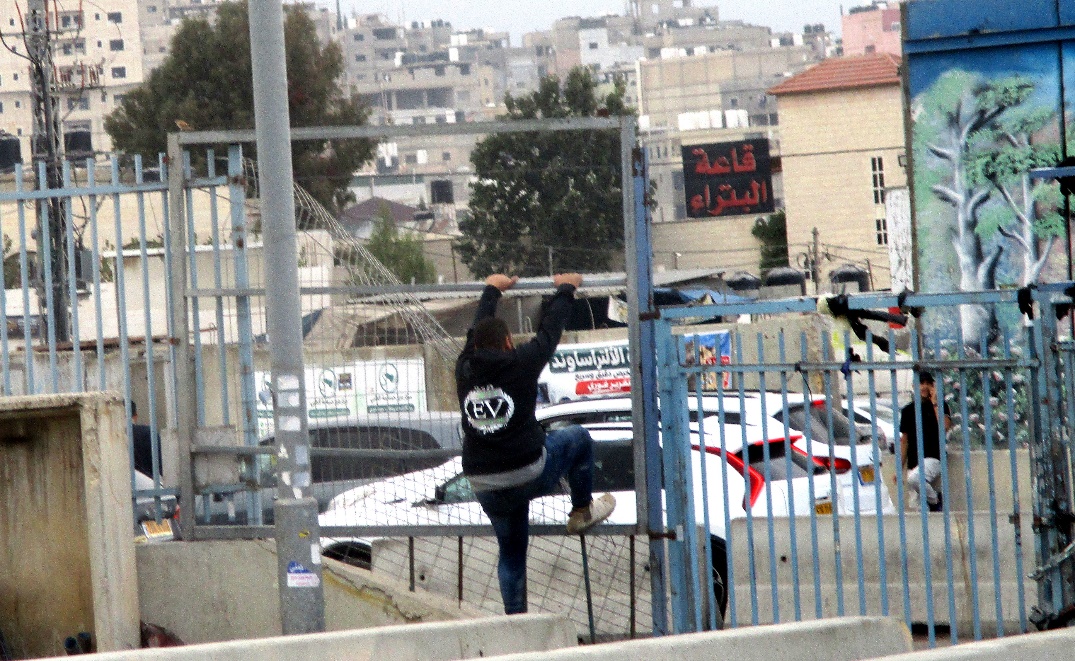 Tamar FleishmanOct-27-2026Qalandiya. Closure – Climbing over the fence
-
