
Qalandiya
The transport returning post-surgery and treated patients to the Gaza Strip from hospitals in the West Bank or Jerusalem was standing there waiting, devoid of driver or human cargo.
First came the driver. “I’ve been going around for two hours now” he said, adding that his patients are allowed out of the Checkpoint only just before the transport gets under way. Some of them are stuck inside the checkpoint since morning.
Better not assume why they are only allowed to travel in an organized fashion.
This procedure leads one to assume that the effort and difficulties are the soldiers’ lot, rather than the fate of those who had just been released from hospital a few hours earlier, as though it were really difficult to verify the patient’s identity by ID and computer, stamp the necessary paper and let them alone.
Last came the patients and their accompaniers, eighteen in all.
There were children, women and elderly, there was an old man whose legs barely held him, his right leg wrapped in blue nylon. There was a pregnant woman, a child with one of his arms amputated, and others.
Gazans returning home, laden with bags and suitcases, trying to make up for the things that the long ongoing siege imposed on the Gaza Strip by Israel has denied them.
A new ordinance of which I hadn’t heard before stipulates that a Palestinian is not allowed to enter Erez Checkpoint with more than two pieces of luggage (I hope to learn more about this during the coming work week).
The patients were heavy laden with luggage in spite of this, many bags and suitcases which could not be pushed through the turnstiles. As they stood helpless in front of the last gate, a DCO soldier arrived, opened the gate and told (me) how they – DCO personnel – are concerned for the Palestinians’ welfare and take good care of them.
To my question whether the Palestinians are happy with this care, he answered – “very”.
(Remember him, like the pistol that appears in the first act – he will be back at the end of the play…).
But those who emerged through the gate that carries the strange sign “Emergency Exit” did not praise the army’s treatment of them, nor its bureaucratic handlings. Quite the contrary. Three women, each separately, said that since 10 a.m. that day they had to wait in the inner offices. A simple calculation tells us that at least they had to wait for six whole hours to get on their way.

Facing a locked gate leading to the DCO offices, a woman waited, trying to attract the attention of the woman-soldier on the inside. After quite a while and much yelling, the soldier responded: “The DCO is already closed”. She did agree, though, to let the woman in to make her case. I joined.
The woman is a US resident who has finished her family visit in Ramallah, and in order to get back home to her family she needs a visa that is supposed to be issued her at the American Consulate in Jerusalem. In the morning the woman traveled to the Beit El DCO. The first to speak with her identified himself as Captain Gil’ad, and passed her on to the care of one of the soldiers, from whom she heard that the confirmation document she needs is issued at Qalandiya, and although the time was already 16:00 (closing time), until 17:00 the DCO personnel are present and will take care of her request. He even gave her his name and phone number, on a piece of paper.
“But it’s closed, there’s no one there”, said the woman-soldier who tried phoning but there was no answer. “Sorry, nothing I can do to help”. The woman phoned the soldier at Beit El who did answer but said that he cannot do a thing on remote…” The woman’s phone was passed on to the woman-soldier and then to me.
I heard from the soldier at Beit El that “to tell you the truth, one soldier made a mistake. There’s nothing we can do now. She has to come tomorrow morning, we open at 9 a.m.” I said: “But her appointment at the Consulate is set for tomorrow morning at 9:45, she’ll be late”. “Nothing to do” closed the discussion.
So that was it, nothing to do. The woman returned to Ramallah, tomorrow she’ll be back at Qalandiya, and when she gets the confirmation she will travel to the Consulate, perhaps officials there will be more flexible and issue her visa in spite of being late – but maybe not.
Only then, when the woman left the checkpoint and disappeared from my sight, did I notice the DCO soldier (the one in the photo) walking around the inner compound, doing nothing.
Closed? Apparently yes.
No one there? Depends where.
Nothing to do? Nothing when no one wants to do anything.
Qalandiya Checkpoint / Atarot Pass (Jerusalem)
See all reports for this place-
Click here to watch a video from Qalandiya checkpoint up to mid 2019 Three kilometers south of Ramallah, in the heart of Palestinian population. Integrates into "Jerusalem Envelope" as part of Wall that separates between northern suburbs that were annexed to Jerusalem in 1967: Kafr Aqab, Semiramis and Qalandiya, and the villages of Ar-Ram and Bir Nabala, also north of Jerusalem, and the city itself. Some residents of Kafr Aqab, Semiramis and Qalandiya have Jerusalem ID cards. A terminal operated by Israel Police has functioned since early 2006. As of August 2006, northbound pedestrians are not checked. Southbound Palestinians must carry Jerusalem IDs; holders of Palestinian Authority IDs cannot pass without special permits. Vehicular traffic from Ramallah to other West Bank areas runs to the north of Qalandiya. In February 2019, the new facility of the checkpoint was inaugurated aiming to make it like a "border crossing". The bars and barbed wire fences were replaced with walls of perforated metal panels. The check is now performed at multiple stations for face recognition and the transfer of an e-card. The rate of passage has improved and its density has generally decreased, but lack of manpower and malfunctions cause periods of stress. The development and paving of the roads has not yet been completed, the traffic of cars and pedestrians is dangerous, and t the entire vicinity of the checkpoint is filthy. In 2020 a huge pedestrian bridge was built over the vehicle crossing with severe mobility restrictions (steep stairs, long and winding route). The pedestrian access from public transport to the checkpoint from the north (Ramallah direction) is unclear, and there have been cases of people, especially people with disabilities, who accidentally reached the vehicle crossing and were shot by the soldiers at the checkpoint. In the summer of 2021, work began on a new, sunken entrance road from Qalandiya that will lead directly to Road 443 towards Jerusalem and Tel Aviv. At the same time, the runways of the old Atarot airport were demolished and infrastructure was prepared for a large bus terminal. (updated October 2021)
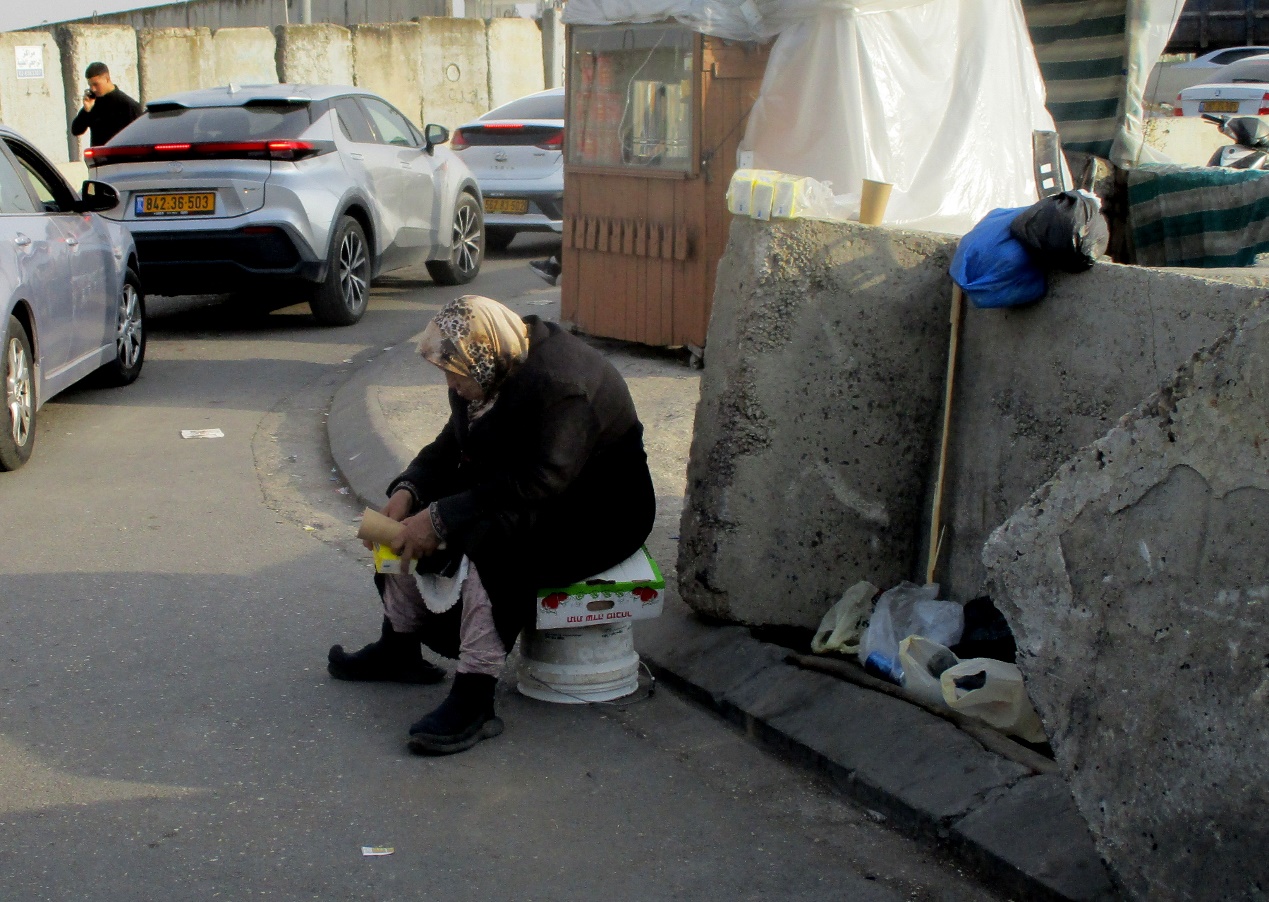 Tamar FleishmanOct-11-2026Qalandiya. Female Beggar
-
