
Qalandiya
COLD, CHAOTIC, CRUEL!
05.10. When we arrived in the bitterly cold wind, we could hear loud banging of metal. This turned out to be caused by flaps of the metal sidings to the pathway that leads through what used to be the parking lot, loosened by the wind and flapping wildly – and dangerously.
The three queues were short, extending slightly beyond the shed. The beigel-seller was nowhere to be seen, defeated no doubt by the cold and wet. We assumed there would be fewer people today because of the extreme weather but, as the morning progressed and the rain seemed to lessen, new people kept coming. The soldier in the cubicle was observant and opened the turnstile fairly frequently, although not letting many pass each time. This was probably because crowds collected at each of the 4 checking stations that were slowly, slowly functioning. In fact, when he saw people making for the closed checking station no.5, he warned people to that effect on his loudspeaker. At checkpoint no.4 the turnstile seemed to be out of order, as people were entering there through the side gate.
His replacement was also conscientious – but the process at the checking stations was agonizingly slow. Meanwhile everyone was waiting in the dreadful cold. At 6.45 the lines collapsed into the usual crush, pushing and yelling. Fortunately this did not last long and somehow order resumed.
The D.C.O. officer and guard arrived at 6.15 to open the “Humanitarian gate”. He was adamant throughout in not allowing “eight o’clockers” through, until just before 8 o’clock when he and the guard left. After that an awful situation developed – and one can only call the term “Humanitarian gate” a sick joke. There came some clearly sick children, a woman with lung complaint, women with blanket-wrapped babes in their arms, apart from the usual crowd of women and others who would normally enter there, instead of the crush in the cages. The soldier in the cubicle came out to see what he could do, and at one point did manage to ‘insert’ a woman and her baby into the cage, but afterwards it became too difficult. In the past there have sometimes been police who have been helpful easing such needy cases through a side gate, but today there was nobody to ask. Who knows what would have happened if someone had arrived in a wheelchair!
We phone the office twice to beg them to open the gate, each time being told “I’m checking.” In despair we phoned Hannah Barag to see if she could exert some influence, but this attempt also failed.
Finally, all those waiting at the gate had to join the normal queues which were advancing painfully slowly. We timed one old man on his stick at the entrance to a cage, and he hadn’t advanced for 15 minutes.
It was quite an enlightening experience for our visitors! For us personally, the one gratifying thing was the friendly way we were greeted by so many, and conversations we could have with those who were anyway delayed. We found that some older women whom we often see all work in some firm to do with vegetables; we had an interesting chat with a math and physics teacher, and a long one with a man who is active in an inter-faith organization. But unfortunately this last man had to tell us about how rudely he and a group he was bringing into Jerusalem one Friday was treated by the policeman on duty (and we recognized the policeman as one whose roughness we have often noticed).
We reached the checking station well after 10 o’clock! Although we ourselves passed through quickly, we could hear others being delayed because they couldn’t understand the Hebrew instructions being shouted by a woman soldier.
We have no idea why everything moved so slowly today.
This is a video taken by Neomi, one of the German girls who came with us on Sunday morning to Qalandiya. The wind was so strong and Chana wrote about the “fence” which was flapping so dangerously. One can see this here and how dangerous it was. When we heard the noise in the beginning it was so loud that we thought that they were actually working outside at what used to be the parking lot with bulldozers. It was also so cold that Neomi’s phone actually froze. A first time.
Qalandiya Checkpoint / Atarot Pass (Jerusalem)
See all reports for this place-
Click here to watch a video from Qalandiya checkpoint up to mid 2019 Three kilometers south of Ramallah, in the heart of Palestinian population. Integrates into "Jerusalem Envelope" as part of Wall that separates between northern suburbs that were annexed to Jerusalem in 1967: Kafr Aqab, Semiramis and Qalandiya, and the villages of Ar-Ram and Bir Nabala, also north of Jerusalem, and the city itself. Some residents of Kafr Aqab, Semiramis and Qalandiya have Jerusalem ID cards. A terminal operated by Israel Police has functioned since early 2006. As of August 2006, northbound pedestrians are not checked. Southbound Palestinians must carry Jerusalem IDs; holders of Palestinian Authority IDs cannot pass without special permits. Vehicular traffic from Ramallah to other West Bank areas runs to the north of Qalandiya. In February 2019, the new facility of the checkpoint was inaugurated aiming to make it like a "border crossing". The bars and barbed wire fences were replaced with walls of perforated metal panels. The check is now performed at multiple stations for face recognition and the transfer of an e-card. The rate of passage has improved and its density has generally decreased, but lack of manpower and malfunctions cause periods of stress. The development and paving of the roads has not yet been completed, the traffic of cars and pedestrians is dangerous, and t the entire vicinity of the checkpoint is filthy. In 2020 a huge pedestrian bridge was built over the vehicle crossing with severe mobility restrictions (steep stairs, long and winding route). The pedestrian access from public transport to the checkpoint from the north (Ramallah direction) is unclear, and there have been cases of people, especially people with disabilities, who accidentally reached the vehicle crossing and were shot by the soldiers at the checkpoint. In the summer of 2021, work began on a new, sunken entrance road from Qalandiya that will lead directly to Road 443 towards Jerusalem and Tel Aviv. At the same time, the runways of the old Atarot airport were demolished and infrastructure was prepared for a large bus terminal. (updated October 2021)
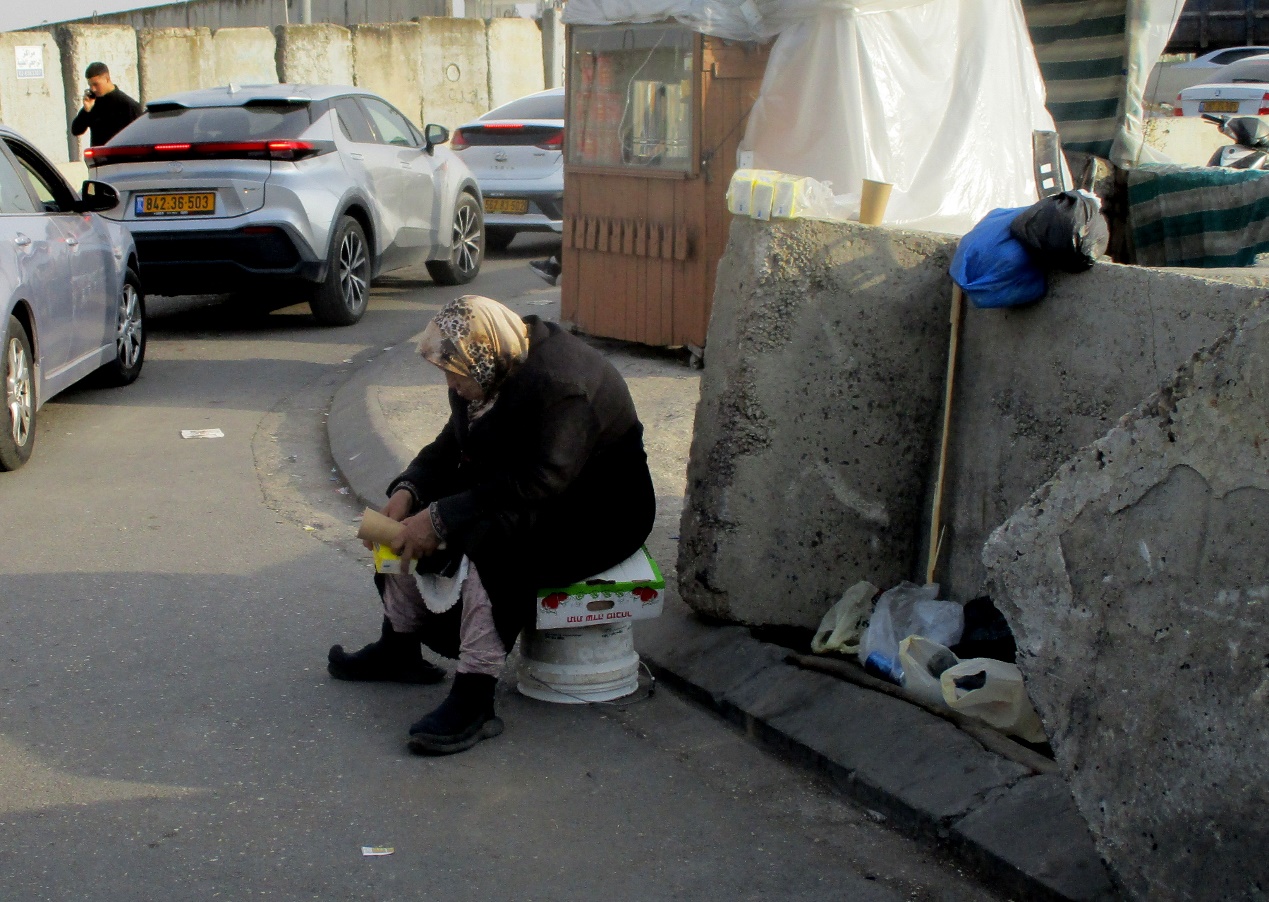 Tamar FleishmanOct-11-2026Qalandiya. Female Beggar
-
