
Qalandiya
We returned to Qalandiya after an absence because of our Passover (Pesach), “holiday of freedom”, which led to the perfect reversal of freedom for the Palestinians – a closure of all the occupied territories. We know that often when there is a closure, the workers at the industrial plants in Atarot, they are allowed to pass, probably under the pressure of their employers. This was the case in Purim, for example. We do not know if this was the case during Passover. (From personal Information we know that a group of computer workers from Ramallah, who work in cooperation with the Intel Development Center at Har Hotzvim and attend training and work meetings there, were not allowed to pass during the intermediate days of the holiday.)
As we reported in the past, we decided to start arriving later, because now the Palestinians also are able to come later than in the past, in light of the rapid passage at the new checkpoint. This time, even after we had collected our guests on the way, we arrived at 6:30. We drove this time from Pisgat Ze’ev and Shu’afat along the wall and saw the new “Atarot Mall”. One of the guests knew that is was owned by Rami Levy. From outside we saw a sign of the Hamashbir Lazarchan. Opens at a perfect time for Pesach and Ramadan
Outside it was las if it was already the middle of the day and the peak of pressure. We walked around the square in front of the checkpoint and saw a group of young people in red shirts distributing flowers and flyers to those leaving the checkpoint. We could not tell who they were while driving . We tried to enter the parking lot, but cars blocked the upper entrance. We continued to the open parking lot so to go to the lower entrance to the parking lot and just then someone left and we had a parking space outside. On our way to the checkpoint, we met the group of young people next to their cars which had blocked the upper entrance to the parking lot. It turns out that they are students from the Hadash cell who had come for the first of May
They were distributing flowers (red and white carnations) to the workers and have finished their shift here. We were told that later on they would also give to the university employees. Later one of the people who came towards us from the direction of the checkpoint presented us with the flower he received … Some of the flowers were thrown on the ground, but they certainly brought a smile to the recipients. We also found the leaflets distributed on the sidewalk. On one side is a quote from Mahmoud Darwish: “One day we will be what we want” (or in a free translation: “All we ask for – let it be”). A painting of a flower and a photograph of a child flying a kite in the colors of the Palestinian flag above a refugee camp
On the other side of the leaflet are messages relating to May Day – the festival of free workers. Wish Happy May. They talk about the daily struggleof the Palestinian workers who come so as to bring up their families in honour, as part of the struggle of the entire Palestinian people for their freedom and independence. Occupation is the great injustice, it says. If I understand correctly, they relate to workers’ rights, work safety, etc.
In the area of the square in front of the checkpoint construction works on the roads and traffic islands continue, but the traffic islands are already paved, making the passage easier. Our guests had both been at the Qalandiya checkpoint, but had not visited it recently. We passed through the old abandoned checkpoint, which they knew, and then we reached the new checkpoint. At the beginning we met our acquaintance Abu Ramzi, the seller of the bagel. Next week, the month of Ramadan begins and then there is no point in his coming to sell his wares because of the fast,. Precisely in the month in which he will have the highest expenses, there is no income
In the meantime we saw that the passage was flowing without delays. A continuous stream of people arrive all the time. After explaining to the guests about the new checkpoint, we went to see the traffic pressure on the way to the vehicle checkpoint and continued towards the Qalandiya refugee camp to see the wall with the graffiti on it. They had heard of Barghouti and knew the paintings, but it is always good to see again. On the other side, smaller paintings and slogans are constantly being added. Always when we arrive here we are greeted with a smile and a blessing. We explained to our guests that the Palestinians usually knew who we were, and indeed, someone who י help in having the security blacklisting removed asked us what documents he had to send and was given the fax number of Sylvia and her team. In the meantime one of the shopkeepers brought a chair for Natanya to sit on.
On the way back we went to the kiosk located at the edge of the fenced area of the checkpoint, next to the parking lot. We purchased coffee and tea and saw that they had already prepared the guard posts and concrete barriers through which the worshipers will pass on Fridays of Ramadan. Meanwhile, our guests hear from us about Machsomwatch and the sad situation in Israel and the territories, and they also tell us about themselves. The Spanish journalist has been living here for five years with her French husband and their young son. She has visited the Gaza Strip several times and we are curious to hear first-hand what is happening there. Soon she and her family are leaving Israel and moving to Paris. Now she is doing an article about MachsomWatch. She has already met with some of our friends and we add what we have to say and recommend a conversation to both our guests with Hannah Barag and Sylvia. Alice is a student from Italy and now lives in Germany, and is here for a short period of time for her research
We returned to the checkpoint and saw that now that it was close to eight. There were more women and older people waiting outside for the hours of eight when they can pass and go to Jerusalem, or those who are waiting for the DCO and the offices to open . Above the middle passage the light is red but on the other side the passages are open and the lines pass with no problem. We enter and and show our guests the new arrangements. At the end of the slalom, the turnstile is open, and in front of the entrance to the turnstile there are the magnometres and x-ray machines. There are also older women waiting for the hour of eight , explaining to someone who has just arrived that there is nothing to go forward in the meantime because the electronic system will not allow them through.
We passed quickly after a brief wait, checked the bags and went over to check the documents. Natanya had lost her identity card this week. She showed the soldiers at the manual inspection booth the documents attesting that a new certificate had been ordered, but the soldiers and the security guard were not sure how to deal with the incident. They let Natanya pass, but we were asked to wait on the side. By now it was eight o’clock and we saw all the adults pass by, many of them through the electronic posts. We noticed that even the manned posts now have a reader of magnetic cards. A person who does not have a card presents the identity card indicating his age to the soldier, who manually checks the computer for no impediment and allows him to pass. A few minutes later, a policeman came over to examine the documents and confirmed that Natanya was entitled to pass.
While waiting, we showed the guests the office area and the way to get out of the DCO, where people were already waiting for the reception to begin. Natanya hadbrought each of them a CD with Neta Efroni’s film about the Qalandiya checkpoint and its development, and now they saw with their own eyes the final stage, which does not appear in the film: A modern and sophisticated checkpoint, a veteran of the occupation, but the end of the occupation is not in sight …
On our way to the car, Beatriz describes what we have been feeling since the opening of the new checkpoint. It is certainly good to see that people are moving quickly and respectfully, and not the terrible sights that were at the old checkpoint. But it is simply making the occupation more effective ….the words are like thorns .
Qalandiya Checkpoint / Atarot Pass (Jerusalem)
See all reports for this place-
Click here to watch a video from Qalandiya checkpoint up to mid 2019 Three kilometers south of Ramallah, in the heart of Palestinian population. Integrates into "Jerusalem Envelope" as part of Wall that separates between northern suburbs that were annexed to Jerusalem in 1967: Kafr Aqab, Semiramis and Qalandiya, and the villages of Ar-Ram and Bir Nabala, also north of Jerusalem, and the city itself. Some residents of Kafr Aqab, Semiramis and Qalandiya have Jerusalem ID cards. A terminal operated by Israel Police has functioned since early 2006. As of August 2006, northbound pedestrians are not checked. Southbound Palestinians must carry Jerusalem IDs; holders of Palestinian Authority IDs cannot pass without special permits. Vehicular traffic from Ramallah to other West Bank areas runs to the north of Qalandiya. In February 2019, the new facility of the checkpoint was inaugurated aiming to make it like a "border crossing". The bars and barbed wire fences were replaced with walls of perforated metal panels. The check is now performed at multiple stations for face recognition and the transfer of an e-card. The rate of passage has improved and its density has generally decreased, but lack of manpower and malfunctions cause periods of stress. The development and paving of the roads has not yet been completed, the traffic of cars and pedestrians is dangerous, and t the entire vicinity of the checkpoint is filthy. In 2020 a huge pedestrian bridge was built over the vehicle crossing with severe mobility restrictions (steep stairs, long and winding route). The pedestrian access from public transport to the checkpoint from the north (Ramallah direction) is unclear, and there have been cases of people, especially people with disabilities, who accidentally reached the vehicle crossing and were shot by the soldiers at the checkpoint. In the summer of 2021, work began on a new, sunken entrance road from Qalandiya that will lead directly to Road 443 towards Jerusalem and Tel Aviv. At the same time, the runways of the old Atarot airport were demolished and infrastructure was prepared for a large bus terminal. (updated October 2021)
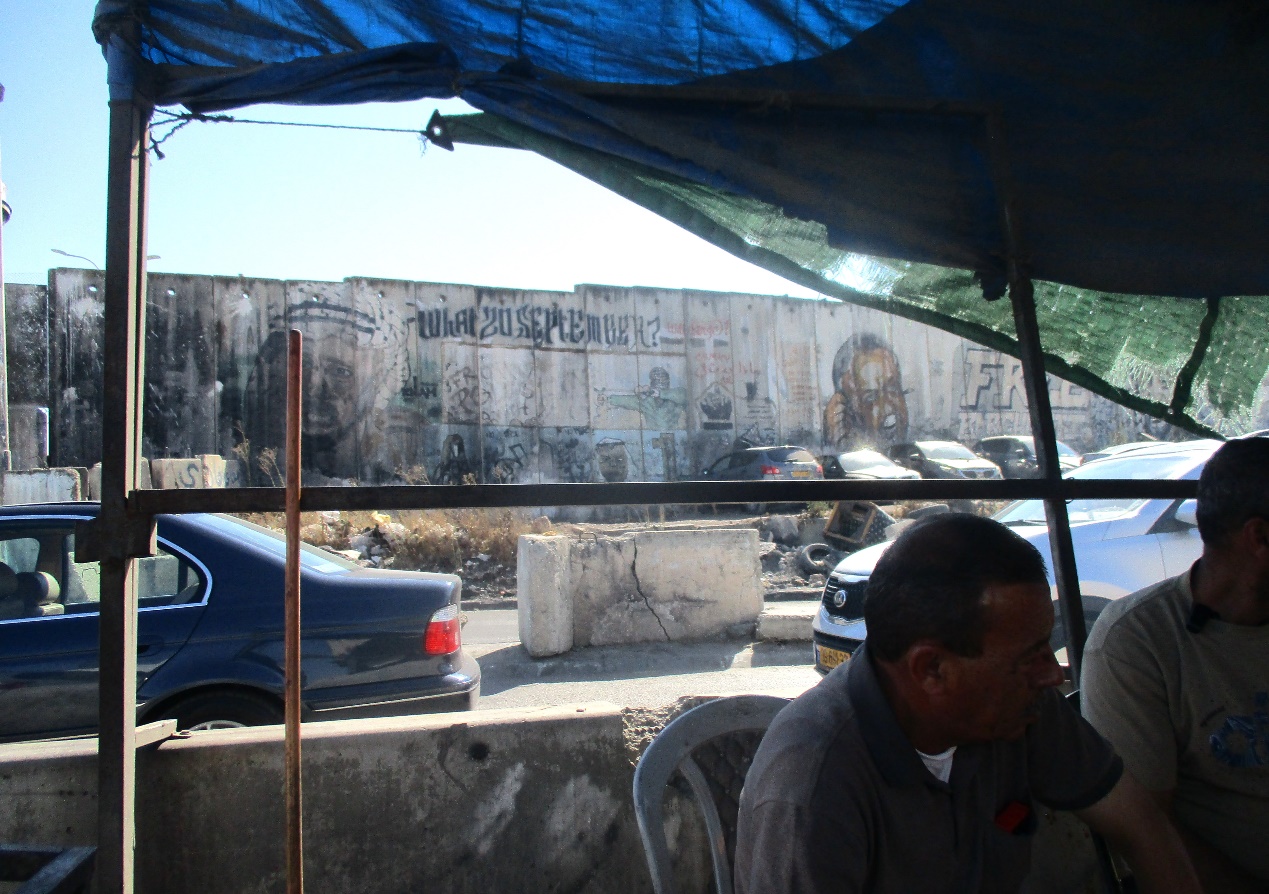 Tamar FleishmanJul-21-2026Qalandiya. Conversation in the shadow of the wall
-
