
Qalandiya, Fri 17.8.12, Morning
Translation: Judith Green
The fifth Friday of Ramadan. An extra Friday, in which Israel allows entrance to Jerusalem, a day on which Palestinians are apparently not dangerous. Which again raises the question about preventing entrance and the permits all the other days of the year.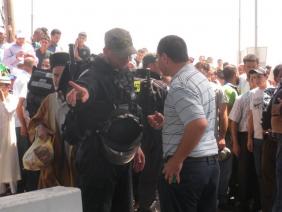
The preparations indicate that the IDF and the police expected a protest by the men who are not yet 40 years old.
The protest remains on the level of complaints and begging and arguments, etc., and not more than that, as they stubbornly refused any loosening of the requirements and the age categories of those allowed in: women, children up to 12, and men over 40.
Refusal to an elderly, handicapped woman, who asked that her youngest son, 20, escort her and volunteered to leave any document they wanted as a guarantee. Refusal to a handicapped man, 55, who was leaning on his son, 15, and was forced to part from him because he was 15; he had to leave his father,who could hardly stand up by himself, to deal with the passage through the obstacles of the checkpoint. Also, all children who were slightly over 12, and using a sort of fish net, so that if, by chance or not, you managed to get through one inspection point, there would be another 2, border guards, police, military police, each one stricter and more stubborn than the last. In the same way, no man, no matter how elderly or handicapped, was allowed through the women's checkpoint, which would have considerably shortened the standing time and the walking in the burning sun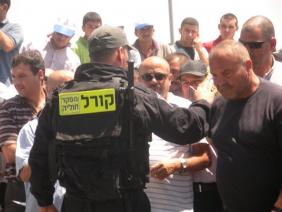 .
.
Nevertheless, some of those who were forbidden entry returned again and again, to nudge, as there was always some hope, and again to promise that they wouldn't disappear, that the security forces would have to be in constant conflict with this terrible, inhumane situation.
The preparation the scenario of revolution included the threatening appearance of the "Coral" unit, the "public disturbance" unit, a euphemism for protest and rebellion. Dark
uniforms with the name of the unit and the rank on a flourescent patch on the back. they were totally threatening and violent in appearance.
According to Google, this unit was on Marmara, cleansed Ashdod of criminals, fought against the drug trade and gambling houses, and accordingly was sent today to prevent disturbances and protect public order.
A young man who seemed to have spoken and behaved in a way not consistent with groveling was beaten and detained. A lot of soldiers surrounded him, fished in his pockets and emptied them on the block, held him by both arms and dragged him to the detention area. A photo follows (on the Facebook page of Tamar F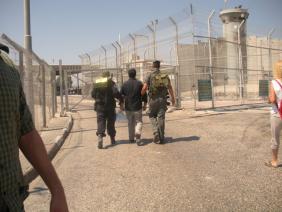 .) http://www.facebook.com/photo.php?fbid=342787995804683&set=a.101947753222043.3946.100002204558281&type=1&relevant_count=1
The "Coral" unit shoved the men with their hands on their chests and decided that they were not allowed into the shaded area, but the sun didn't stay still, and the shade moved in the direction of the Palestinians, and immediately came the shouted command, "Move back 2 meters!" and whoever didn't obey was shoved.
The DCO representative, an experienced officer in a fluorescent vest, was there supposedly to allow a certain consideration for extreme cases, but refused all requests, refused and even lauged, mocked the requests, "I have 4 children", "I am 34 and have a magnetic card", "I have been traveling several hours from Jenin", "My son is only 13 and is still a child". Laughed, and asked the Palestinians what other excuses they couldl make up.
But he knew how to say that a work permit for Maale Ephraim is not valid today, because Maale Ephraim is not Israel, since this time it serves the system of denial of entry, which enforces the Israeli statement that the al Aksa mosque is in United Jerusalem of Jewish Israel.
Even among those who were not refused, there was not exactly a peaceful atmosphere or feeling of accomplishment. You could see anxiety in their eyes all the time. The constant anxiety of standing at the checkpoint, that it won't suddenly close arbitrarily, that the documents are at hand, that they won't crush my child. That the permit is valid, that I will actually find my wife on the other side, and all kinds of other things in the mind of someone whose rights are in someone else's hands, who decided to allow him something this one day.
Qalandiya Checkpoint / Atarot Pass (Jerusalem)
See all reports for this place-
Click here to watch a video from Qalandiya checkpoint up to mid 2019 Three kilometers south of Ramallah, in the heart of Palestinian population. Integrates into "Jerusalem Envelope" as part of Wall that separates between northern suburbs that were annexed to Jerusalem in 1967: Kafr Aqab, Semiramis and Qalandiya, and the villages of Ar-Ram and Bir Nabala, also north of Jerusalem, and the city itself. Some residents of Kafr Aqab, Semiramis and Qalandiya have Jerusalem ID cards. A terminal operated by Israel Police has functioned since early 2006. As of August 2006, northbound pedestrians are not checked. Southbound Palestinians must carry Jerusalem IDs; holders of Palestinian Authority IDs cannot pass without special permits. Vehicular traffic from Ramallah to other West Bank areas runs to the north of Qalandiya. In February 2019, the new facility of the checkpoint was inaugurated aiming to make it like a "border crossing". The bars and barbed wire fences were replaced with walls of perforated metal panels. The check is now performed at multiple stations for face recognition and the transfer of an e-card. The rate of passage has improved and its density has generally decreased, but lack of manpower and malfunctions cause periods of stress. The development and paving of the roads has not yet been completed, the traffic of cars and pedestrians is dangerous, and t the entire vicinity of the checkpoint is filthy. In 2020 a huge pedestrian bridge was built over the vehicle crossing with severe mobility restrictions (steep stairs, long and winding route). The pedestrian access from public transport to the checkpoint from the north (Ramallah direction) is unclear, and there have been cases of people, especially people with disabilities, who accidentally reached the vehicle crossing and were shot by the soldiers at the checkpoint. In the summer of 2021, work began on a new, sunken entrance road from Qalandiya that will lead directly to Road 443 towards Jerusalem and Tel Aviv. At the same time, the runways of the old Atarot airport were demolished and infrastructure was prepared for a large bus terminal. (updated October 2021)
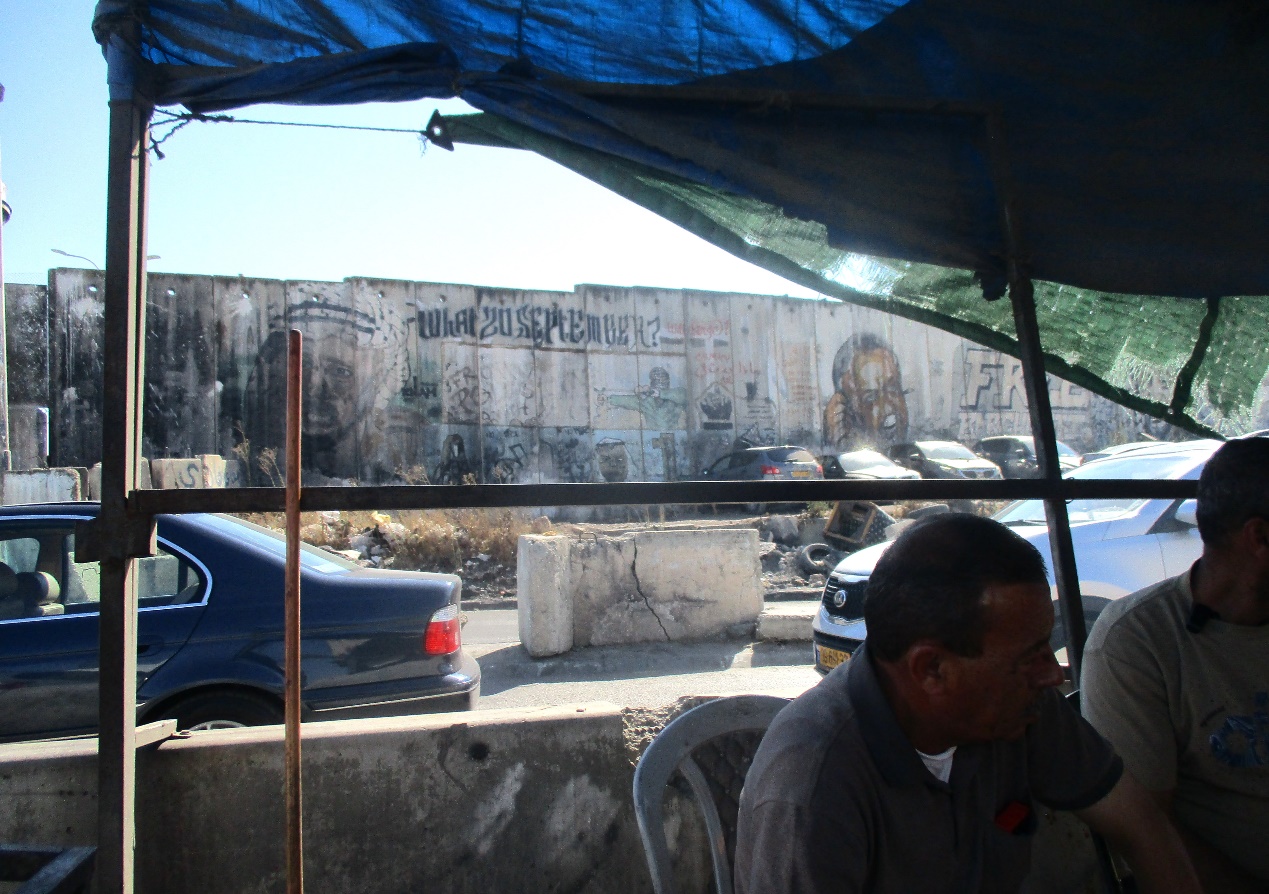 Tamar FleishmanJul-21-2026Qalandiya. Conversation in the shadow of the wall
-
