
Qalandiya, Mon 6.10.08, Afternoon
2:30 till 5:00 PM
Our shift was short due to other commitments.
We arrived at the mosque at Nebi Samuel and were amazed at the number of cars and taxis parked there. Dozens of ultra-orthodox Jews emerged from those vehicles. The apparently came to pray at the time of the High Holidays at the grave of the Prophet in the synagogue next to the mosque.
We turned right towards the remnants of the Palestinian village, which had been there before the Six-Day War. At the entrance to the village were two rather well kept houses, especially one of them, surrounded by a flowering garden. Beyond we entered another (darker) world – barren rocky soil covered with scrap metal and garbage. A few structures, mostly sad looking and many shacks erected from corrugated iron, planks and plastic sheets in various stages of disintegration. A stone structure the size of a room had a sign stating that this was the schoolhouse.
We went over to talk to Akram, owner of a small grocery shop, which supplies the meager needs of the inhabitants. Akram was born in the village about fity years ago. His wife and children cannot stay with him in the village and live in Bir Naballa. Until a couple of months ago he could visit them from time to time, but since the ‘Fabric of Life Road’ has been in use to which there is no access, he can only visit them via the fields in roundabout ways. The reason, why his family cannot live with him, is that there is no possibility to enlarge existing buildings or – God forbid – build a new home. The shop has a small hole in the wall which is hardly large enough to house him. Like in other places the lands in Nebi Samuel belong to the state and the residents, in possession of green Id’s don’t even have any rights. Any attempt to build or renovate in order to slightly improve the living conditions is immediately doomed to demolition.
We walked around a little in the village and talked to another inhabitant who said that huis fate had improved somewhat recently since his father had died and his house of two rooms had become available so that he could bring his family to live with him in the village… He showed us a house where the owner had tried to add a small kitchen. What we saw was a tiny house with a gaping hole next to it – the remains of the kitchenette. The man also told us that he had been unable to get a work permit for the last 18 months. At that time there was a fight between two men in the village; one was injured and bleeding. Without thinking twice he loaded the wounded man into his car, called for an ambulance and notified the police that he was driving with a wounded man to the CP. Upon arrival at the CP there was indeed an ambulance to pick up the wounded man, but the sad story of our friend only started there. He was immediately arrested and blamed for causing the injury. The pleas of the wounded man who even told the police who in fact had been guilty did not help. He was put into custody for an entire week and is not entitled to receive a work permit since. Finally last May he received from the authorities an official announcement stating that his file had been closed and he was told that with this paper he should apply to the Border Police base in Shuafat in order to delete his name from the black list on the computer. The only problem is that he has no permission to get to Shuafat….
Heavy-hearted from all we had seen and heard we drove to Qalandia. But here all seemed calm and quiet, there were no queues at all, the entry into Israel proceeded fast without screaming an unnecessary delays.
At the CP on the way to Qalandia before the turn-off to Atarot traffic flowed smoothly too.
Qalandiya Checkpoint / Atarot Pass (Jerusalem)
See all reports for this place-
Click here to watch a video from Qalandiya checkpoint up to mid 2019 Three kilometers south of Ramallah, in the heart of Palestinian population. Integrates into "Jerusalem Envelope" as part of Wall that separates between northern suburbs that were annexed to Jerusalem in 1967: Kafr Aqab, Semiramis and Qalandiya, and the villages of Ar-Ram and Bir Nabala, also north of Jerusalem, and the city itself. Some residents of Kafr Aqab, Semiramis and Qalandiya have Jerusalem ID cards. A terminal operated by Israel Police has functioned since early 2006. As of August 2006, northbound pedestrians are not checked. Southbound Palestinians must carry Jerusalem IDs; holders of Palestinian Authority IDs cannot pass without special permits. Vehicular traffic from Ramallah to other West Bank areas runs to the north of Qalandiya. In February 2019, the new facility of the checkpoint was inaugurated aiming to make it like a "border crossing". The bars and barbed wire fences were replaced with walls of perforated metal panels. The check is now performed at multiple stations for face recognition and the transfer of an e-card. The rate of passage has improved and its density has generally decreased, but lack of manpower and malfunctions cause periods of stress. The development and paving of the roads has not yet been completed, the traffic of cars and pedestrians is dangerous, and t the entire vicinity of the checkpoint is filthy. In 2020 a huge pedestrian bridge was built over the vehicle crossing with severe mobility restrictions (steep stairs, long and winding route). The pedestrian access from public transport to the checkpoint from the north (Ramallah direction) is unclear, and there have been cases of people, especially people with disabilities, who accidentally reached the vehicle crossing and were shot by the soldiers at the checkpoint. In the summer of 2021, work began on a new, sunken entrance road from Qalandiya that will lead directly to Road 443 towards Jerusalem and Tel Aviv. At the same time, the runways of the old Atarot airport were demolished and infrastructure was prepared for a large bus terminal. (updated October 2021)
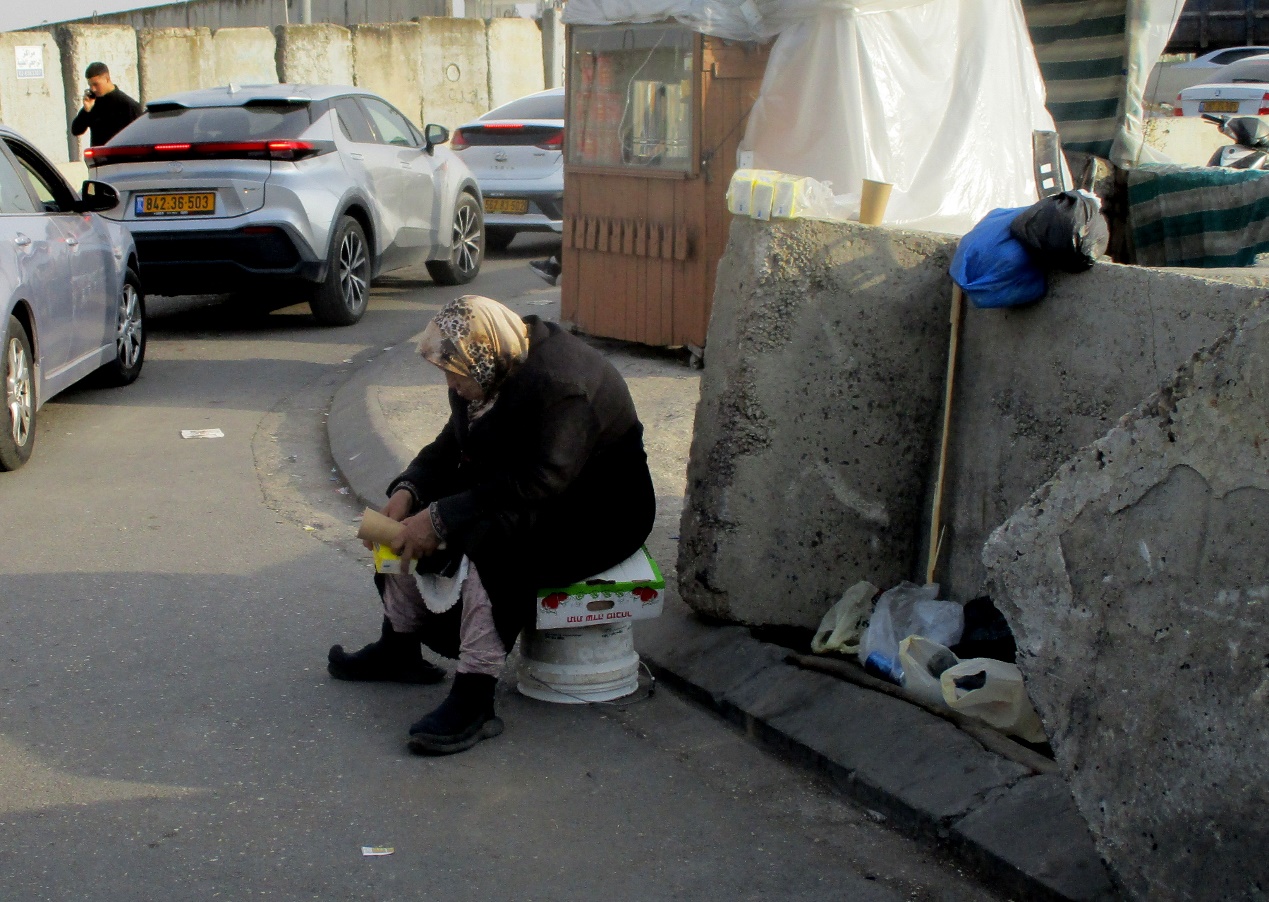 Tamar FleishmanOct-11-2026Qalandiya. Female Beggar
-
