
Qalandiya - people are transferred from one ambulance to another
There is no regular supply of water to houses in Gaza.
Like the iconic pistol in the first act of a play, the problem of water will appear and be told again later on.
***
Some time before dark, an ambulance from the West Bank waited at the area allotted in the Qalandiya Checkpoint compound to carry out the back-to-back procedure by which patients from the West Bank are transferred to Israel and back, a procedure that was essentially meant for goods, not humans – but people, their time and pains are not a factor that affects official Israeli procedures establishing that only this way, from one ambulance to another – patients or wounded or dead people are transferred.
This procedure has been practiced for years and has taken over the minds of people who see it as obvious, who couldn’t imagine things working differently, that patients could not possibly reach their destination as fast as possible without being dragged between ambulances and stretchers, that strange hands would not rummage their personal belongings, that weapons would not be pointed at their bodies.
Perhaps I too have grown accustomed to this.
But then I noticed the eyes of Abdul Rahman, piercing black eyes, looking at me, not letting go.

This is a boy from Gaza who was electrocuted, said the ambulance driver who brought him from Ramallah, and opened the ambulance door for me.
I thought I would be looking at body burns, but what I saw was a bright whole delicate boy tied to a stretcher, and sitting beside him was his father, whose hand would not stop caressing the face and head of his son.
What is your name, boy? I asked, and the father answered.
How old are you? I asked, and the father answered.
Does he hear anything? I asked, and the father said ‘we don’t know’.
The driver explained that the electric current running through the body hit the heart and the brain. Since then, he has been like this.
A boy trapped in a body, and no one knows whether he knows it.
He was electrocuted at home, by the water pump, the father said.
The driver explained that they (father and son) are coming back from a Ramallah hospital where physical therapist specialists taught the father how to care for his son.
The fact that in order to obtain optimal physical therapy, Palestinians must apply to and be issued permits by the Israeli occupation authorities, that one must go far away from home in Gaza, all the way to Ramallah and back, that this process means not only loss of precious time but exorbitant expenses – is one of the products of the lack of medical means and training that Israel imposes on the medical system in Gaza.
As for the water issue:
Since there is no regular water supply to the homes, people place water tanks on their roofs. But the water does not come of its own power, neither to the tank nor to the faucet – only by way of a water pump that is operated electrically. But infrastructures in Gaza are shabby, and electric cables are often exposed, and without grounding.
This state of construction is neither the fault of the Gaza Strip inhabitants, nor of the builders – it is one of the results of the ongoing siege laid by Israel, that allows construction materials to enter the Strip only at a minimal, restricted rate.
Qalandiya Checkpoint / Atarot Pass (Jerusalem)
See all reports for this place-
Click here to watch a video from Qalandiya checkpoint up to mid 2019 Three kilometers south of Ramallah, in the heart of Palestinian population. Integrates into "Jerusalem Envelope" as part of Wall that separates between northern suburbs that were annexed to Jerusalem in 1967: Kafr Aqab, Semiramis and Qalandiya, and the villages of Ar-Ram and Bir Nabala, also north of Jerusalem, and the city itself. Some residents of Kafr Aqab, Semiramis and Qalandiya have Jerusalem ID cards. A terminal operated by Israel Police has functioned since early 2006. As of August 2006, northbound pedestrians are not checked. Southbound Palestinians must carry Jerusalem IDs; holders of Palestinian Authority IDs cannot pass without special permits. Vehicular traffic from Ramallah to other West Bank areas runs to the north of Qalandiya. In February 2019, the new facility of the checkpoint was inaugurated aiming to make it like a "border crossing". The bars and barbed wire fences were replaced with walls of perforated metal panels. The check is now performed at multiple stations for face recognition and the transfer of an e-card. The rate of passage has improved and its density has generally decreased, but lack of manpower and malfunctions cause periods of stress. The development and paving of the roads has not yet been completed, the traffic of cars and pedestrians is dangerous, and t the entire vicinity of the checkpoint is filthy. In 2020 a huge pedestrian bridge was built over the vehicle crossing with severe mobility restrictions (steep stairs, long and winding route). The pedestrian access from public transport to the checkpoint from the north (Ramallah direction) is unclear, and there have been cases of people, especially people with disabilities, who accidentally reached the vehicle crossing and were shot by the soldiers at the checkpoint. In the summer of 2021, work began on a new, sunken entrance road from Qalandiya that will lead directly to Road 443 towards Jerusalem and Tel Aviv. At the same time, the runways of the old Atarot airport were demolished and infrastructure was prepared for a large bus terminal. (updated October 2021)
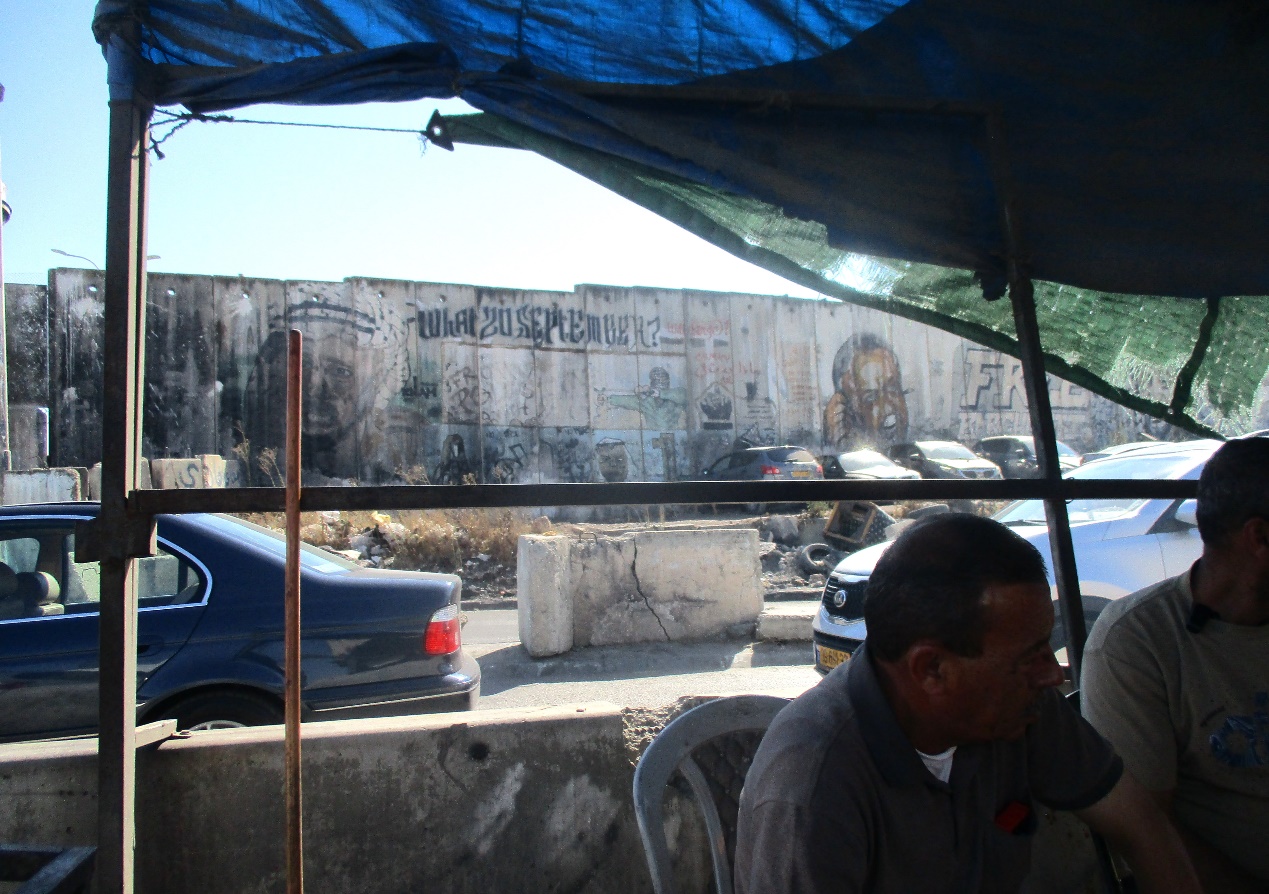 Tamar FleishmanJul-21-2026Qalandiya. Conversation in the shadow of the wall
-
