
Qalandiya, Sun 26.6.11, Afternoon
Translation: Ruth Fleishman
The west wing of the checkpoint was once again closed to the public and their vehicles.
Preparations for September?
A group of high ranking officers came out form the checkpoint facility; among them were military officers, police officers and some civilians and security guards with rifles.
They discussed renovations plans for the pillbox on the corner, a construction that had been abandoned and neglected for (at least) two years, following its arson by Palestinian demonstrators and the damages it sustained.
The group estimated the distance from which stones were thrown during demonstrations, one of them was familiar with the facts and the history of the site and claimed that protestors didn't mind throwing stones even if they hit their own people: "They really don't care whom they hit".
They also expressed their opinions regarding the installation of the video cameras on top of the polls- they transfer images of everything that happens inside and outside the refugee camp.

At the shed leading to the checkpoint, on the relics of the benches, while a boy named Haled [in the picture] tried desperately to sell us some water as he put on the most wonderful smile we had ever seen, that was meant for the camera, and right beside us was Fadi, a stout man, trying to seduce the lovely Christiana with juicy figs, in that reality, ignoring the stench and neglect, we sat with our friend from Gaza, drinking the steaming coffee that Iman, the coffee salesman, had brewed for us.
We talked about personal and political issues. We heard of the malnourishment that residents of the Gaza Strip suffer from, the main cause are the high unemployment rates and poverty, a large percentage of the people are in need of UNRWA's assistance: "malnourishment is a gender problem", our friend pointed out and explained that women and children are the ones most afflicted by it.
Our friend's expertise and profession is in public health care, he told us that many pregnant women suffer from acute anemia that later affects the health of their children. We heard from him about the opening of Rafih passage, at first there was much excitement regarding it's opening, but that had been cooled off in view of the fact that entering the strip had become much easier, but before exiting it one must register in advance. The waiting list is long and the bureaucratic process is slow and difficult.
He also told us that many of the resident of the strip are hoping that Gilad Shalit would be released, since they believe that their dear ones, who are imprisoned in Israeli jails, would return to their families.
Qalandiya Checkpoint / Atarot Pass (Jerusalem)
See all reports for this place-
Click here to watch a video from Qalandiya checkpoint up to mid 2019 Three kilometers south of Ramallah, in the heart of Palestinian population. Integrates into "Jerusalem Envelope" as part of Wall that separates between northern suburbs that were annexed to Jerusalem in 1967: Kafr Aqab, Semiramis and Qalandiya, and the villages of Ar-Ram and Bir Nabala, also north of Jerusalem, and the city itself. Some residents of Kafr Aqab, Semiramis and Qalandiya have Jerusalem ID cards. A terminal operated by Israel Police has functioned since early 2006. As of August 2006, northbound pedestrians are not checked. Southbound Palestinians must carry Jerusalem IDs; holders of Palestinian Authority IDs cannot pass without special permits. Vehicular traffic from Ramallah to other West Bank areas runs to the north of Qalandiya. In February 2019, the new facility of the checkpoint was inaugurated aiming to make it like a "border crossing". The bars and barbed wire fences were replaced with walls of perforated metal panels. The check is now performed at multiple stations for face recognition and the transfer of an e-card. The rate of passage has improved and its density has generally decreased, but lack of manpower and malfunctions cause periods of stress. The development and paving of the roads has not yet been completed, the traffic of cars and pedestrians is dangerous, and t the entire vicinity of the checkpoint is filthy. In 2020 a huge pedestrian bridge was built over the vehicle crossing with severe mobility restrictions (steep stairs, long and winding route). The pedestrian access from public transport to the checkpoint from the north (Ramallah direction) is unclear, and there have been cases of people, especially people with disabilities, who accidentally reached the vehicle crossing and were shot by the soldiers at the checkpoint. In the summer of 2021, work began on a new, sunken entrance road from Qalandiya that will lead directly to Road 443 towards Jerusalem and Tel Aviv. At the same time, the runways of the old Atarot airport were demolished and infrastructure was prepared for a large bus terminal. (updated October 2021)
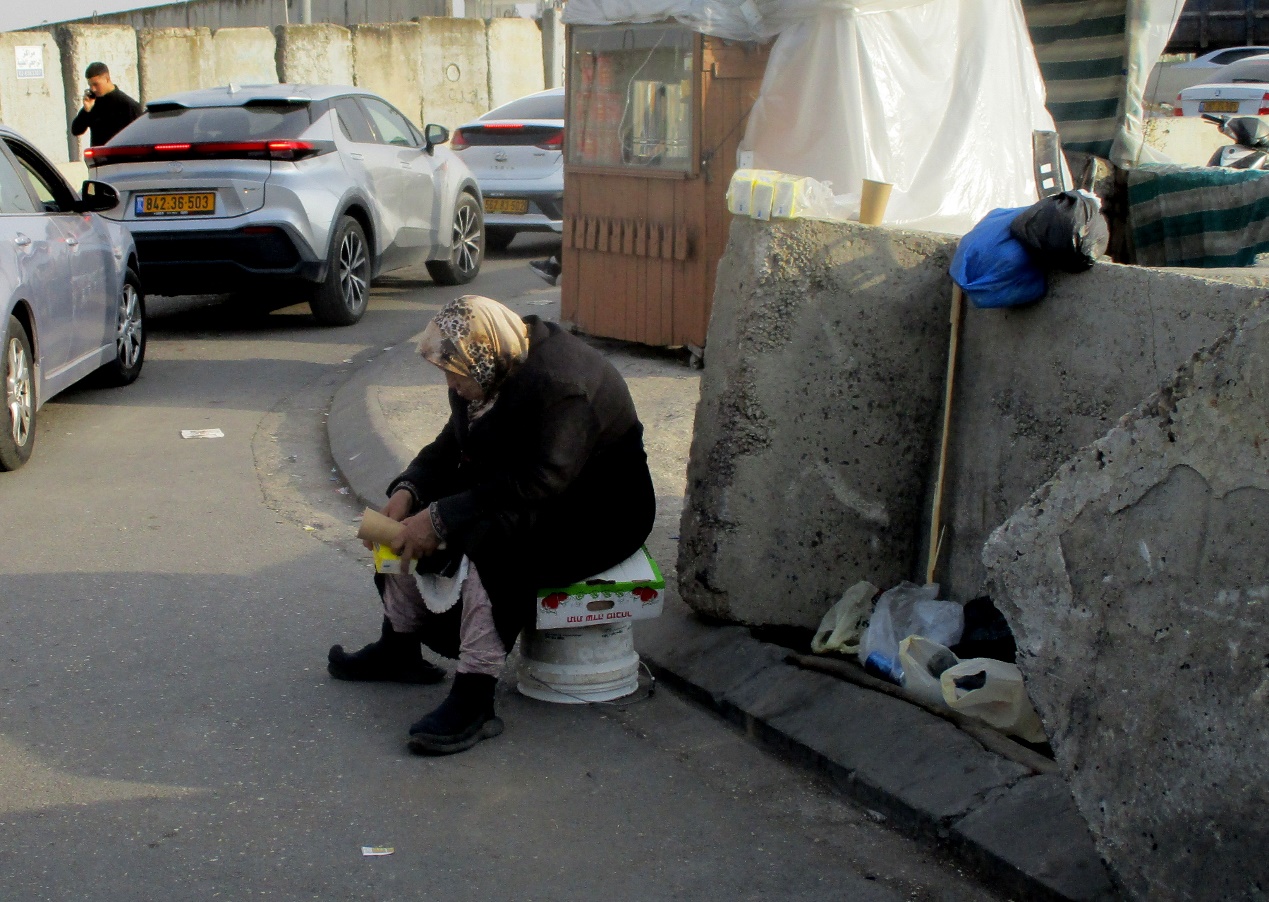 Tamar FleishmanOct-11-2026Qalandiya. Female Beggar
-
