
Qalandiya - the checkpoint is temporarily closed due to a suspicious object
Bad Morning at Qalandiya
We reached the northern (Palestinian) side of the checkpoint at 6:00 a.m. and by 6:30 we thought our shift was ending, for the lines that had been long for most of the first half-hour had already been swallowed up into the “slaloms” (the stage before entering the checkpoint building). However, we soon saw that the lines began sprouting again. And then, at 6:45, a stream of people who had already entered the building were returning outside and announced that the checkpoint had been closed. How? Why? They weren’t told. We waited a few minutes to see whether this was perhaps a misunderstanding and then called Hannah Barag to ask whether she would inquire about an explanation that could pass on to the people asking what they should do now.
Hanna called back with the information that the checkpoint had been closed because of a “suspicious object.” We also noted that although traffic proceeded southward from Kafr Aqeb (inside the Jerusalem city limits but on the Palestinian side of the Separation Barrier) into East Jerusalem and essentially anywhere in Israel, there was no traffic at all in the opposite direction toward Ramallah and the rest of the central West Bank. We walked up to the fence separating this empty lane near the vehicle checkpoint and saw that it had been blocked both by a metal gate (in the form of two locked doors) and two metal or plastic arms that go up and down, resembling those commonly used to block entry into parking lots.
Since most of the Palestinians who remained after the checkpoint closed were now milling around on the “porch” (the section at the entrance to the checkpoint that contains the “slaloms), for health reasons we decided to keep out a distance and toured the area that was once been the northern parking lot of the checkpoint. It has now been paved over to create lanes and traffic islands for the Palestinian minibusses that bring people to the checkpoint from various areas of the West Bank (only one of which had arrived during the two-and-a-half hours we stood outside). At the northern edge of this area is a strip that has white lines painted to mark parking spaces for about 15 cars, though we have never seen a car there. Today, the planning and design of this large area – which used to accommodate about 100 cars—appears somewhat bizarre, or at least a waste of precious space. But we won’t quibble over this today of all days.
At 7:35 a tourist bus filled with Palestinians of all ages apparently headed for a tour somewhere in Jerusalem or Israel, arrived and discharged its passengers to go through the checkpoint on foot. They joined the crowd waiting on the “porch” or the steps leading up to it for about 10 minutes, then got back on the bus and left. We thought that perhaps they were going to have coffee in Kafr Aqeb or Ramallah before returning in the hope that the checkpoint would be opened. From our standpoint, their fate is unknown.
But … less than five minutes after they departed, the red lights that signal locked turnstiles turned green; people crowded at the entrances to the slaloms and then slowly formed (tight) lines; the traffic through the vehicle checkpoint toward Ramallah and points north resumed; it appeared that the situation returned to what it had been at 6:45 when the checkpoint closed—plus an even larger number of frustrated and anxious people bunched up on even tighter lines.
For reasons of health, we waited another 40 minutes, till 8:30, when the lines no longer extended outside the slaloms, to enter the one on the right (one of three) and maintained our distance inside it (the only people to do so). But after we entered the “waiting room” (the stage between the slalom and the security-check area), the soldiers neglected to close the turnstile leading into the room, so that it was soon fully crowded. Hearing what sounded like two turnstiles turning to usher people into the checking area next to ours, we saw that the lines in that waiting room were very short (only one turnstile was working in our room) and moved next door—again with health considerations in mind.
Finally, in the last stage of the security check, we saw that only a third of the scanning machines were working for those people with biometric permits, and only one booth was manned for people who have to show their documents to a soldier– so that again there was a tight line to reach that booth.
It took us 30 minutes waiting in lines from the time we entered the slalom outside until we completed the security check and left at 9:00.
There’s nothing to be said about closing the checkpoint due to a suspicious object. Stuff happens. And to be generous, let’s say that one can survive without information about why the checkpoint was closed and approximately when it may be opened again. But as we wrote in our previous report: managing the checkpoint built to accommodate the number of people who were there this morning with only one-third or less than the technical and human resources meant to operate during “rush hour”—and this especially during a pandemic—is a health hazard of the first order. And it erases the value of all the human effort and financial investment made in building a new checkpoint in order to improve the conditions of passage. It also shows, much to our regret, that new checkpoint or no, the deep contempt that the authorities who run it have for Palestinians has not changed one whit. That’s the lesson of today’s shift.
Qalandiya Checkpoint / Atarot Pass (Jerusalem)
See all reports for this place-
Click here to watch a video from Qalandiya checkpoint up to mid 2019 Three kilometers south of Ramallah, in the heart of Palestinian population. Integrates into "Jerusalem Envelope" as part of Wall that separates between northern suburbs that were annexed to Jerusalem in 1967: Kafr Aqab, Semiramis and Qalandiya, and the villages of Ar-Ram and Bir Nabala, also north of Jerusalem, and the city itself. Some residents of Kafr Aqab, Semiramis and Qalandiya have Jerusalem ID cards. A terminal operated by Israel Police has functioned since early 2006. As of August 2006, northbound pedestrians are not checked. Southbound Palestinians must carry Jerusalem IDs; holders of Palestinian Authority IDs cannot pass without special permits. Vehicular traffic from Ramallah to other West Bank areas runs to the north of Qalandiya. In February 2019, the new facility of the checkpoint was inaugurated aiming to make it like a "border crossing". The bars and barbed wire fences were replaced with walls of perforated metal panels. The check is now performed at multiple stations for face recognition and the transfer of an e-card. The rate of passage has improved and its density has generally decreased, but lack of manpower and malfunctions cause periods of stress. The development and paving of the roads has not yet been completed, the traffic of cars and pedestrians is dangerous, and t the entire vicinity of the checkpoint is filthy. In 2020 a huge pedestrian bridge was built over the vehicle crossing with severe mobility restrictions (steep stairs, long and winding route). The pedestrian access from public transport to the checkpoint from the north (Ramallah direction) is unclear, and there have been cases of people, especially people with disabilities, who accidentally reached the vehicle crossing and were shot by the soldiers at the checkpoint. In the summer of 2021, work began on a new, sunken entrance road from Qalandiya that will lead directly to Road 443 towards Jerusalem and Tel Aviv. At the same time, the runways of the old Atarot airport were demolished and infrastructure was prepared for a large bus terminal. (updated October 2021)
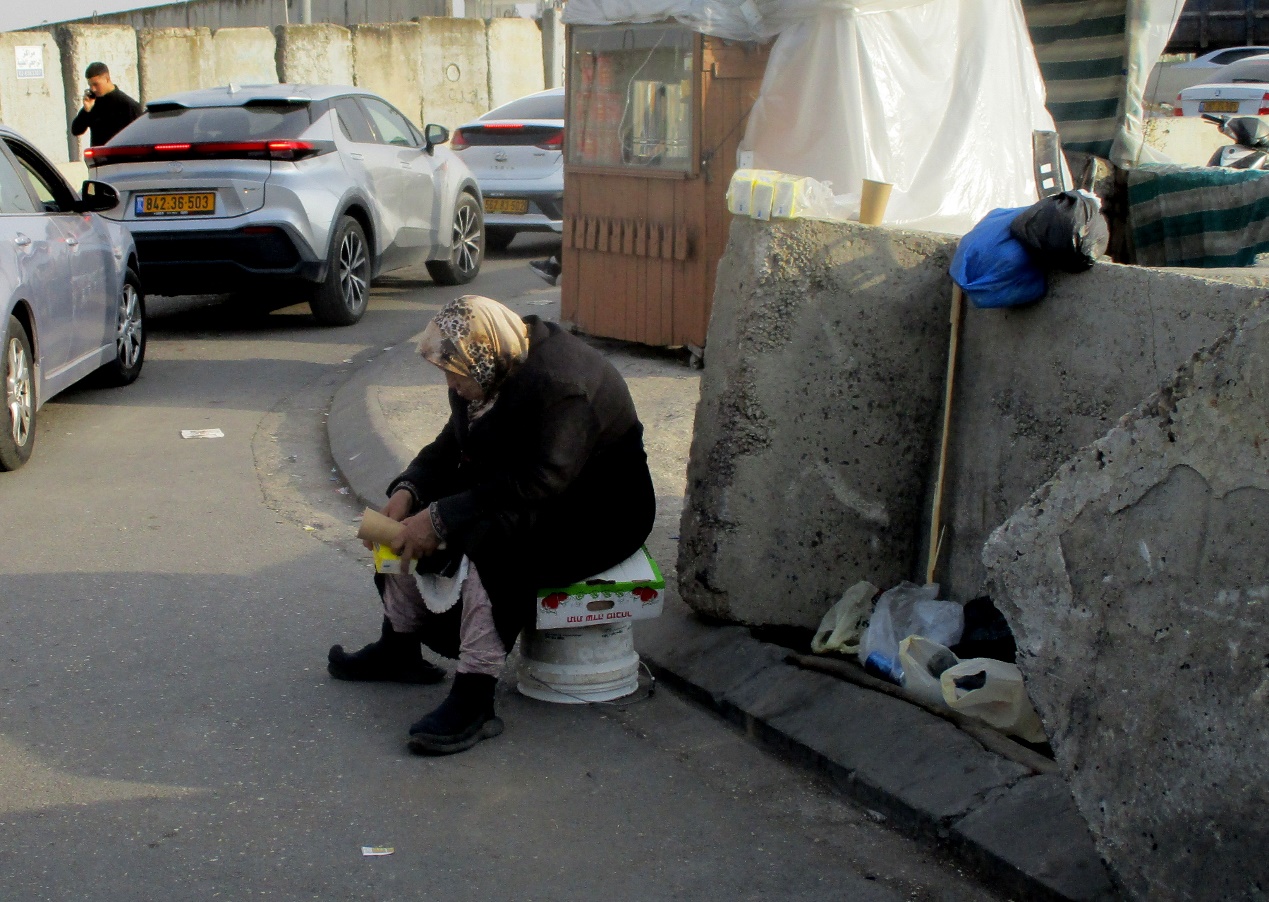 Tamar FleishmanOct-11-2026Qalandiya. Female Beggar
-
