
Qalandiya - third Friday of Ramadan
The seeds of hatred
Facts that do not stand out in real time penetrate like acid into stone, like seeds into crumbling soil that will eventually bear fruit, results unknown.

Such were the seeds sown in the two brothers – 5.5 and 3-years-old – who had prepared themselves and were thrilled and happy to greet this Ramadan day, on which their mother dressed them in the identical special, festive, white clothes prepared for this day. But on their way to the Al Aqsa Mosque in a city where their feet had never touched before, on the very first selection station at Qalandiya Checkpoint they were stopped. Their hope was dashed at once, in a reality where those in charge are not their parents but strangers in uniforms with pointed rifles.

In that selection station the women (in the photo) were stopped, and after being chased away remained for a long time by the wall, some of whom asked to be photographed and spoken about, and others who covered their faces not to be exposed. They stood or sat and refused to leave, hoping the tide might turn. But it didn’t, and they had to turn back and leave, their insult wrapped in grief.

The gate that supposedly serves humanitarian cases was reached by a disabled man in a wheelchair, led by his son. The man showed his papers to the soldier behind the glass. The soldier took a look at the man and the boy, and said:
“You may cross, but your son looks grown up to me, he cannot cross here. Your son must go around to where all the other men cross.” But the man, dependent on his son and unable to proceed without him, gave the soldier the son’s birth certificate. “Why does he not have an ID?” the soldier asked. “Because he is not yet 16, only 3 months from now. Look at the birth certificate” the father answered.
“He should go around”, the soldier ruled.
“Please, please” the father pleaded.
The soldier insisted: “Nothing I can do about it. Let him go around.”
I tried too: “Look at him, the man needs his son, he cannot climb the bridge on his own…” But I and my words were empty air to the soldier whose ears were deaf and feelings sealed.

The third Ramadan Friday at Qalandiya was day of sadness and much fear. At the meeting points where in previous weeks tens of thousands had congregated, one could count a meager few dozen.
The scenes of the recent nights at Al Aqsa echoed in the collective memory and became vapors of fear in the hearts.
The few still knocking at the gates did not cause the armed men to soften their hearts. On the contrary, extra vigilance was obvious.
An hour before the gates closed, some order was given to make anyone unauthorized by the authorities to leave – all the photographers and journalists and representatives of international organizations.
When a group of generals arrived and praised itself on managing to regiment the passages to Al Aqsa, I approached them and asked why the new distancing order? What threat is there in photographers or representatives of international organizations?
Their answer was to turn their backs on me and leave.
Qalandiya Checkpoint / Atarot Pass (Jerusalem)
See all reports for this place-
Click here to watch a video from Qalandiya checkpoint up to mid 2019 Three kilometers south of Ramallah, in the heart of Palestinian population. Integrates into "Jerusalem Envelope" as part of Wall that separates between northern suburbs that were annexed to Jerusalem in 1967: Kafr Aqab, Semiramis and Qalandiya, and the villages of Ar-Ram and Bir Nabala, also north of Jerusalem, and the city itself. Some residents of Kafr Aqab, Semiramis and Qalandiya have Jerusalem ID cards. A terminal operated by Israel Police has functioned since early 2006. As of August 2006, northbound pedestrians are not checked. Southbound Palestinians must carry Jerusalem IDs; holders of Palestinian Authority IDs cannot pass without special permits. Vehicular traffic from Ramallah to other West Bank areas runs to the north of Qalandiya. In February 2019, the new facility of the checkpoint was inaugurated aiming to make it like a "border crossing". The bars and barbed wire fences were replaced with walls of perforated metal panels. The check is now performed at multiple stations for face recognition and the transfer of an e-card. The rate of passage has improved and its density has generally decreased, but lack of manpower and malfunctions cause periods of stress. The development and paving of the roads has not yet been completed, the traffic of cars and pedestrians is dangerous, and t the entire vicinity of the checkpoint is filthy. In 2020 a huge pedestrian bridge was built over the vehicle crossing with severe mobility restrictions (steep stairs, long and winding route). The pedestrian access from public transport to the checkpoint from the north (Ramallah direction) is unclear, and there have been cases of people, especially people with disabilities, who accidentally reached the vehicle crossing and were shot by the soldiers at the checkpoint. In the summer of 2021, work began on a new, sunken entrance road from Qalandiya that will lead directly to Road 443 towards Jerusalem and Tel Aviv. At the same time, the runways of the old Atarot airport were demolished and infrastructure was prepared for a large bus terminal. (updated October 2021)
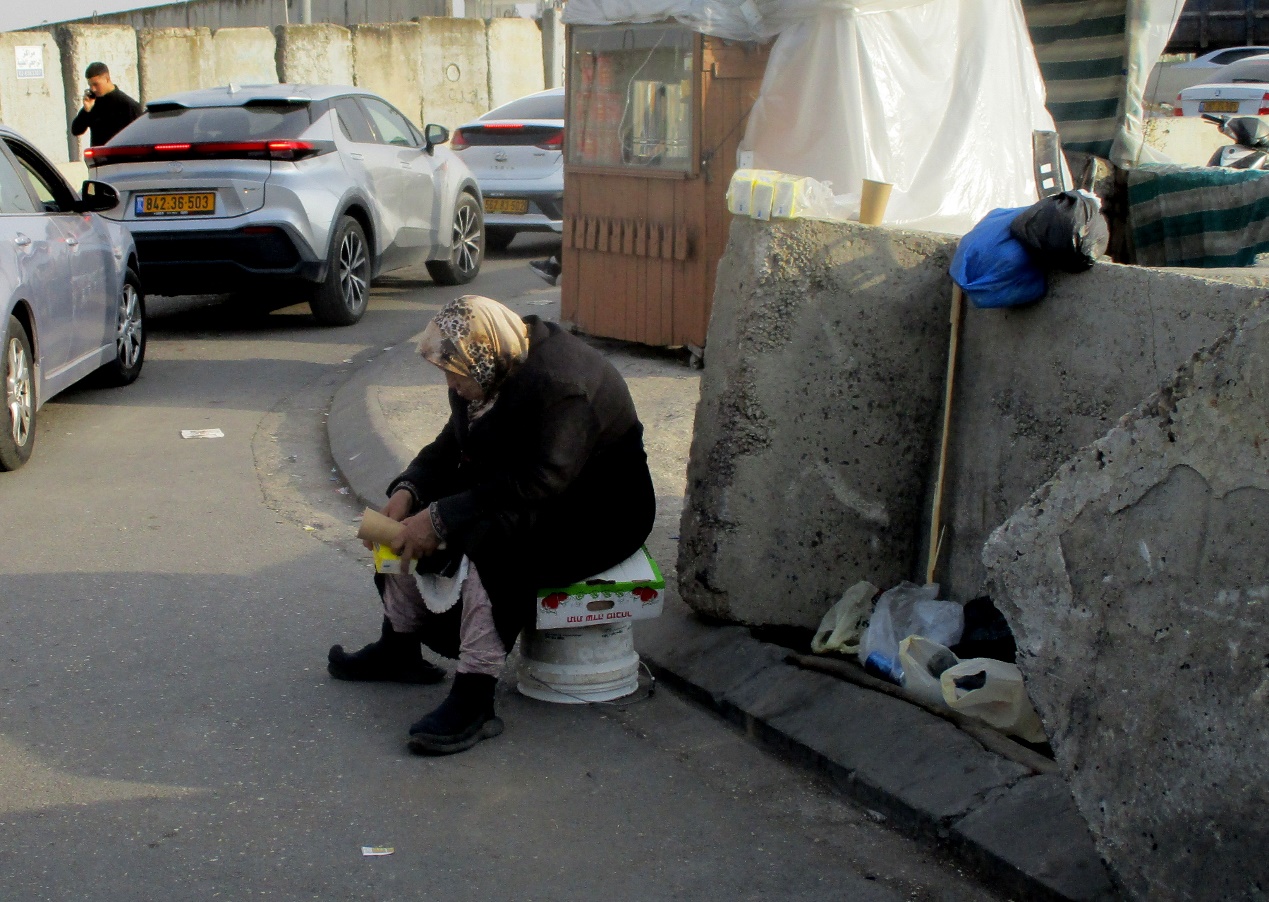 Tamar FleishmanOct-11-2026Qalandiya. Female Beggar
-
